Groenewold IT Solutions LogoGroenewold IT Solutions – Home
Next.js development – performant React web apps with SEO, App Router and Core Web Vitals
Next.js · React · TypeScript · SSR · Core Web Vitals

Next.js development: SEO-strong React web apps with measurable performance

For mid-sized companies: App Router, Server Components, hreflang and headless integrations—engineering from Germany in Leer/East Frisia – delivery and project ownership from Germany (Leer/East Frisia), named contacts, no offshore guesswork.

  • 250+ delivered projects
  • 5.0 stars on Google
  • 100% engineering in Germany

Next.js – React with SEO and performance built in

Next.js is our default for marketing-heavy and data-driven web apps: server-side rendering, static generation where it helps, and the App Router for clear data flows.

We combine Next.js with TypeScript, Tailwind and headless CMS or Laravel/Node backends – a codebase your team can maintain long term.

Technology overview: Next.js Development – stack details on our technology page. For fast product validation see MVP development, for accessible interfaces accessible software development.

Our Next.js stack at a glance

Next.js logoReact logoTypeScript logoTailwind CSS logo

TypeScript, Tailwind and proven CI/CD pipelines – one codebase your team can maintain long term.
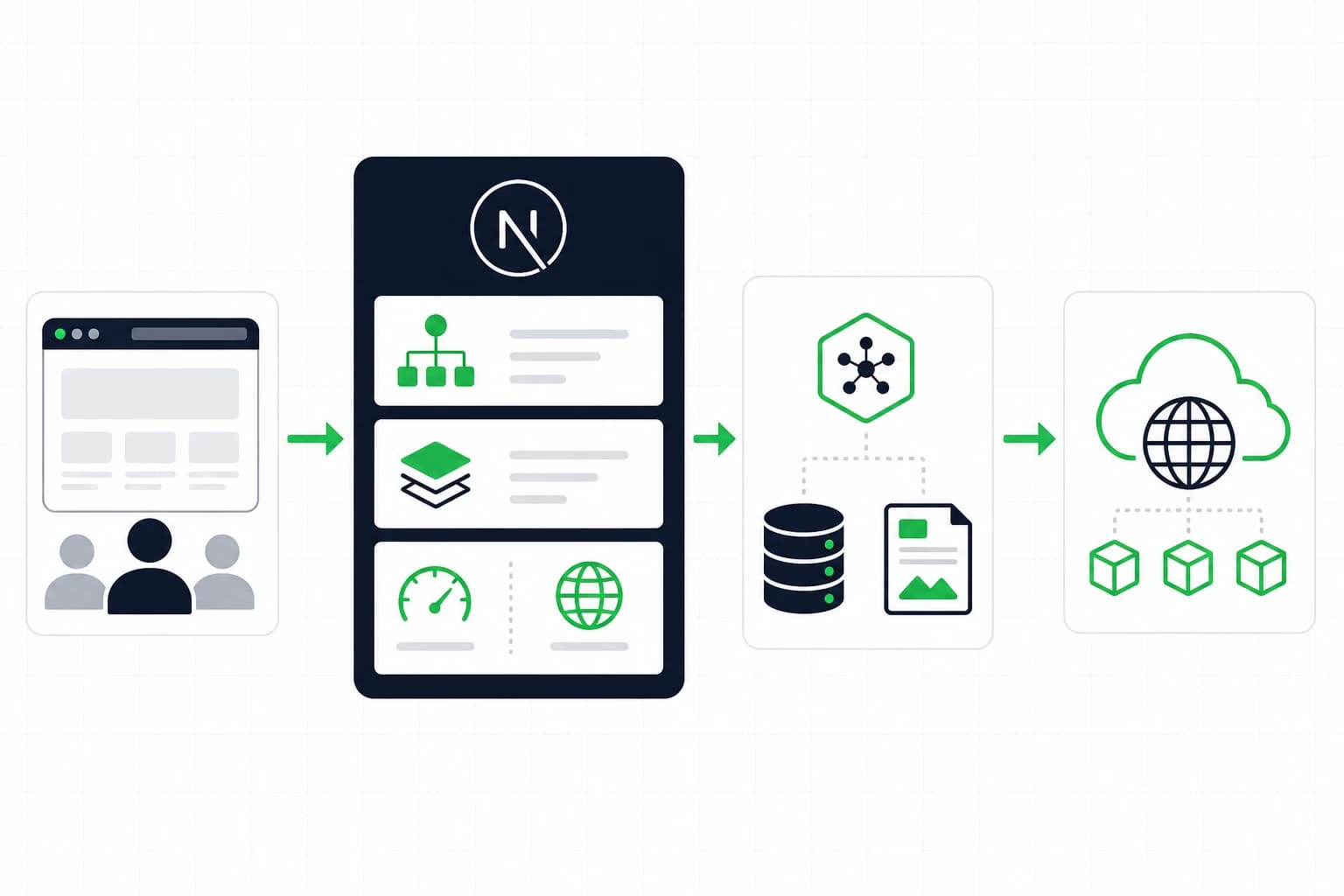
Next.js architecture: App Router and Server Components connecting browser, APIs, CMS and edge CDN

Our Next.js services

From marketing sites to B2B portals with login and APIs.

Marketing & content sites

SEO structure, hreflang, Schema.org, fast LCP – including multilingual (DE/EN).

Web apps & portals

Auth, dashboards, forms and existing API integration – clear separation of UI and domain.

Headless & composable

CMS, PIM or shop APIs as data sources – Next.js as the performant layer on top.

Performance & DX

Bundle analysis, caching, edge where useful, ESLint/CI and documented component libraries.

Core Web Vitals

Improve LCP, INP and CLS measurably – not just Lighthouse peaks.

TypeScript

Type-safe props, API clients and fewer production errors.

SEO architecture

Canonical URLs, structured data and internal linking.

Operations

Vercel, Docker or self-hosted – including monitoring.

Next.js in practice
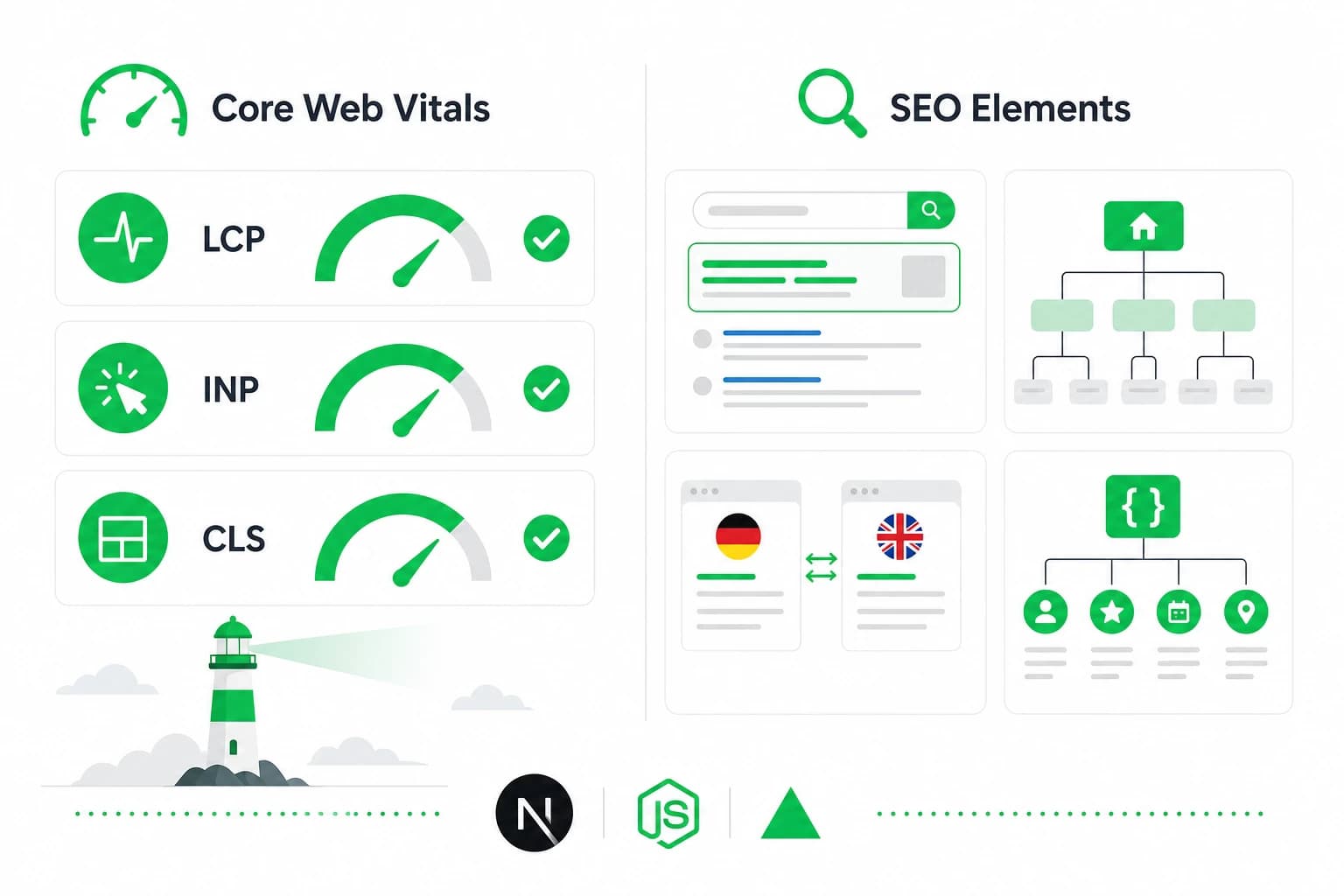
Next.js SEO and Core Web Vitals: LCP, INP, CLS, hreflang, sitemap and Schema.org

We avoid unnecessary client components, cache data deliberately and test critical flows with Playwright. Releases are automated and rollback-ready.

  • Server Components for static/expensive parts
  • ISR/revalidate for content without full rebuilds
  • Security headers and tuned CSP
  • Accessibility in components from the start

Share goals and current estate – we outline architecture, sprint plan and budget.

Frequently asked questions

FAQ on Next.js development

Stack choice, costs and architecture

Next.js or classic React (SPA) – when does each approach fit?
For public pages, SEO and fast first paint, Next.js is our default: server-side rendering, static generation and the App Router deliver indexable HTML. Pure SPAs without server rendering suit mainly internal tools with no indexing. We advise honestly – and compare with web app development and React as the technology baseline.
What does a Next.js application cost – and how transparent is the quote?
Marketing relaunches often start from around €15,000; B2B portals with auth, roles and integrations tend towards €30,000–90,000. A separate backend applies if no API exists yet. We separate frontend, backend and operations clearly in the quote. Use our web development cost calculator and book a strategy call for a scope sketch after a workshop.
App Router or Pages Router – what do you recommend for greenfield?

Greenfield projects use the App Router: Server Components, clearer layouts and better data flows. We maintain Pages Router estates and migrate gradually when ROI and risk are clear – not as a big-bang without test coverage. The decision depends on team know-how, plugin ecosystem and release cadence; in the workshop we fix the route and document migration paths.

Which backend fits Next.js – Laravel, Node.js or headless SaaS?
Next.js stays the UI layer – we pick the backend by team and estate: Laravel, Node.js, .NET or headless CMS/shop APIs. We connect REST and GraphQL with typed clients, auth (JWT, OAuth2, session) and clear error handling. Business logic belongs on the server, not in client components.
How long does a Next.js relaunch take until go-live?

A multilingual marketing site with CMS integration is often live in 6–10 weeks – including SEO baseline and Core Web Vitals checks. Portals with login, dashboards and ERP integrations typically need 3–6 months. The main time factor is scope discipline and fast feedback from business and IT, not React itself. We work in two-week sprints with demos on staging environments.

SEO, performance, hosting and operations

How do you improve Core Web Vitals (LCP, INP, CLS) with Next.js?
We measure LCP, INP and CLS in field and lab data – not only Lighthouse peaks. Server Components reduce client JavaScript; images use next/image with proper sizes. Caching, ISR/revalidate and deliberate bundle analysis are standard. See also web development for performance budgets.
Hosting: Vercel, Docker or self-hosted – what makes sense?

Vercel fits many Next.js projects with edge and simple deploys. Docker and self-hosted (e.g. Hetzner, Kubernetes) make sense for compliance, fixed SLAs or when IT already runs a container platform. We document environments, secrets and rollback – regardless of vendor. The choice is clarified in the architecture workshop, not on launch day.

Multilingual sites, hreflang and SEO architecture – how do you implement that?
For DE/EN pages we plan canonical URLs, hreflang sets without 3xx targets and structured data (Schema.org, FAQPage only when FAQ text is visible in HTML). Internal linking and clean sitemaps are included – see our Next.js technology page. With headless CMS we sync slugs and metadata between editorial and build.
Headless CMS, shop APIs and composable frontends – do you support that?
Yes – CMS, PIM or shop backends provide content via API; Next.js renders performantly on top. Typical combinations: headless with CMS & e-commerce platforms, B2B data from ERP via API integration. Preview modes and ISR balance editorial workflow and performance.
Do you handle maintenance, security updates and feature sprints after launch?
On request with SLA: Next.js/React upgrades, dependency patches, monitoring and planned releases. We review security headers, CSP and auth flows regularly. See software maintenance. Without care, framework versions age and CVE risk rises – especially on public portals.
When is Next.js not the right choice?
Less ideal if you need only a native mobile app, if the product should run purely server-side without a React UI, or if a small team does not want to maintain a JavaScript ecosystem. Then web & mobile development with another stack may fit better. Use our project check for a quick fit assessment.

Request Next.js project

Share goals, current estate and SEO requirements – we outline architecture, sprint plan and a realistic budget from Germany.

Next.js Development: structured delivery approach

Björn Groenewold

Up to 50% of your investment via BAFA/KfW

Use our funding calculator to see which government grants may apply to your project.

Björn Groenewold – Managing Director

Next.js Development & React Agency Germany | Groenewold IT Solutions