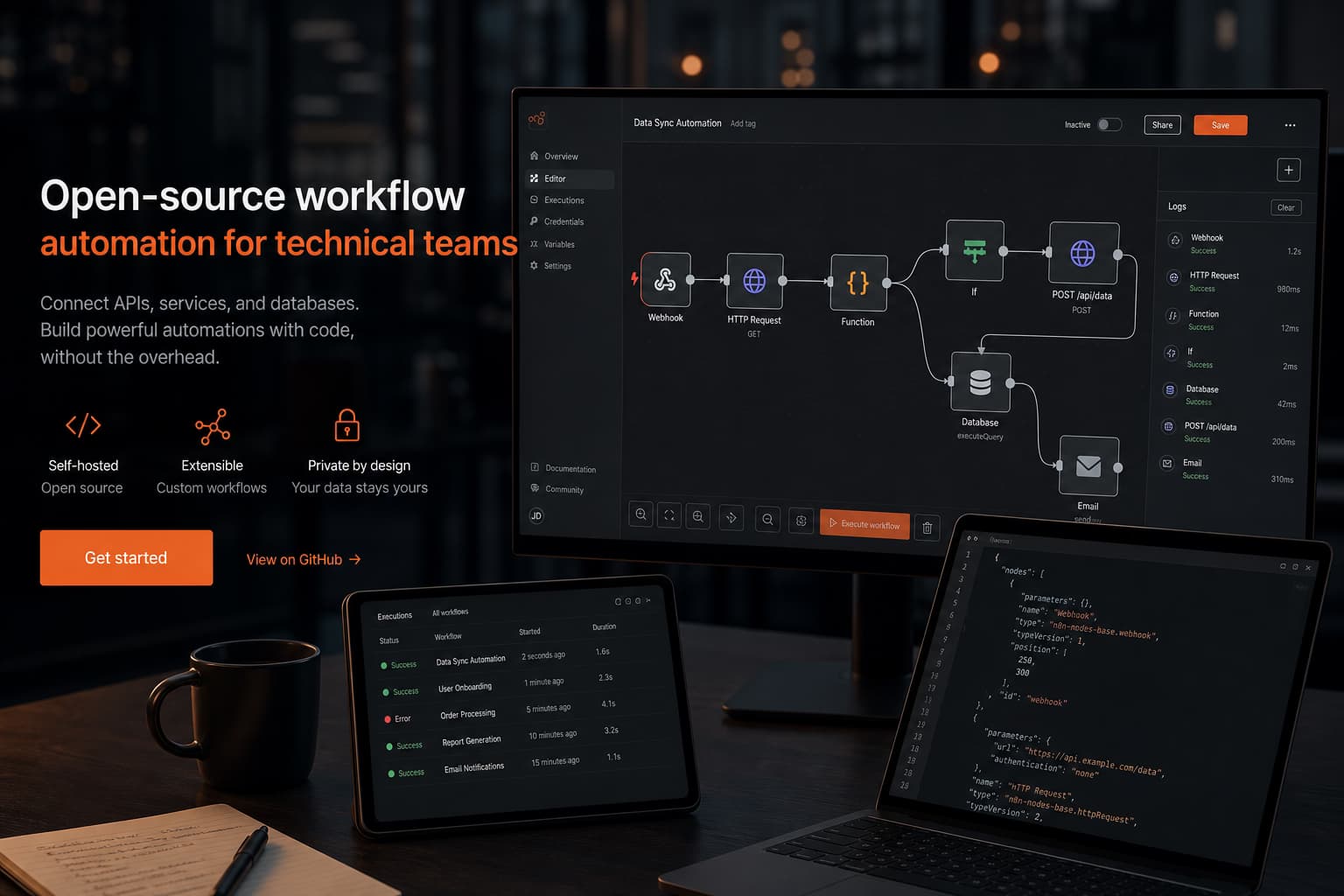
n8n for efficient business processes
We implement self-hosted n8n on your infrastructure or German cloud: webhook-driven workflows, ERP/CRM hooks, error handling and monitoring—ideal for GDPR-sensitive processes without mandatory US hosting.
For mid-sized companies: fair-code licence, self-hosted—API orchestration between ERP, CRM and SaaS – delivery and project ownership from Germany (Leer/East Frisia), named contacts, no offshore guesswork.
- 250+ delivered projects
- 5.0 stars on Google
- 100% engineering in Germany
n8n connects systems through APIs and webhooks. Self-hosting controls the workflow server; external nodes, model APIs and connected systems remain separate data flows.
n8n: context, benefits and typical use cases
n8n connects applications through a visual workflow editor and can be self-hosted for internal processes. This makes it useful for API orchestration where teams want to control execution, credentials and logs in infrastructure they choose.
Self-hosting keeps the workflow server, credentials and execution logs in your chosen infrastructure. Data may still leave that environment when a workflow calls external SaaS nodes, model APIs, webhooks or other target systems. We therefore document each data flow and assess DPAs, regions, retention and subprocessors separately.
Typical scenarios: lead routing from web forms to CRM, bidirectional ERP–shop sync, event-driven Slack/Teams messages, light ETL between databases or AI steps via HTTP nodes to internal LLM endpoints.
We combine n8n with custom code nodes (JavaScript/Python), queue handling and retry strategies so workflows are production-grade, not demos.
Project references
Selected case studies from our project work
Documented examples with transparent evidence types — browse matching references or open the full case study.





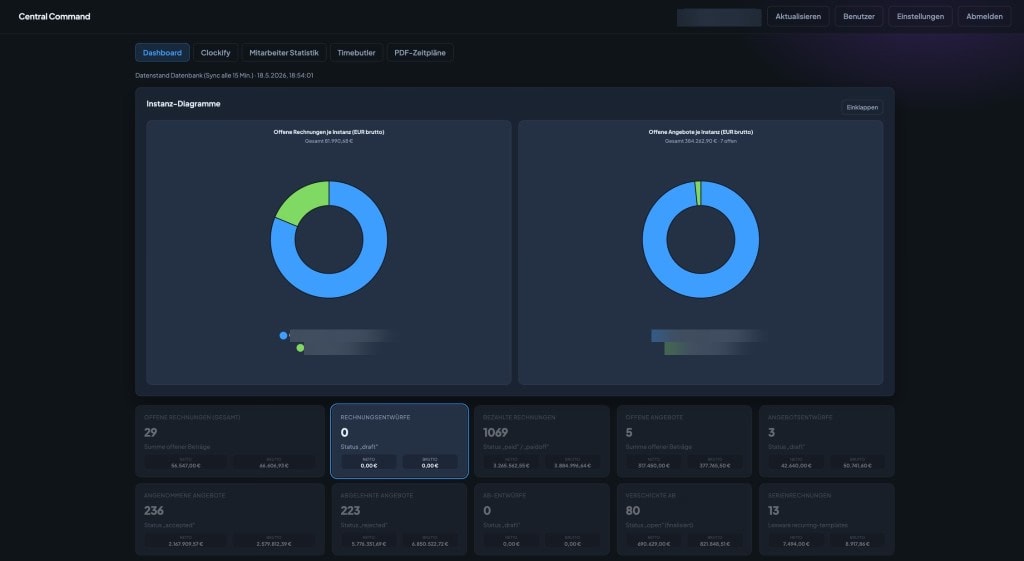
Our services at a glance
Self-hosted setup
Install on VM, Kubernetes or Docker with backup, TLS and HA options.
Workflow design
Modular flows with error workflows, dead-letter queues and idempotent API calls.
ERP & CRM
Odoo, SAP, DATEV context, HubSpot, Salesforce—via REST, OData or database nodes.
Webhooks & events
Real-time triggers from shops, forms, monitoring or message queues.
Security & GDPR
Credential vault, network segmentation, logging without personal data leaks.
Operations & updates
Version upgrades, workflow exports in Git and runbooks for your IT team.
When companies should prioritise n8n
SaaS automation starts fast, but depending on provider and configuration it may process data in third countries, while task limits can become expensive at scale. Self-hosted n8n fits when the workflow server should run on controlled infrastructure or custom logic is required. External nodes and APIs still need separate assessment.
We advise vendor-neutrally: n8n for control and scale, Make or Power Automate when low-code in business units is the priority.
We explain the key terms in depth in our glossary: n8n, Webhook.
Approach: analysis, design, implementation and operations
Architecture
Hosting, network, credentials and monitoring concept.
Pilot workflow
One end-to-end flow with measurable benefit and error handling.
Integration
Connect more systems, Git export and CI for workflows.
Operations
SLA, alerting and training for extensions by your team.

„With self-hosted n8n, mid-market firms control the workflow server and scale task volume more predictably—when operations, updates and all external data flows are managed professionally.“
Integration into existing systems, data flows and processes
An n8n instance without backup, monitoring and versioning becomes a single point of failure fast. We deliver runbooks, Git sync for workflows and clear ownership between IT and business.
Also: /en/services/api-integration for APIs n8n can call reliably.
- Self-hosted in DE/EU
- Webhook and API orchestration
- Error workflows & retries
- Odoo, CRM, shop integration
- GDPR-aligned architecture
Costs: /en/costs/automation.
Frequently asked questions
FAQ: n8n workflows
Operations, security and cost
n8n Cloud or self-hosted?
n8n Cloud starts fast; self-hosting places the workflow server, credentials and logs in the chosen infrastructure and can make high-volume costs more predictable.
It does not create complete data control by itself: external nodes, model APIs and connected SaaS systems remain separate data flows. For GDPR-sensitive processes we combine EU or German hosting with DPA, region and retention reviews.
What does n8n implementation cost?
Setup and first production workflow often from €5,000–12,000; multiple integrations and HA accordingly higher.
Ongoing: hosting and maintenance instead of per-task SaaS fees.
Which systems can n8n connect?
Practically anything with REST, webhooks or email: Odoo, HubSpot, Shopify, PostgreSQL, Slack, Microsoft 365, finance middleware.
Missing connectors we build as HTTP nodes or custom functions—without vendor lock-in.
Integration, error handling and operations
How do we handle errors and retries in n8n?
Error workflows, exponential backoff, dead-letter queues and alerting (email, Teams, PagerDuty).
Critical processes get idempotency and manual approval steps. We document runbooks for your ops team.
Do we need developers for n8n maintenance?
Simple flows can be maintained by business teams with training.
Complex integrations, credential rotation and HA operations should sit with IT or us. We offer enablement plus optional retainer—scaled to maturity.
n8n vs Make vs Power Automate – when n8n?
n8n when self-hosting, GDPR control and complex API orchestration matter.
Make/Power Automate for fast citizen-developer entry in SaaS ecosystems. We recommend by privacy, volume and team—not hype.
Privacy, licensing and funding
Is self-hosted n8n GDPR-compliant?
Self-hosting n8n on German or EU infrastructure can keep the workflow server, credentials and logs under your operational control, but it does not make every workflow GDPR-compliant automatically.
External nodes, model APIs, webhooks and target systems may still receive data. We document these flows, configure credentials and logging, and review DPAs, regions and retention. We plan secure APIs via /en/services/api-integration.
What licence does n8n use—is it really open source?
n8n uses the Sustainable Use License and describes the model as fair-code or source-available, not unrestricted open source under the OSI definition.
Internal use and self-hosting are generally permitted, while offering or reselling a competing hosted service is restricted. Before production use we review the licence, edition, hosting and operating costs. We classify alternatives in /en/services/automation.
Is n8n automation eligible for German public funding?
Automation and digitalisation projects are often partly eligible depending on the programme and company size.
We review the conditions with you and outline the options. The exact funding amount depends on the current programme status.
Hosting, database and scaling
What hosting options exist for self-hosted n8n?
n8n runs on a single VM (e.g.
Hetzner, IONOS), in Docker or scalably on Kubernetes—depending on load and availability needs. For GDPR-sensitive processes we recommend German data centres or your own cloud. We extend the architecture where needed.
Which database does n8n need and how is it operated?
For production we use PostgreSQL instead of the default SQLite file, because it is more stable with multiple workers and high volume.
We handle configuration, backups and database performance so the instance stays reliable.
How does n8n scale at high task volume?
n8n supports queue mode with Redis and multiple worker nodes so workflows run in parallel and resilient.
This processes large webhook and event volumes without the task limits of classic SaaS tools. We size workers, database and Redis to your load profile.
How do we protect n8n against outages (backup & disaster recovery)?
We back up the n8n database and workflow exports regularly and define a recovery concept with recovery times (RTO/RPO).
This lets operations resume quickly and reproducibly after an outage. We cover ongoing operations via /en/services/automation.
Security, updates and monitoring
How does n8n manage credentials and API keys securely?
Credentials are stored encrypted and are not visible in plain text inside workflows; access can be restricted via roles and network segmentation.
We add credential rotation and a secrets concept aligned with your compliance requirements—important for audits.
How do we secure n8n webhooks against unauthorised access?
Incoming webhooks are protected via authentication (header tokens, HMAC signatures or basic auth), IP restrictions and TLS.
Only authorised systems can trigger flows and payloads stay tamper-proof. This complements the GDPR-aligned architecture we set up for every instance.
What happens to our workflows during an n8n version upgrade?
Before every upgrade we back up workflows and the database and test the new version in a staging environment before it goes live.
This avoids breaking changes on node updates and keeps your automation running. We cover ongoing operations via /en/services/automation.
How do we monitor n8n workflows in operation?
We set up execution logging, health checks and alerting via email, Teams or PagerDuty so errors surface immediately—not only when a department complains.
We also deliver runbooks with clear ownership between IT and business. For connected systems this fits /en/services/api-integration.
Integration, AI and custom development
How do I integrate AI or LLMs into n8n workflows?
Via HTTP request nodes or the native AI nodes you can call OpenAI, Azure OpenAI or internal LLM endpoints—e.g.
for document classification, text extraction or RAG steps. For sensitive data we run the model on-premise and combine n8n with our AI expertise.
Can we develop custom nodes and integrations for n8n?
Yes—missing connectors are built as custom nodes or via code nodes in JavaScript or Python.
This connects niche or legacy systems that have no ready-made n8n connector. We build the underlying APIs where needed via /en/services/api-integration.
Can n8n connect finance and accounting systems?
Documents, master data and payment information can be orchestrated towards finance systems via REST APIs or middleware—for example syncing from shop or ERP.
This reduces manual exports and double entry. We plan the end-to-end chain with /en/services/automation.
Can we migrate existing Zapier or Make scenarios to n8n?
Yes—we analyse existing scenarios and rebuild them as n8n workflows, including triggers, data mapping and error paths.
The goal is usually to reduce per-task fees and control the workflow server through self-hosting. External applications and APIs remain documented parts of the data flow. We deepen the platform comparison under /en/services/make-automation.
Project, quality and team
When is n8n a better fit than custom development?
n8n fits when standard systems are orchestrated via APIs and the visual editor eases maintenance and transparency.
For highly specific business logic or product features, custom software is often the better choice. We advise vendor-neutrally which approach is more economical per use case.
How long does a typical n8n project take?
A first production workflow including hosting setup is often delivered in 2–4 weeks; complex multi-system integrations with HA operations take longer accordingly.
We deliberately start with a pilot workflow with measurable benefit before rolling out wider. Guidance: /en/costs/automation.
How do we version n8n workflows and run CI/CD?
We export workflows as JSON and store them in Git so changes are traceable and reproducible.
A CI pipeline promotes workflows between staging and production—no manual copy-paste in the editor. Operations stay stable even with multiple editors.
How do we test n8n workflows before go-live?
We build workflows modularly with test data, test error paths deliberately and run a separate staging instance.
Flows only go live after successful tests—avoiding silent failures in core processes. This is part of our structured audit approach.
How do we enable the internal team on n8n?
In workshops we teach structure, best practices and error handling so business teams can maintain simple flows themselves.
More complex tasks stay with IT or us via an optional retainer—scaled to maturity. This avoids vendor lock-in and keeps you in control.
Scope: n8n workflows vs Make, Power Automate and RPA
n8n is fair-code software for self-hostable workflow orchestration. Hosting, processing agreements, access controls and data flows require a project-specific review. For Microsoft Power Platform, choose Power Automate, not Make on Make and not desktop bots on RPA implementation.
APIs: API integration. Overview: automation & workflows. Overview: automation & workflows (overview).
Related paths and adjacent topics
Service overview: Automation & workflows (overview)
More automation & workflow services
Adjacent service categories
Quick context: A compact summary of this service – aligned with your project.
Service at a glance – for your decision
n8n Workflows: compact service description
Definition: n8n workflows orchestrate processes self-hosted in DE/EU: webhooks, ERP connectivity, error handling and reproducible operations via Git.
When it applies: When manual steps in ERP, Office or line-of-business apps cost time and cause errors and automation must be introduced with governance.
Audience: Operations, IT and business teams that want end-to-end digitisation, not isolated macros.
Outcome: Documented bots/flows, monitoring and business sign-off; interfaces from Integration keep processes continuous.
Approach: Process mining or as-is capture, tool and architecture choice, pilot automation, rollout with monitoring and exception handling.
Prerequisites and limits: Prerequisites and limits: measurable processes, system access and process owners. Limits: not ERP greenfield or cloud migration without process focus—we link to the matching services.
Differentiation: Bespoke software → Software & platforms; AI assistants → AI & ML; strategic process consulting → Consulting & strategy. This page (n8n Workflows) is the main service page – the overview lists all related services.
Trust: RPA and workflow projects with references; delivery from East Frisia, combinable with integration and support.
Sensible next step: Sensible next step for n8n Workflows: outline process and tool landscape—process mining or RPA pilot as entry.
Approach in steps
- Use cases and hosting decision: We clarify with you which processes to automate (data sync, API bridges, reporting) and whether n8n should run in the cloud, on-premises, or in your own cloud (e.g. Hetzner, AWS). Privacy and maintenance effort feed into the decision.
- Workflows with clean error paths: We build workflows modularly, with test data and defined error paths. So you know at every failure what happened—instead of only that 'something isn't working'.
- Security and credentials management: We set up credential management, logging, and (for self-hosting) backups and updates. So n8n stays secure and audits can be served at any time.
- Handover and ongoing care: We train your team on n8n and hand over workflow documentation. On request we take over update and maintenance contracts—but you're never locked in.
Next step with Groenewold IT Solutions
We outline hosting, first workflow and operating model in one call.

Up to 50% of your investment via BAFA/KfW
Use our funding calculator to see which government grants may apply to your project.
Björn Groenewold – Managing Director
Service cluster
Related services for Automation & workflows: choose the right method
A guide to core-process automation, RPA, Power Automate, fair-code n8n, Make and process mining with transparent planning assumptions.