Standard CMS, headless or bespoke development?
A standard CMS fits when editorial work, page structures and approvals can use established features. We configure roles, templates and extensions while keeping changes away from the product core. This keeps updates manageable for conventional corporate websites.
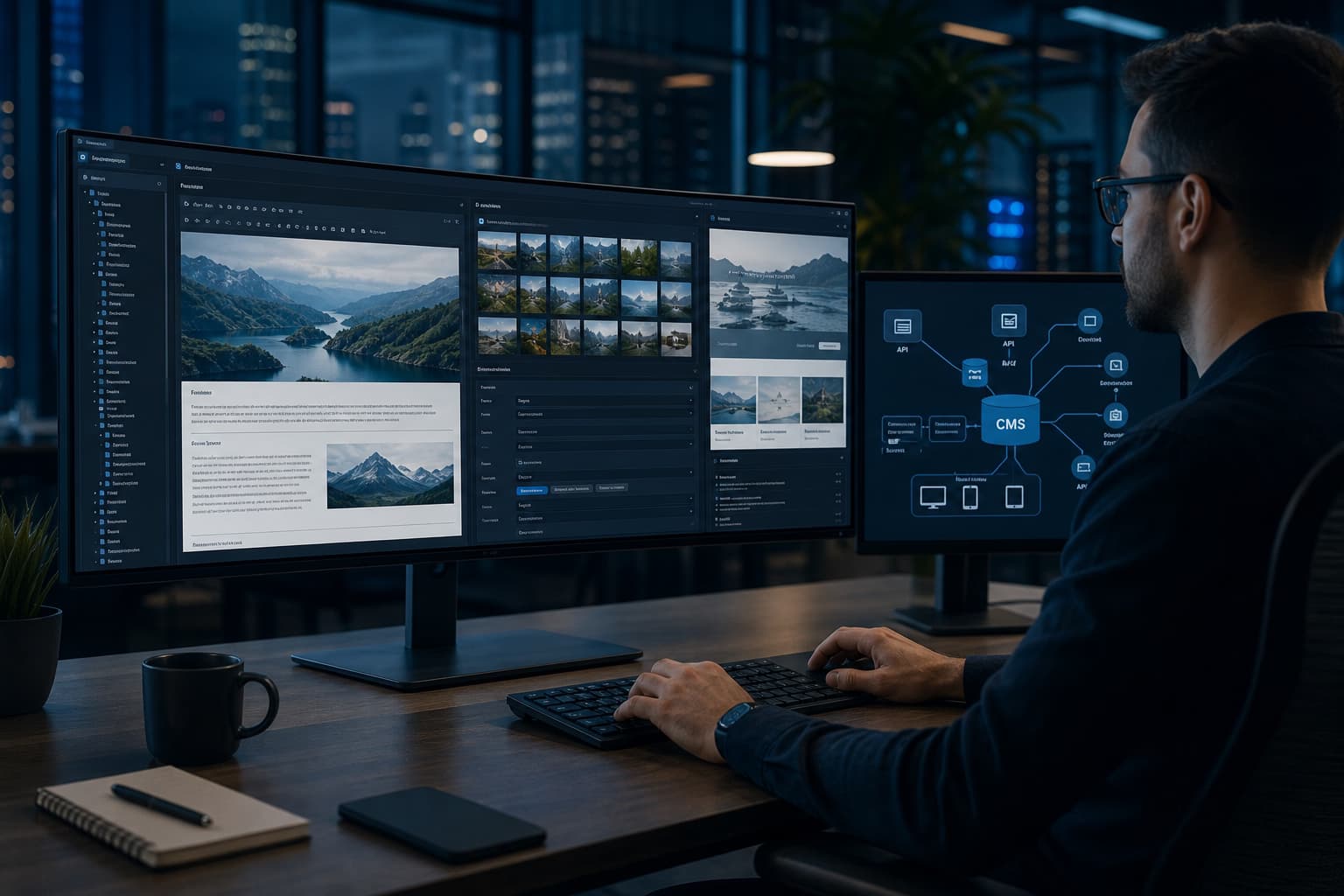
Headless delivery fits when one content source serves a website, app and partner portal. A bespoke CMS is justified only when the data model, domain rules or approvals would otherwise depend on fragile workarounds. We decide from editorial needs, interfaces, operations and total effort—not from a preferred vendor.
Editorial workflow and connected systems
A representative workflow starts with a structured draft. A subject expert checks required fields and claims, then an accountable role approves that version. Preview shows the result on web and mobile before publication. Version history and comments preserve the decision trail.
Product, customer and media data should not be maintained twice. Documented APIs connect the CMS with PIM, CRM and domain systems. Modern storefronts and sites can use our Next.js development service, while the CMS and ecommerce platform guide covers the wider product decision.
Migration, training and update ownership
Discovery records content types, media, metadata, URLs and owners. A mapping identifies what can be automated, what needs cleansing and what requires editorial review. Test migrations and business samples precede cutover; redirects and search receive their own acceptance checks.
Role-based training focuses on real editorial and administration tasks. The operating agreement names who updates the CMS core, extensions, frontend and interfaces. Staging tests, maintenance windows and a documented fallback stop ownership becoming unclear after go-live. Generic web work is not presented as CMS evidence unless the editorial and integration contribution is confirmed.
CMS development for organisations with complex content processes
CMS development matters once content must move through approvals, translations and channels in an audit-safe way – not just “live on the web”. Without solid content management system programming you get hand-offs between marketing, subject matter experts and IT – every campaign costs twice. We build a custom CMS when standard stacks become a risk through plugin piles or missing domain models – for multi-stage approvals, industry rules or strict data residency and hosting in Germany.
Content management system programming for us means concrete content types, traceable APIs and an editorial UI that fits your roles – not the other way around. If you commission bespoke CMS work, budget and timeline should attach to an MVP; we ship releases with tests, documentation and monitoring instead of endless wishlists. For international teams, enterprise CMS solutions matter once tenants, SSO and auditing become mandatory; custom CMS development stays an option when SaaS limits or licence logic bite. In proofs of concept we validate critical workflows and interfaces early – so there are no surprises only after the first sprint review.
We connect projects closely with custom software development for APIs and backends and web and mobile development for frontends. Where commerce and content meet, we align with ecommerce, Shopify and CMS platforms in one roadmap.
Goals, KPIs and roles
We translate business goals into measurable requirements for publishing speed, defect rates and time-to-approval.
Domain model and content types
Structures for text, media, taxonomies and relations are planned so migration and extension work without data swamps.
Hosting, compliance and operations
Data location, processor agreements and access models are aligned early with security and privacy – not first at audit time.
Project references
Selected case studies from our project work
Documented examples with transparent evidence types — browse matching references or open the full case study.




Building a custom CMS: when the special path pays off
Scenario 1: Complex editorial and approval workflows. Multi-stage approvals, legal review before publishing or integration into print chains often exceed default draft/publish states.
Scenario 2: Multi-channel publishing with high performance needs. One story across web, app, newsletter and partners – classic CMS plus plugins can become slow; headless with static generation often wins.
Scenario 3: Strict privacy and integration requirements. German hosting, no US-only cloud, ERP/shop/CRM without one-size-fits-all plugins.
Scenario 4: Legacy editorial stacks and special formats. Instead of endless tuning we build a CMS that speaks your structures and interfaces.
More on delivery: Web development and Software development.
Content management system programming: architecture, APIs and frontend
The choice between headless, traditional and hybrid CMS defines flexibility and frontend coupling. Traditional couples editing and rendering tightly; headless serves content only via APIs; hybrid combines WYSIWYG with API access for more channels.
We use React and Next.js on the frontend; Strapi, Sanity, Directus or bespoke APIs as backends; REST or GraphQL for APIs.
| Criterion | Headless | Traditional | Hybrid |
|---|---|---|---|
| Architecture | API content, separate frontend | Editing and rendering in one | Website + API for more channels |
| Flexibility | Very high | Limited by templates | Medium |
| Performance | Very good (static) | Depends on stack | Good if frontend tuned |
| Editor UX | Content-focused UI | Familiar WYSIWYG | Combination |
| Cost pattern | Backend + frontend build | Licences + customising | Middle ground |
Bespoke CMS: editorial UX, workflows and tenants
Bespoke CMS means fields, roles and approvals mirror your organisation – not a generic admin template. We train editors on real workflows and provide preview, validation and media guidelines.
Approvals, versioning, traceability
Revision safety and comments activate where compliance or QA demand it.
Multilingual and localisation
Translation status, fallbacks and reference locales are modelled so half-finished content does not go live.
Training and documentation
Workshops plus quick guides reduce post-go-live support tickets measurably.
Custom CMS development and enterprise CMS solutions at a glance
Custom CMS development applies where domain logic and interfaces are the product. Enterprise CMS solutions add tenancy, SSO, audit and operations with clear responsibilities between marketing and IT.
Goals, channels, headless vs hybrid, content structures, APIs and ERP/shop/CRM integration – with milestones for quotes and delivery.
Editorial UI, APIs and frontend to spec; multilingual workflows, media library, permissions – documented and maintainable.
Structured migration from WordPress, TYPO3 (technology overview) or others with mapping, cleanup and test runs before cutover.
Updates, security patches, monitoring and support – optionally with SLA and feature extensions.
Migration, operations and continuous improvement
After go-live, CMS development remains a product: releases, security and performance are planned. We help with incidents, capacity and features – without every ticket becoming an ad-hoc project.
CI/CD and quality assurance
Automated tests and staging deployments limit regressions.
Monitoring and incidents
Availability, API latency and error rates are monitored; escalation paths are documented.
Roadmap and lifecycle
Features are prioritised by value and risk – alongside regulatory duties and platform upgrades.