Python development – Django, FastAPI and AI backends for data-intensive web applications
Python · Django · FastAPI · AI · data pipelines · Made in Germany

Python development: Django, FastAPI and AI backends for data-intensive applications

For mid-sized companies: web APIs, ETL pipelines and ML integration with tests, typing and production-ready deployment—Python agency from Germany – delivery and project ownership from Germany (Leer/East Frisia), named contacts, no offshore guesswork.

  • 250+ delivered projects
  • 5.0 stars on Google
  • 100% engineering in Germany

Python — the leading language for data and AI

Python has the largest ecosystem for data processing, machine learning and AI development. With Django and FastAPI we build scalable web APIs and backends – from simple REST services to complex data platforms with Celery, Redis and PostgreSQL.
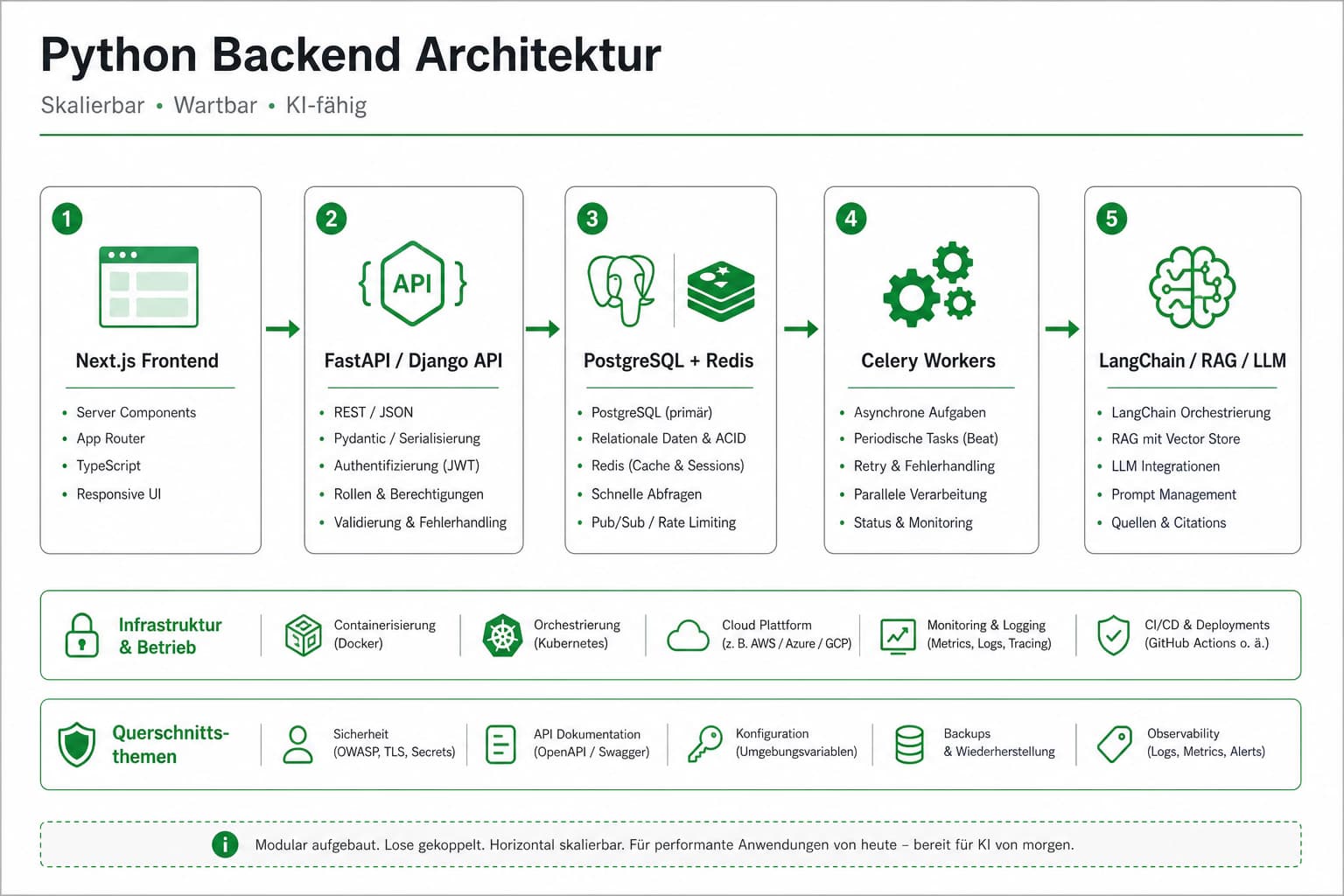
Python backend architecture: Next.js frontend, FastAPI and Django, PostgreSQL, Redis, Celery and AI integration

For AI applications Python is the practical default: PyTorch, scikit-learn, LangChain and Hugging Face run natively in Python. As a Python agency from Germany we deliver backends, REST APIs, ETL pipelines and AI backends – from architecture through implementation to production on AWS, Azure or your own servers.

Python development complements our custom software development and AI solutions for business. Technology overview: Python – stack details on our technology page.

Our Python services

Django applications

Django is the batteries-included framework for full web apps: ORM models, built-in admin, Django REST Framework for APIs and Channels for real-time features. We deliver clean app design, custom user models, Celery for background jobs and pytest-django test suites. Deployment via Docker on AWS ECS, Kubernetes or classic VPS setups.

FastAPI backends and microservices

FastAPI is our choice for high-performance APIs: async/await, automatic OpenAPI docs, Pydantic validation and strong throughput. We build FastAPI for ML inference, LLM integrations, microservices and performance-critical components – containerised on Kubernetes with CI/CD.

ETL pipelines and data processing

Python is the standard for ETL: extract from APIs, databases, CSV/Excel or ERP, transform and load into warehouses. We use Pandas, Polars, SQLAlchemy and Airflow – alongside database & BI and automation.
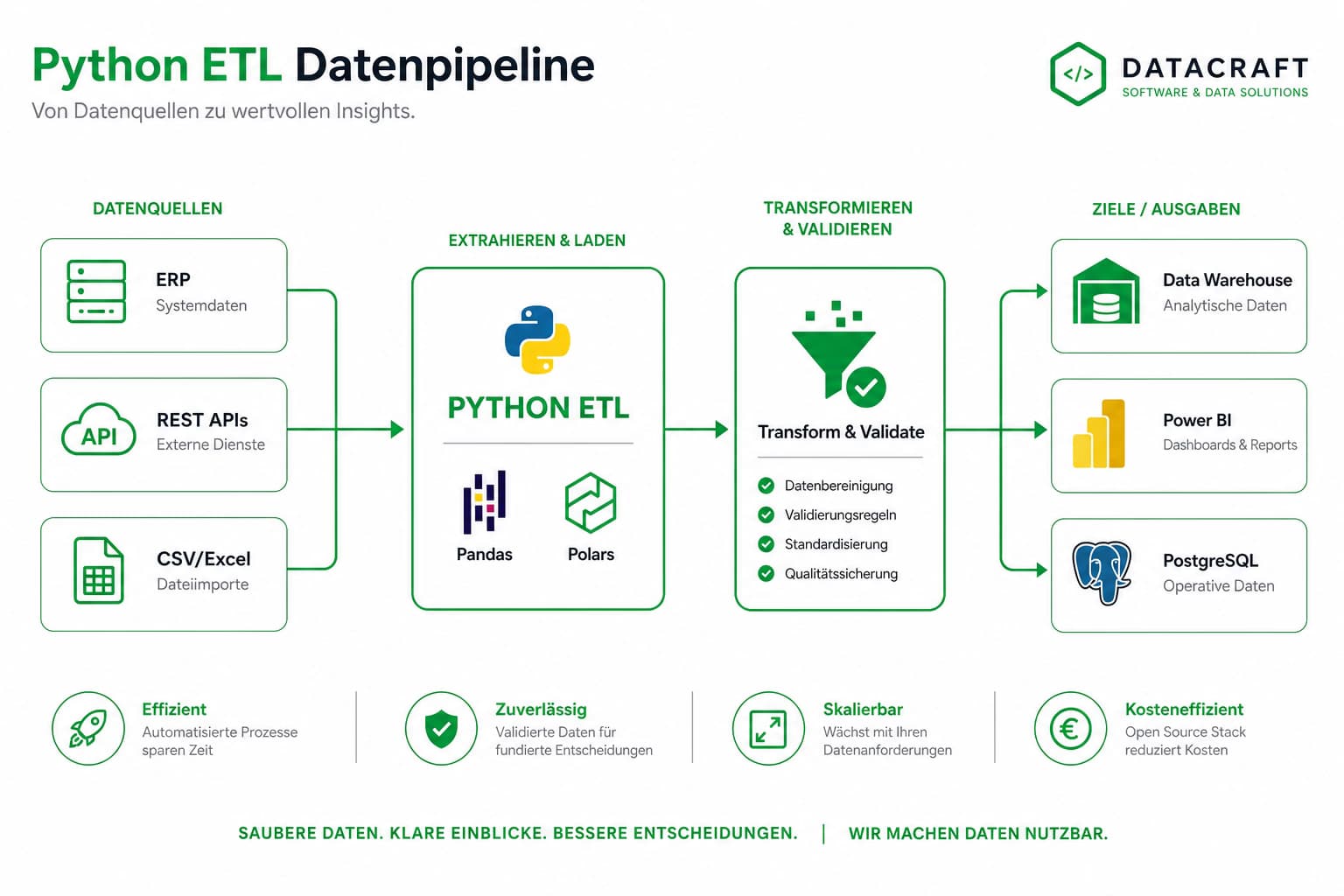
Python ETL data pipeline from ERP, APIs and CSV via Pandas and Polars to data warehouse and BI
Typical Python ETL: ERP, APIs and files through Pandas/Polars into warehouse and BI.

AI and ML integration

Python backs AI services: LangChain and LlamaIndex for RAG, OpenAI and Anthropic API integration, FastAPI inference and vector databases (pgvector, Chroma). See AI agents and AI chatbot agency.

Django & FastAPI

Scalable web apps and high-performance APIs – Django ORM, DRF and async FastAPI.

ETL & data processing

Pandas, Polars, Airflow and SQLAlchemy – robust ETL for integration and BI.

AI & ML backends

LangChain, FastAPI inference and RAG – AI integration for production environments.

Deployment & DevOps

Docker, Kubernetes, AWS ECS and CI/CD – Python apps deployed for production.

Python in practice: from prototype to production
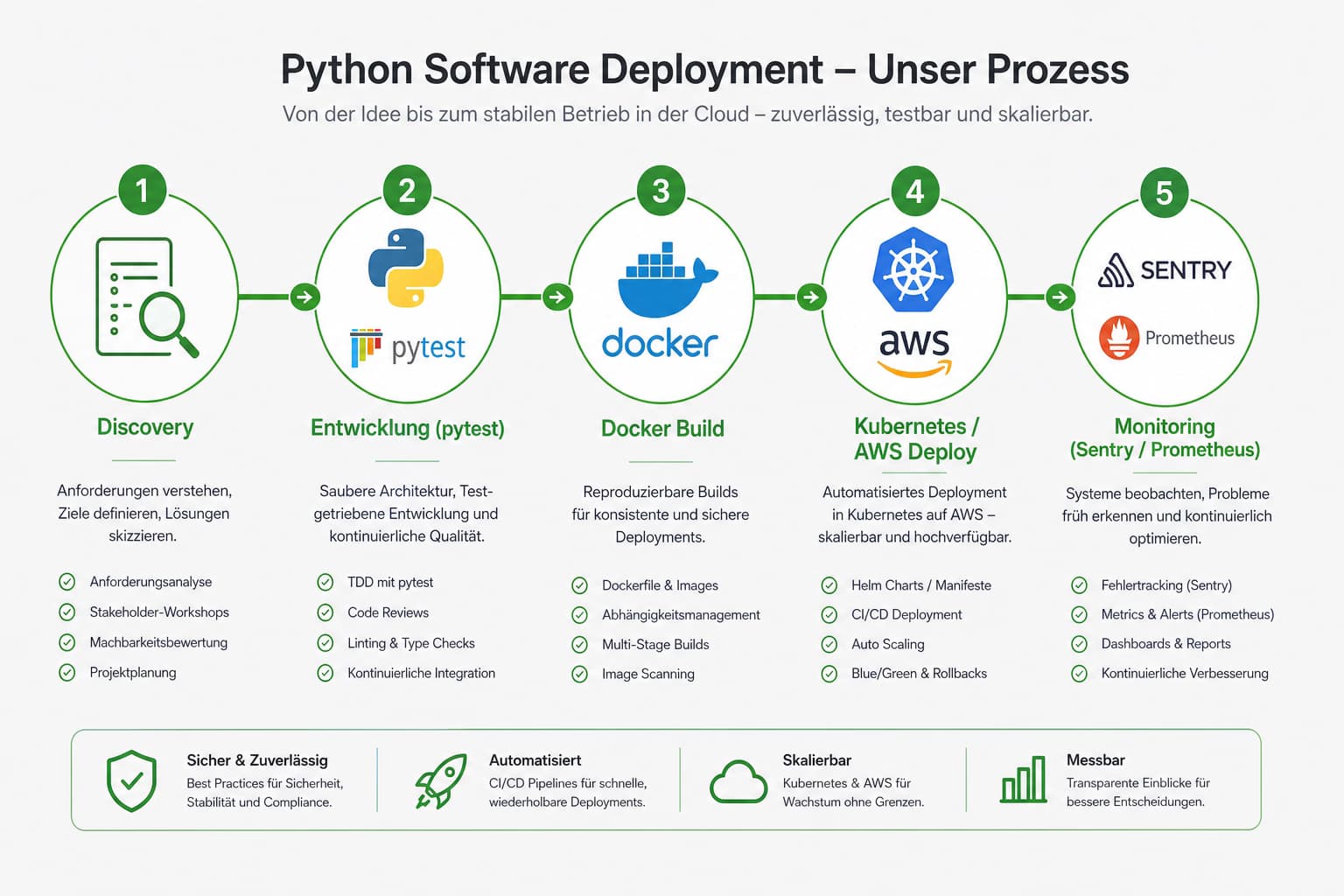
Python deployment process: discovery, pytest, Docker, Kubernetes and monitoring
Production Python: discovery, pytest, Docker, Kubernetes/AWS and monitoring with Sentry and Prometheus.

Python works for fast prototypes and large-scale production. Scaling comes from architecture: Celery for async tasks, Redis caching, horizontal scaling with Docker and Kubernetes.

Quality means pytest with high coverage, Black and Flake8 linting, Bandit security scans and Dependabot dependency updates in CI/CD.

  • FastAPI + async: high throughput per instance depending on workload
  • Celery: long background jobs without HTTP timeouts
  • Django ORM: type-safe queries without SQL injection risk
  • Docker + Kubernetes: horizontal scaling at load peaks
  • pytest: automated tests with ~80% coverage as standard
  • Sentry + Prometheus: error tracking and performance monitoring in production

We build Python backends that scale and stay maintainable. After a free discovery call you get a transparent fixed-price quote – or start in the project check.

Frequently asked questions

FAQ on Python development

Technology, frameworks and costs

When is Python the right choice for a business application?
Python fits when data processing, analytics or machine learning are central – it has the largest ecosystem for data science and AI. Also strong for fast API delivery (FastAPI, Django REST), automation scripts and ETL, or when your team already knows Python. Less ideal for latency-critical real-time systems (see Go development), mobile-only apps or estates that benefit from a strictly static enterprise stack. For public web UIs we often use Next.js; Python is our default backend for data-heavy systems and AI integrations.
Django or FastAPI – which framework fits better?

Django suits classic web apps with admin, users and ORM models, plus teams that prefer conventions. FastAPI suits high-performance REST/GraphQL APIs (async, Pydantic, OpenAPI), microservices in Kubernetes, ML inference and LLM backends. In practice we often combine Django for admin/data models with FastAPI for performance or ML endpoints.

What does a Python web application or API cost?
A production-ready Python REST API (FastAPI or DRF) with database, auth and CRUD often ranges from €8,000 to €25,000. A full Django app with admin, roles and deployment typically €15,000–40,000. Data-heavy systems with ETL, Celery, PostgreSQL and Redis can reach €20,000–80,000. ML APIs with FastAPI from around €12,000. Use our software development cost calculator and a discovery call for a transparent fixed-price quote.
How does Groenewold IT integrate Python with AI and machine learning?
PyTorch and TensorFlow for custom models, scikit-learn for classical ML, LangChain and LlamaIndex for LLM apps (RAG, AI agents, document chat), Hugging Face for NLP and FastAPI as inference APIs. For GPT-4, Claude or Gemini via API we build backends with vector stores (RAG). More: AI solutions for business.
Is Python fast enough for production business applications?

Yes for most enterprise workloads. Bottlenecks are usually database and I/O, not the language. FastAPI uses async/await for concurrency. For compute-heavy paths we use C extensions (NumPy, SciPy) or Go/Rust microservices without changing the whole stack.

Python vs. Node.js or Java – how do we choose the stack?
Node.js when your team already uses TypeScript/React and real-time WebSockets matter – see Node.js development. Java for complex enterprise logic and long-standing Java teams (Java development). Python wins for data science, AI, ETL and fast API prototypes. The project check maps use case, team and IT landscape – stack-neutral, no technology dogma.

Scaling, security and quality

How does Python software scale under high traffic?

Horizontally: multiple FastAPI/Django instances behind a load balancer (Nginx, AWS ALB). Celery + Redis for long tasks. Redis or Memcached for caching. PostgreSQL read replicas for read load. Docker + Kubernetes for autoscaling. Sentry and Prometheus/Grafana surface bottlenecks before users feel them.

What are the security risks with Python backends?
Typical risks: outdated dependencies (CVEs), missing auth on APIs, SQL injection via raw SQL, secrets in code and weak session handling. We mitigate with dependency scanning (Bandit, Dependabot), OWASP-oriented API design, environment-based secrets and regular patches – aligned with GDPR-compliant software development where personal data is involved.
How does a typical Python project with Groenewold IT run?
After an initial call we run discovery (requirements, architecture, data sources), fixed-price milestones and two-week sprints with demos. You see working increments – not slides only. Handover to your Git repo with tests, deployment docs and optional team training. Development from Leer (East Frisia), Made in Germany, without offshore subcontractors.
Can you productionise existing Python scripts or Jupyter notebooks?

Yes – internal scripts that work but lack tests, logging, error handling or deployment. We structure modules, add pytest and type hints, containerise and connect to your APIs or ERP. Goal: a maintainable system your team can run, not a one-person prototype.

GDPR, hosting and data residency for Python backends

Personal data only via documented APIs and hosting in Germany or the EU matching your privacy role. We choose GDPR-aligned push, analytics and logging tools. Secrets in vaults or env vars – never in the repository. For AI backends we document flows to external LLM APIs for compliance reviews.

Do you provide maintenance and evolution after go-live?
Yes – SLA for bugfixes, dependency updates (Python, Django, FastAPI), security patches and feature sprints. Unmaintained Python estates age quickly. See software maintenance. Many clients stay with us from MVP to enterprise operations.
When is Python not the right choice?
Less ideal for latency-critical real-time systems, mobile-only apps, CPU-bound workloads without native extensions, or when IT is strictly standardised on .NET/Java without building Python skills. We may recommend .NET, Java or Go. The project check clarifies fit – we do not sell Python where it does not belong.

Request a Python project

Describe data sources, API requirements and AI goals – we sketch architecture, stack and a realistic timeline Made in Germany.

Scope: Python vs. Node and AI

Python for Django/FastAPI and data—Node: Node.js development; AI services: AI & Machine Learning.

Related paths and adjacent topics

Service overview: Software & platforms (overview)

More services in software & platforms

Adjacent service categories

Python development: from use case to production code

Björn Groenewold

Up to 50% of your investment via BAFA/KfW

Use our funding calculator to see which government grants may apply to your project.

Björn GroenewoldManaging Director