Software development
Digitization in the middle class: How to measure your success
Digitization is no longer a trend for medium-sized enterprises, but a need to remain competitive. But how to measure the success of Digitalisie...

A KPI dashboard bundles the metrics executives and business teams need daily—built on database consulting and data analytics services. BI consulting turns that into business intelligence you can rely on.
Business Intelligence only works when KPIs are defined consistently and data from ERP, CRM and production mean the same thing—not when every team maintains its own spreadsheet truth. With structured BI consulting we clarify responsibilities, KPI definitions and interfaces before any tool rollout: which decisions should accelerate, which risks must surface early?
Database consulting covers modelling, migration and performance so reporting stays stable. Data analytics services add exploratory analysis, forecasting or data-quality work —from cleansing to dashboards. For mid-sized businesses we favour pragmatic releases and clear ownership between IT and business—not the largest licence footprint.
Typical bottlenecks are duplicate master data, inconsistent currencies or overnight batch jobs that delay KPIs. We integrate interfaces to existing ERP and CRM systems so Business Intelligence does not stall on isolated islands. We clarify roles and test data early so pilot and production stay aligned—supported by legacy modernisation where needed, Made in Germany.
Without reliable data quality, every KPI dashboard stays vulnerable to variances — so we connect BI projects with database consulting and the right data warehouse.
BI projects often fail not because of tooling, but because of unclear data ownership and missing data documentation.
Before dashboards and KPI reports work reliably, responsibilities for data maintenance, metric definitions and source priority must be agreed between business units and IT—that is an organisational prerequisite, and the first step of every credible BI project.
More on related services: data analytics services and dashboards overview, database solutions for mid-sized companies and the glossary entry Business Intelligence explained simply.
We deliver concrete implementation steps from East Frisia—Made in Germany—not slide decks alone.
Project references
Documented examples with transparent evidence types — browse matching references or open the full case study.
From design through database development to data migration—we build stable, performant and secure data architectures.
We support modelling (normalisation, indexes, partitioning), SQL or NoSQL development and optimisation, and migration from legacy platforms—including cleansing, mapping and acceptance tests. Estimate effort via our data migration cost guide.
Performance tuning, backup and recovery concepts plus documentation keep your estate maintainable and extensible—optionally with ongoing software maintenance.
Business Intelligence (BI) turns your data into meaningful reports, dashboards and KPIs—so strategy rests on facts, not gut feel.
We use proven database and BI technologies that fit your existing stack.
For relational workloads we work with SQL Server, PostgreSQL and MySQL depending on scale, licensing and cloud attachment. For flexible or document-centric models we use MongoDB.
For BI we deploy Power BI and Tableau, adding ETL pipelines, warehouse concepts and ERP or CRM connectors where needed. Tool choices are joint decisions based on sources, budget and user expectations.
PostgreSQL is open source, ACID-compliant and strong for complex queries, transactions and large volumes. We recommend it when you need integrity and extensions (JSON, full-text search, PostGIS)—typical for web apps, ERP ties and reporting. Broad cloud support (AWS RDS, Azure, GCP) makes it a durable mid-market choice.
MySQL/MariaDB are widespread and straightforward to operate—ideal when you already run MySQL or need fast reads at moderate complexity (e.g. portals, CMS). MariaDB stays compatible with MySQL and often improves licensing. For heavy write loads we compare PostgreSQL or specialised engines.
MongoDB offers a flexible document model—suited to evolving schemas, prototypes or highly variable documents. We pair it with clear conventions when strict multi-document transactions matter, aligned with our database consulting.
Redis accelerates caching, sessions and real-time paths. We combine it with durable databases so speed and safety align.
(1) Identify and connect sources: We map ERP, CRM, spreadsheets and APIs—what exists where, at what quality, under which compliance rules. Gaps and duplicate maintenance surface early—often tied to data silos; fixing them improves every downstream metric.
(2) Build ETL: Extract, transform and load—cleansing, harmonising identifiers, currencies and dates into a central model. We document and automate ETL so your BI estate stays maintainable.
(3) Data warehouse or data lake: A single analytical backbone. Together we choose warehouse discipline, lake flexibility or hybrid patterns—e.g. lake for raw landing, warehouse for governed KPIs—built on our database solutions.
(4) Dashboards and reports: Using Metabase, Grafana, Power BI or tailored stacks we deliver live dashboards and standard packs. KPIs stay traceably defined—see BI tools & dashboards.
(5) Train departments for self-service BI: Where appropriate we empower teams with governed access. More: API and integration development, breaking down data silos, artificial intelligence services.
A manufacturer with five sites held data across ERP (orders and stock), MES (machine data) and Excel for ad-hoc analyses. Leadership lacked one KPI view and spent hours consolidating weekly; definitions diverged between plants—typical for manufacturing networks with grown IT landscapes.
Groenewold IT Solutions unified sources via ETL into a PostgreSQL-based warehouse, defined a shared metric model and shipped a real-time Metabase dashboard. Leadership now sees OEE, scrap and delivery performance across sites; production can filter by machine, shift or order with alerts on threshold breaches—supported by monitoring.
Monthly reporting time dropped by roughly 60 % while consistency improved through shared calculations and fewer manual errors—a pattern we repeat in data analytics projects.
Without trustworthy master data, BI stalls: duplicate customers, variant article numbers, inconsistent supplier labels. We often start database development that encodes cleansing rules, deduplication and golden-record logic before the first chart ships.
The result is measurable: identical definitions everywhere, comparable revenue across systems, reliable filters in self-service tools—see data quality for BI.
In practice this means fuzzy vs exact matching, source priorities (ERP before CRM before spreadsheets), pipeline validation (mandatory fields, value ranges, referential integrity) and approval workflows for fixes.
Workshops align terms like "active customer" or "open order" so shared Business Intelligence models replace competing spreadsheet definitions.
Overnight batches fall short when manufacturing, logistics or service need minute-level freshness. With change data capture or event-driven pipelines we stream operational changes into a data warehouse or streaming layer without hammering sources with full scans—supporting alarms, operational cockpits and same-day forecasts.
Latency, cost and fault tolerance must balance: not every KPI needs sub-second updates; critical signals often do. We dimension architecture with you and add monitoring (lag, failure rates, upstream schema drift).
Integration development connects heterogeneous systems—from REST and events to controlled batch exports when legacy exposes no modern API—so data analytics supports daily operations, not only hindsight. For Microsoft Power BI self-service dashboards, see our data analytics services.
Business intelligence consulting starts with the question of which building block makes your steering reliable first. The matrix maps typical situations to the right building block, data foundation, result and an effort indication.
| Situation | Recommended building block | Data foundation | Result | Effort (indication) |
|---|---|---|---|---|
| Data ownership and KPIs unclear | BI governance and KPI catalog | ERP, CRM, spreadsheets | Binding KPI definitions | 2–4 weeks |
| Slow queries, legacy systems | Database consulting via database solutions | Existing databases | Performant, stable storage | 2–6 weeks |
| Heterogeneous sources, silos | Data warehouse / central layer | ERP, CRM, production | Consolidated data foundation | 4–8 weeks |
| No reporting in the decision rhythm | Dashboards with Power BI | Warehouse, data models | KPI dashboards for decision-makers | 3–6 weeks |
| Near-real-time metrics needed (CDC) | Near-real-time pipelines | Transactional data | Current, reliable values | project-dependent |
| Self-service for business units | Semantic layer and data analytics services | Approved data models | Governed self-service BI | medium |
Business Intelligence is more than dashboards—it is the infrastructure that ensures the right data is available at the right time in the right quality for decisions. Poorly built BI creates trust in wrong numbers; that is costlier than no BI at all.
We build BI systems business teams actually use: self-service for daily questions, deep dives for strategy, and automated reports delivered to the right recipients on schedule.
Talk to us when you want your data foundation to drive better decisions—we start with a short review of sources and reporting needs, or use our project check.
Frequently asked questions
A semantic model translates technical tables into approved business terms, measures and relationships.
Business teams can build permitted analyses without recreating logic in every workbook. Time zones, currencies, access rules and metric ownership remain centrally documented.
Standard reports and self-service therefore use the same definitions; new measures still require business approval and a responsible data owner.
A KPI dashboard pays off when metrics are copied from multiple spreadsheets today, leaders quote different numbers for the same KPI, or reporting deadlines slip regularly.
Before ERP rollouts or group reporting, a productive dashboard reduces the risk of conflicting steering information. We check whether data quality, interfaces or a data warehouse must come first—before visualisation takes centre stage.
That avoids charts without trustworthy sources; instead you get a release plan with measurable benefit for executives and business teams.
We start with KPI workshops: which decisions should accelerate, which sources are authoritative?
Database consulting and data analytics services cleanse sources, define transformations and deliver the technical pipeline. Then we implement the KPI dashboard in Power BI, Metabase or comparable tools—including permissions and training.
Organisationally we agree metric owners and acceptance criteria with finance and business units. After go-live we monitor freshness, runtime and variances so the dashboard stays useful in daily work, not only as a project screenshot.

Review KPI dashboard & BI potential
We align KPIs, sources and dashboard scope in a structured intro call.
Business Intelligence needs trustworthy data.
Without a consistent data model, every dashboard stays shallow. Database consulting first checks whether your existing systems need migration, cleansing or performance tuning before KPIs go live. When sources are mixed, we plan a central layer or warehouse.
Data analytics services can run data-quality and exploration work in parallel. BI consulting then aligns KPI definitions and roles so business and IT share the same language.
Internationally, Data Analytics and Business Intelligence Solutions often appear as separate work packages—we combine both in one release plan instead of isolated silos.
Data analytics services cover profiling, cleansing, metric definitions and technical delivery from pipelines to dashboards—not just a PDF at month-end.
We separate exploratory analyses (hypotheses, visual prototypes) from embedded KPIs in operations. Database consulting keeps queries fast and prevents history from fragmenting across ad-hoc copies. BI consulting decides with you which metrics may be self-service and which need governance.
Business Intelligence Solutions as a platform topic covers licensing, hosting and permissions—so analytics works in production, not only in notebooks.
External BI consulting pays off when timelines are tight and ERP, CRM and spreadsheet data must be unified—often before group reporting or certifications.
Internal teams know the systems; external partners bring migration patterns and benchmarks from similar SMEs. Database consulting adds value where indexing, partitioning or high availability is technically critical. Data analytics services deliver credible proof-of-concept work before large platform budgets are approved.
We coordinate training and documentation so nothing stays a black box after go-live.
Book a data strategy session
Where are silos and missing KPIs? We prioritise database consulting, data analytics services and BI consulting together with you.
Data Analytics refers to exploratory models, hypothesis tests and statistical analysis on clean datasets.
Business Intelligence Solutions describes live dashboards, reports and permissions with defined KPIs. In practice the phases overlap: analytics delivers insight, BI puts it into daily use. Database consulting covers schema and performance for both.
Data analytics services may include workshops, feature preparation and pipeline handover. BI consulting prevents every new chart from using different definitions—critical for finance and audit.
We inventory sources by business value and technical risk: which data feeds critical KPIs, which are redundant?
Database consulting then plans step-by-step migration with parallel runs and checks rather than a big-bang switch. Data analytics services deliver variance checks between old and new. Business Intelligence surfaces only consolidated metrics so users do not jump between conflicting systems.
BI consulting aligns cutover dates with business units. Analytics can shadow-run until accuracy targets are met—especially for inventory and financial data.
Where are your silos and missing reports? We explore database and BI opportunities with you—without obligation.
Request a sessionBusiness intelligence consulting connects data storage, semantic models, and dashboards—so metrics align technically and functionally.
| Use case | Benefit | Differentiation | Outcome | Next step |
|---|---|---|---|---|
| BI without a reliable database layer | Warehouse, ETL, and KPI model from one partner | Not exploratory data analytics—architecture focus | Scalable BI platform | Assess BI potential |
| Power BI / Metabase should go production-ready | Semantic layer, DAX/model, and permissions | Tool implementation on /en/services/power-bi | Dashboards with clear data lineage | Power BI consulting |
| Master data and historization are missing | Database consulting before reporting | Not AI implementation—data foundation first | Auditable number base | Database solutions |
This URL covers BI storage, semantic layers and near-real-time pipelines – not strategic BI consulting on data analytics and not Power BI tool delivery on Power BI.
Database foundation: database solutions. Overview: Data, analytics & databases.
Service overview: Data, analytics & databases (overview)

Use our funding calculator to see which government grants may apply to your project.
Björn Groenewold – Managing Director
Service cluster
Related services for Data & analytics: analysis, BI or database engineering?
A guide to KPI analysis, BI models, Power BI reporting and database engineering; RAG is positioned as an adjacent AI service.
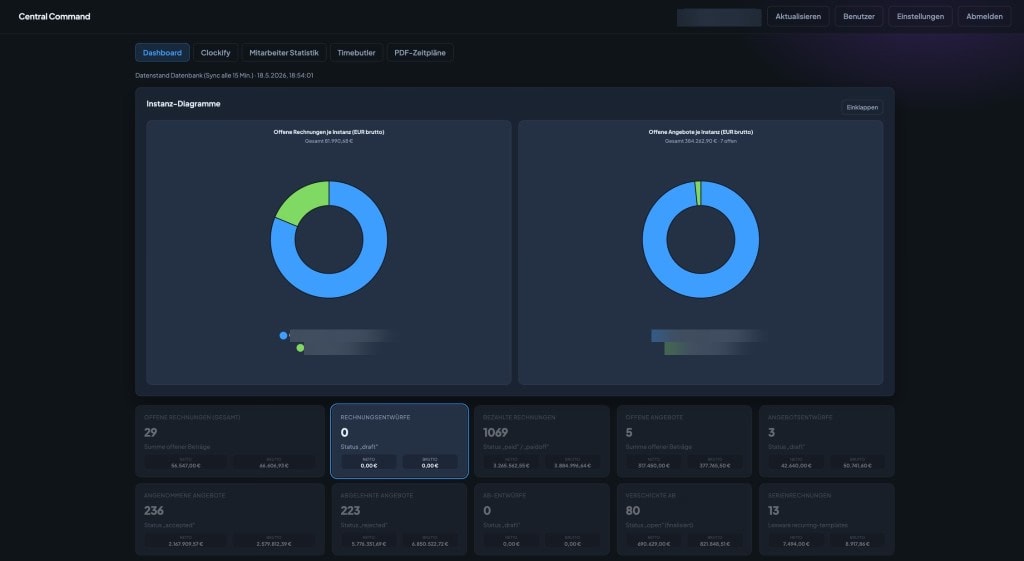
From the field: Central Command – Lexware, Clockify & Timebutler (in-house). All references.

Use our interactive calculator for a first budget indication—free and non-binding.
Thorsten Frieling – Projektmanagement
On the scheduling page, pick a free slot for a 30-minute intro call about Database Business Intelligence – straightforward next steps.
Free & non-binding · 30-minute intro call
Book next available slotRecent articles from our blog that match this service.
Digitization in the middle class: How to measure your success
Digitization is no longer a trend for medium-sized enterprises, but a need to remain competitive. But how to measure the success of Digitalisie...
Digital Transformation: Leadership and Change Management as key to success
Digital transformation is more than just the introduction of new technologies. It is a profound change process that affects companies of all sizes. Especially for small and...
Digital Transformation: The Power of Partnerships and Ecosystems
Digital transformation is no longer an option for small and medium-sized enterprises (SMEs), but a need to remain competitive. But the way to the digital future...