
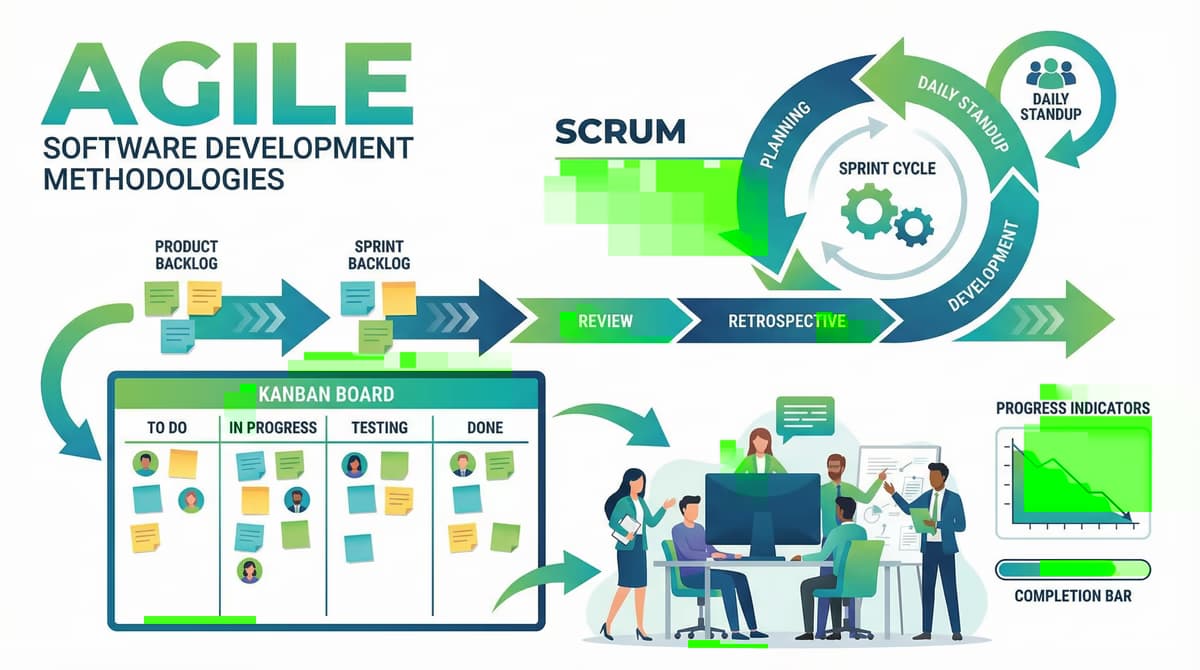
The decision for a development method is one of the most fundamental points in each [software project](/services/software development). It affects communication, planning, flexibility and ultimately the success of the entire project. The two most prominent approaches that are often discussed as counter-poles are the traditional waterfall model and the modern agile methods.
But what method is the right one for your project? In this article we compare the two approaches, illuminate their strengths and weaknesses and give you a clear decision-making aid.
This article is part of our comprehensive guide: The ultimate guide to [software development](/services/software development) 2026.
The waterfall model: The classic approach
The waterfall model is a linear and sequential process. As with a waterfall, the project flows from one phase of the software development life cycle (SDLC) irreversibly to the next. A new phase only begins when the previous one has been completely completed and removed.
- The typical process looks like this: *
Requirements analysis
System design
Implementation
Testing
Provision
Maintenance
Strengths of the waterfall model
clear structure and planability: Due to the solid phases and milestones, schedules and budgets can be calculated well at the start of the project.
Comprehensive documentation: Each phase produces detailed documentation, which facilitates maintenance and transfer of the project.
Discipline: The rigid frame forces a high discipline in the requirement definition and design.
weaknesses of the waterfall model
** Low flexibility:** Changes in requirements during the project are difficult and can be implemented at high cost. The model is not suitable for dynamic environments.
Spätes Feedback: The customer or end user sees the finished product very late in the process. Misinterpretations of the requirements are often discovered only in the test phase.
High risk: If in a late phase it turns out that basic assumptions were wrong, this can endanger the entire project.
**When is the waterfall model suitable? * *
The waterfall model is best suited for projects where the ** requirements are fully known from the outset, clearly defined and stable**. Examples are projects with legal requirements or the development of safety-critical software, in which complete documentation is essential.
Agile Development: Flexibility and Iteration
Agile methods were developed in response to the rigidity of the waterfall model. Instead of a large monolithic plan, Agility sets on short, iterative development cycles, so-called Sprints. Known agile frameworks are Scrum and Kanban.
The core principle: After each sprint (typically 2-4 weeks) w
About the author
Groenewold IT Solutions
Softwareentwicklung & Digitalisierung
Praxiserprobte Einblicke aus Projekten rund um individuelle Softwareentwicklung, Integration, Modernisierung und Betrieb – mit Fokus auf messbare Ergebnisse und nachhaltige Architektur.
Related topics:
Read more
Related articles
These posts might also interest you.
Onshore vs. Offshore: 3 reasons why local development provides better ROI
The hourly rate is only half the truth. We show why onshore development in Germany has its nose at speed, quality and ROI.
18 February 2026
Software developmentCrowdfunding for software projects: A promising alternative?
In the dynamic world of software development, securing financing is often one of the largest obstacles for innovative projects. Traditional ways such as bank loans or venture capital are...
16 February 2026
Software developmentSoftware migration: Why user training is the key to success
> An SEO-optimized blog post about the importance of user training in a software migration.
16 February 2026
Free download
Checklist: 10 questions before software development
What to clarify before investing in custom software – budget, timeline, requirements and more.
Get the checklist in a consultationRelevant next steps
Related services & solutions
Based on this article's topic, these pages are often the most useful next steps.