
Agile [Software development](/services/software development): Scrum, Kanban and Co.
Agile Software development: Scrum, Kanban and Co. simply explained
Flexibility and speed are crucial in the fast-paced world of technology. Rigid, linear development models belong to the past. The future belongs to agile software development. But what is hidden behind Buzzwords like Scrum, Kanban and Sprints? This article demystrates the agile methods and shows how they can help your company develop better software faster.
What is agile software development?
Agile software development is an iterative approach in which requirements and solutions arise through the cooperation of self-organizing, cross-functional teams. Instead of a large "Big Bang" release planned in advance, the software is developed and delivered in small, functional increments. This allows continuous feedback, quick adjustments and high transparency throughout the entire process.
The Agile Manifesto: The four guiding principles
The basis of the agile movement is the "Agile Manifesto" formulated in 2001, which highlights four central values:
Individuals and interactions more than processes and tools
** Functional software** more than comprehensive documentation
Cooperation with the customer more than contract negotiation
React on change more than following a plan
Scrum: The structured sprint
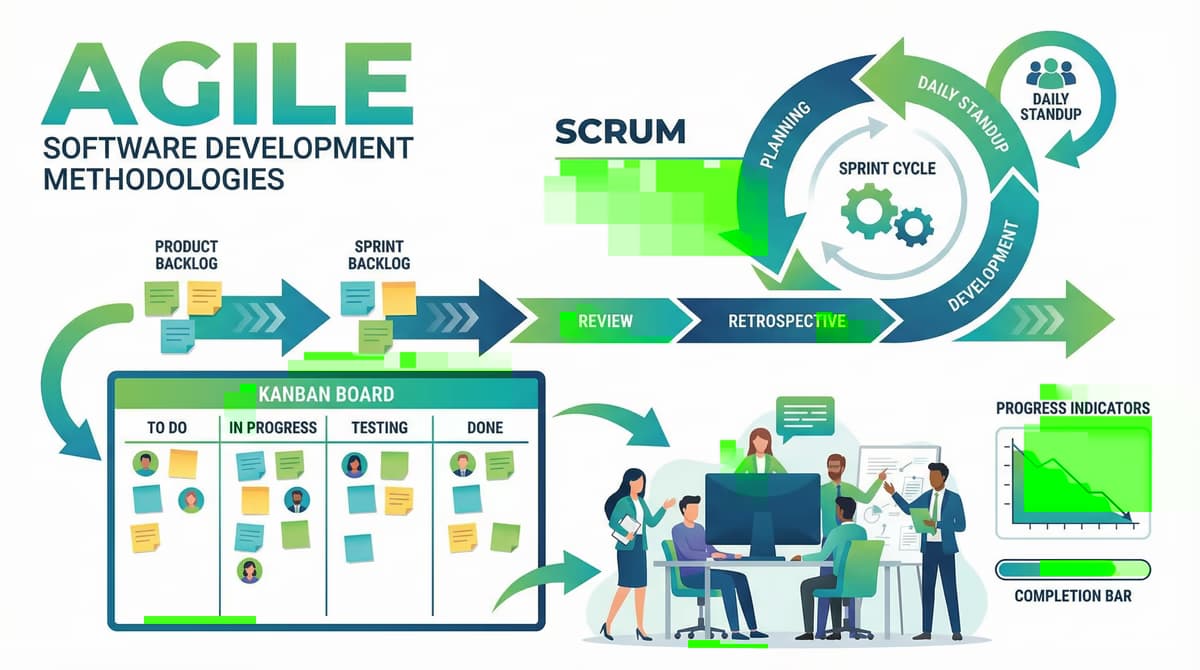
Scrum is the most popular agile framework. It structured the development in fixed periods of time, the so-called Sprints, which usually last 1-4 weeks. Each sprint has a defined target and provides a potentially deliverable software increment.
The roles in Scrum
Product Owner: Represents the interests of the stakeholders and is responsible for the Product Backlog (the Requirement List).
Scrum Master: Make sure the team complies with the Scrum rules and eliminates obstacles.
Development team: A self-organized team of developers responsible for implementing the requirements.
The Scrum events
Sprint Planning: The team plans which tasks will be implemented in the next sprint.
Daily Scrum: A short daily meeting to discuss progress and identify obstacles.
Sprint Review: At the end of the sprint, the result is presented to the stakeholders.
Sprint Retrospective: The team reflects on the past sprint and identifies potential for improvement.
Kanban: The visual workflow
Kanban is another agile method that focuses on visualization of the working flow. With a Kanban board, the entire process is presented transparently from idea to completion. The work is divided into individual tasks (cards) which are divided by different columns
About the author
Groenewold IT Solutions
Softwareentwicklung & Digitalisierung
Praxiserprobte Einblicke aus Projekten rund um individuelle Softwareentwicklung, Integration, Modernisierung und Betrieb – mit Fokus auf messbare Ergebnisse und nachhaltige Architektur.
Related topics:
Read more
Related articles
These posts might also interest you.
Onshore vs. Offshore: 3 reasons why local development provides better ROI
The hourly rate is only half the truth. We show why onshore development in Germany has its nose at speed, quality and ROI.
18 February 2026
Software developmentCrowdfunding for software projects: A promising alternative?
In the dynamic world of software development, securing financing is often one of the largest obstacles for innovative projects. Traditional ways such as bank loans or venture capital are...
16 February 2026
Software developmentAgile vs. Waterfall: What method fits your project?
A detailed comparison between agile methods (Scrum, Kanban) and the traditional waterfall model. Learn the strengths, weaknesses and when which method is best suited.
16 February 2026
Free download
Checklist: 10 questions before software development
What to clarify before investing in custom software – budget, timeline, requirements and more.
Get the checklist in a consultationRelevant next steps
Related services & solutions
Based on this article's topic, these pages are often the most useful next steps.