
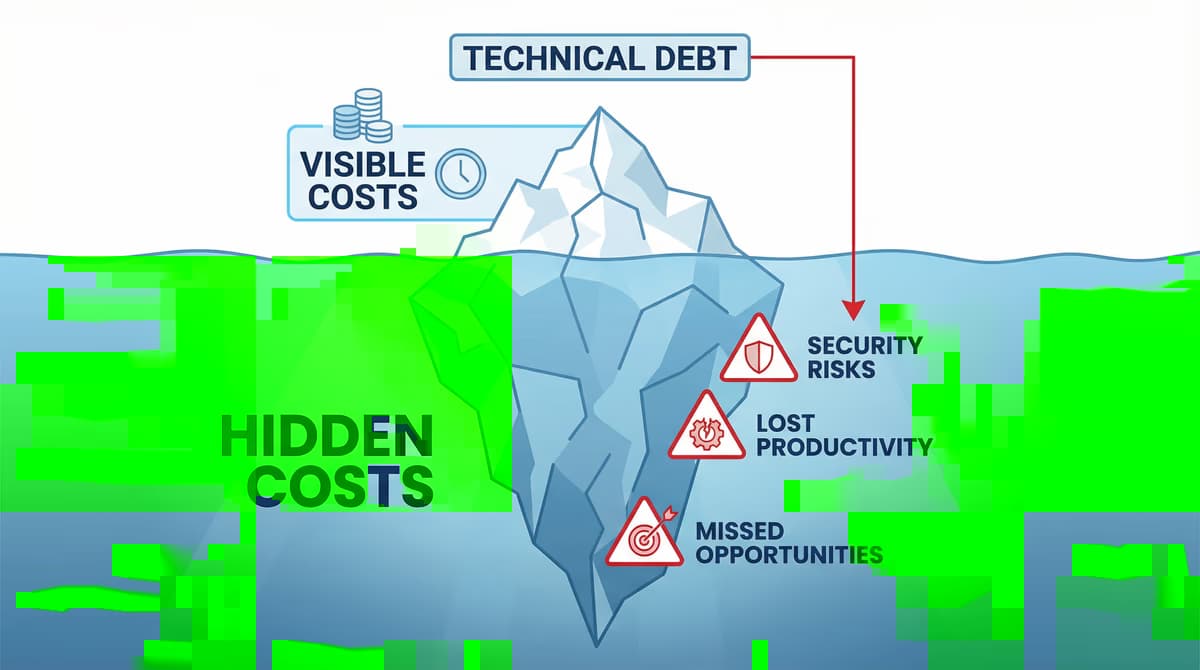
Code reviews: A strong weapon in the fight against technical debt
The term "technical debt" is ubiquitous in [software development](/services/software development). Similar to financial debts, they can accumulate over time and considerably slow down and increase the further development of a project. But there are effective strategies to manage this invisible load and keep the code base healthy. One of the most effective methods is regular code reviews. In this post, we will examine how code reviews help to proactively identify and reduce technical debt.
What are technical debts exactly?
The term of technical debt, coined by Ward Cunningham, describes the implicit costs incurred by reworking on a software, because one has opted for a simple but suboptimal solution instead of choosing a better but more elaborate approach. These "debts" must eventually be "refunded", usually by refactoring the code, which costs additional time and resources. One can imagine it like a loan: one gets an advantage in the short term (faster delivery), but later has to pay interest in the form of increased maintenance, lower stability and slower development.
Types and causes of technical debt
It is roughly differentiated between ** desired** and ** unintended** technical debt. Proven debts are deliberately accepted to comply with a tight deadline, for example, or to receive a fast market feedback for a new feature. However, this decision should be documented and linked to a clear plan for the later elimination. Unintentional debts often arise unn through lack of experience, inadequate communication in the team or lack of standards. The main causes are manifold:
- Time pressure: Fast, often dirty solutions are preferred to keep dates.
- Deficient knowledge: Developers may not know the best practices, design patterns or the subtleties of the programming language used.
- **Old technology:**The technology used is no longer contemporary, is no longer supported and makes maintenance and extension more difficult.
- Selective documentation: Changes are difficult to understand and implement, leading to inconsistent implementations.
- Inadequate tests: Without a solid network of automated tests, refactoring becomes risky, which leads to the necessary improvements being postponed.
Regardless of their origin, technical debts lead to a lower development speed, increased susceptibility to errors and decreasing motivation in the team. It is therefore crucial to establish strategies for technical debt.
The central role of code reviews
Code reviews are a systematic process, be
About the author
Groenewold IT Solutions
Softwareentwicklung & Digitalisierung
Praxiserprobte Einblicke aus Projekten rund um individuelle Softwareentwicklung, Integration, Modernisierung und Betrieb – mit Fokus auf messbare Ergebnisse und nachhaltige Architektur.
Related topics:
Read more
Related articles
These posts might also interest you.
Onshore vs. Offshore: 3 reasons why local development provides better ROI
The hourly rate is only half the truth. We show why onshore development in Germany has its nose at speed, quality and ROI.
18 February 2026
Software developmentCrowdfunding for software projects: A promising alternative?
In the dynamic world of software development, securing financing is often one of the largest obstacles for innovative projects. Traditional ways such as bank loans or venture capital are...
16 February 2026
Software developmentAgile vs. Waterfall: What method fits your project?
A detailed comparison between agile methods (Scrum, Kanban) and the traditional waterfall model. Learn the strengths, weaknesses and when which method is best suited.
16 February 2026
Free download
Checklist: 10 questions before software development
What to clarify before investing in custom software – budget, timeline, requirements and more.
Get the checklist in a consultationRelevant next steps
Related services & solutions
Based on this article's topic, these pages are often the most useful next steps.