
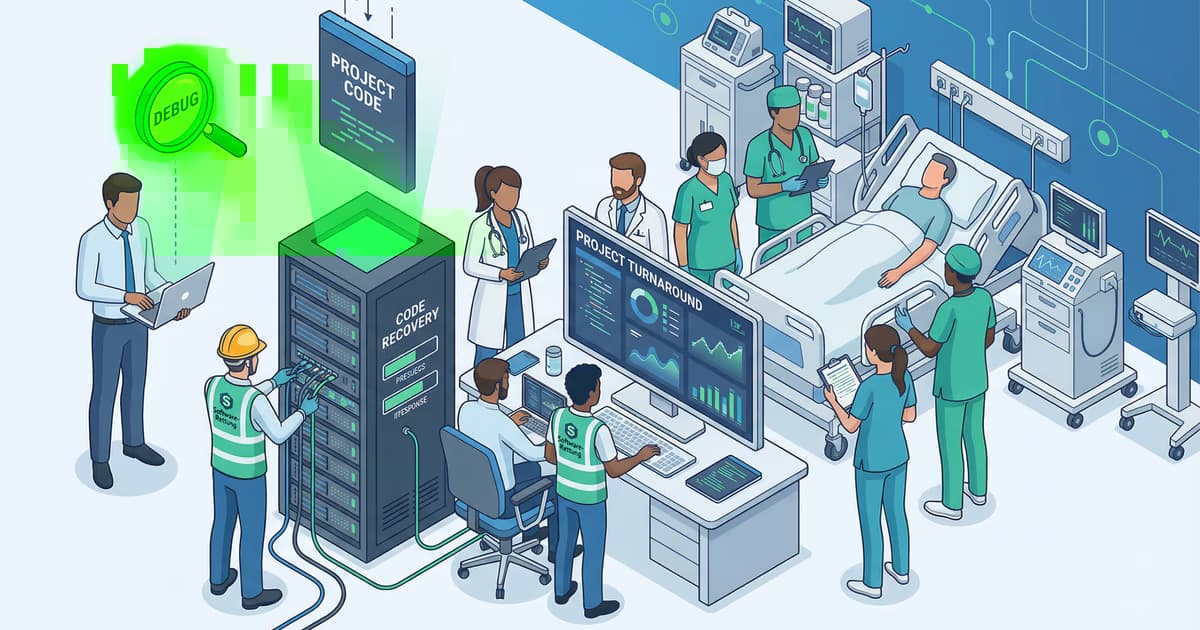
The financial world is an ecosystem based on confidence, precision and above all on functional technology. Banks and financial service providers manage billions of transactions, sensitive customer data and must meet the strictest regulatory requirements. In this high-risk environment, the IT infrastructure is not only a supporting tool, but the Heartpiece of the entire business operation. But what happens when this heartpiece gets stuck? If historically grown, complex software systems – the so-called Legacy systems – reach their limits, become inefficient or even fail? The answer is often the Software-Rettung, a specialized IT-performance that is launched in the financial industry for the invisible life insurance for the core business.
This detailed article highlights why software maintenance for financial services and banks is not only an option but a strategic necessity. We describe the specific challenges of the industry, the decisive advantages of professional refurbishment and present specific applications that make up the difference between stagnation and future-proof competitiveness.
The critical challenge: Why financial IT calls for salvation (H2)
The IT landscape in banks is often a patchwork of systems developed and linked for decades. These Legacy systems are functional, but they bring a number of problems that can be existential in the modern digital financial market.
1. Regulatory pressure and compliance traps (H3)
The financial sector is subject to constant changes in regulations. Laws such as MiFID II, PSD2, GDPR and DORA (Digital Operational Resilience Act) in the EU place enormous demands on IT systems. Outdated software is often not flexible enough to implement these changes quickly and cost-effectively.
** Problem:** Manual adjustments are error-prone and time-consuming.
**Risk:**High fines, damage to reputation and loss of operating licences.
2. Vulnerabilities and Cyber threats (H3)
Banks are the primary goal of cyber attacks. Legacy software, which is no longer actively maintained or based on outdated programming languages, offers attackers a larger attack area. The digital resilience (Operational Resilience) is directly linked to the state of the software.
** Problem:** Outdated security mechanisms and missing patches.
Risk: Data leaks, financial losses due to fraud and massive loss of confidence among customers.
3. Inefficiency and high operating costs (H3)
Maintenance and operation of old systems are often extremely expensive. Specialized staff for outdated programming languages (e.g. COBOL) is rare and expensive. Slowly prevent
About the author
Groenewold IT Solutions
Softwareentwicklung & Digitalisierung
Praxiserprobte Einblicke aus Projekten rund um individuelle Softwareentwicklung, Integration, Modernisierung und Betrieb – mit Fokus auf messbare Ergebnisse und nachhaltige Architektur.
Related topics:
Read more
Related articles
These posts might also interest you.
App Development for Crafts & Services: The Turbo for your Digitalization
Digitization is no longer an abstract topic of the future, but a handful of necessity that does not stop traditional industries such as crafts and services. In a world where the smartphone is a...
16 February 2026
Software maintenanceAgile software maintenance: How Scrum & Kanban improves your processes
Agile methods can revolutionize software maintenance. Learn how Scrum and Kanban make your processes more flexible and transparent.
16 February 2026
Software maintenanceCode review: Detecting quality problems early
Learn how code reviews reveal quality problems early. Best practices, checklists and tools for effective code reviews.
14 February 2026
Free download
Checklist: 10 questions before software development
What to clarify before investing in custom software – budget, timeline, requirements and more.
Get the checklist in a consultationRelevant next steps
Related services & solutions
Based on this article's topic, these pages are often the most useful next steps.