
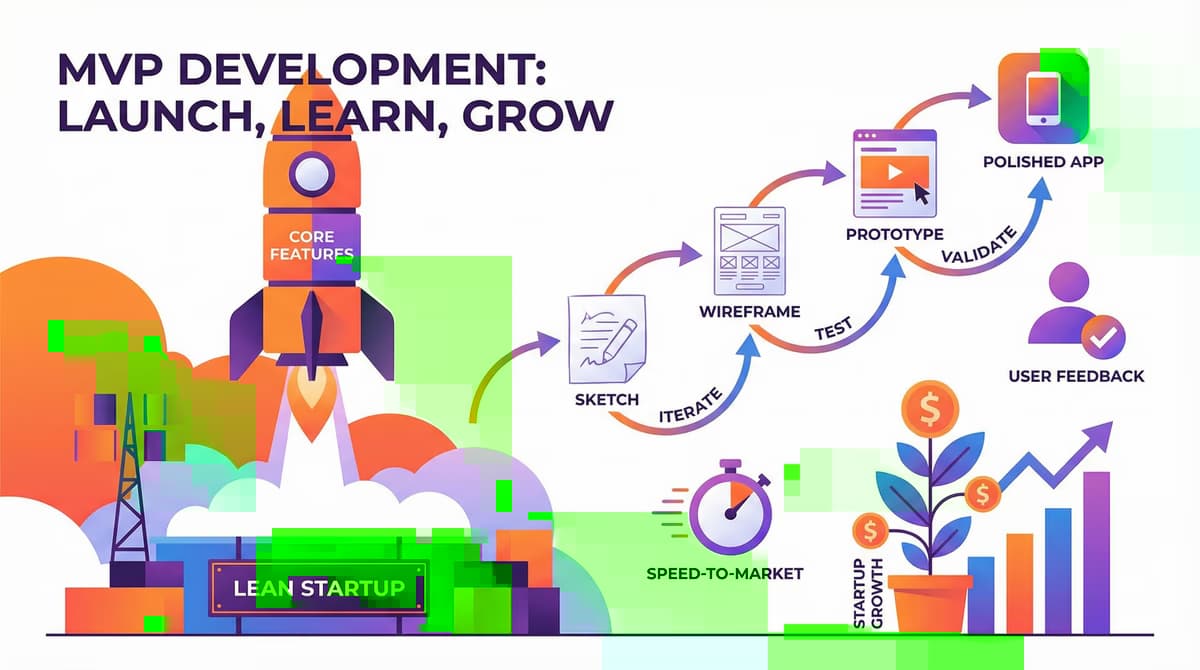
A comprehensive guide on MVP development. Learn all about agile methods, MVP, Cloud, AI, legacy systems, DevOps and digital transformation.
> Key Takeaway: A Minimum Viable Product (MVP) tests the core hypothesis of a product with minimal effort in the real market. Development includes: validate the problem, define a single core feature, develop in 6–12 weeks, test with real users, and iterate based on feedback. This helps startups avoid costly misdevelopment.
MVP Development: Startups bring their idea to the market quickly
MVP Development: Startups bring their idea to the market quickly
The path from a brilliant idea to a successful digital product is long and full of risks. Many startups fail because they invest years and untotals in the development of a perfect product, only to determine that the market does not need it. The solution? Minimum Viable Product (MVP). This guide explains the MVP approach and shows how startups can quickly validate their vision and bring it to the market with minimal risk.
What is a minimum Viable Product (MVP)?
A minimum Viable Product is a version of a new product created with minimal effort to enable maximum validated learning across customers. It is not about publishing an unfinished or inferior product. A MVP must be "viable" (viable), i.e. it must solve the core problem of the target group and provide a first real added value. It contains only the absolutely necessary core functions to test the basic product idea on the market.
The advantages of the MVP approach
Finish market launch: You can market your product in weeks or a few months instead of years.
Risk minimisation: You avoid high investment in a product that may not be in demand.
Frühes User Feedback: You collect valuable feedback from real users who enter the development.
Validation of business idea: They test your basic assumptions about the market and the target group.
Investoren convince: A successful MVP is the best proof that your idea has potential.
The MVP[development process](/performance/software development) in 4 steps
Market research and definition of core function: What is the most pressing problem of your target group? Which one function does your product need to have to solve this problem? Focus on the absolute minimum.
Priorization of features (e.g. MoSCoW method):
Must-have: Unavoidable functions for the core product.
Should-have: Important but not critical functions.
Could-have: Useful but not necessary functions.
Won't-have: Functions not taken into account for the MVP.
Develop and Launch: Develop the MVP with the defined "must-have" functions. An experienced Software agency can help develop quickly and efficiently.
Measure Learning, Iterating (Build-Measure-Learn): After the launch, the most important part begins: Measure user behavior, collect feedback and use the insights to improve and expand the product in iterative cycles.
Frequent errors in MVP development
- Too many functions: The "M" in MVP stands for "Minimum". Resistance
About the author

Managing Director & Founder
For over 15 years Björn Groenewold has been developing software solutions for the mid-market. As founder of Groenewold IT Solutions he has successfully supported more than 250 projects – from legacy modernisation to AI integration.
Read more
Related articles
These posts might also interest you.
Onshore vs. Offshore: 3 reasons why local development provides better ROI
The hourly rate is only half the truth. We show why onshore development in…
Crowdfunding for software projects: A promising alternative?
In the dynamic world of software development, securing financing is often one…
Software migration: Why user training is the key to success
Introducing new software is a crucial step for companies. A software migration…
Free download
Checklist: 10 questions before software development
Key points before you start: budget, timeline, and requirements.
Get the checklist in a consultationRelevant next steps
Related services & solutions
Based on this article's topic, these pages are often the most useful next steps.