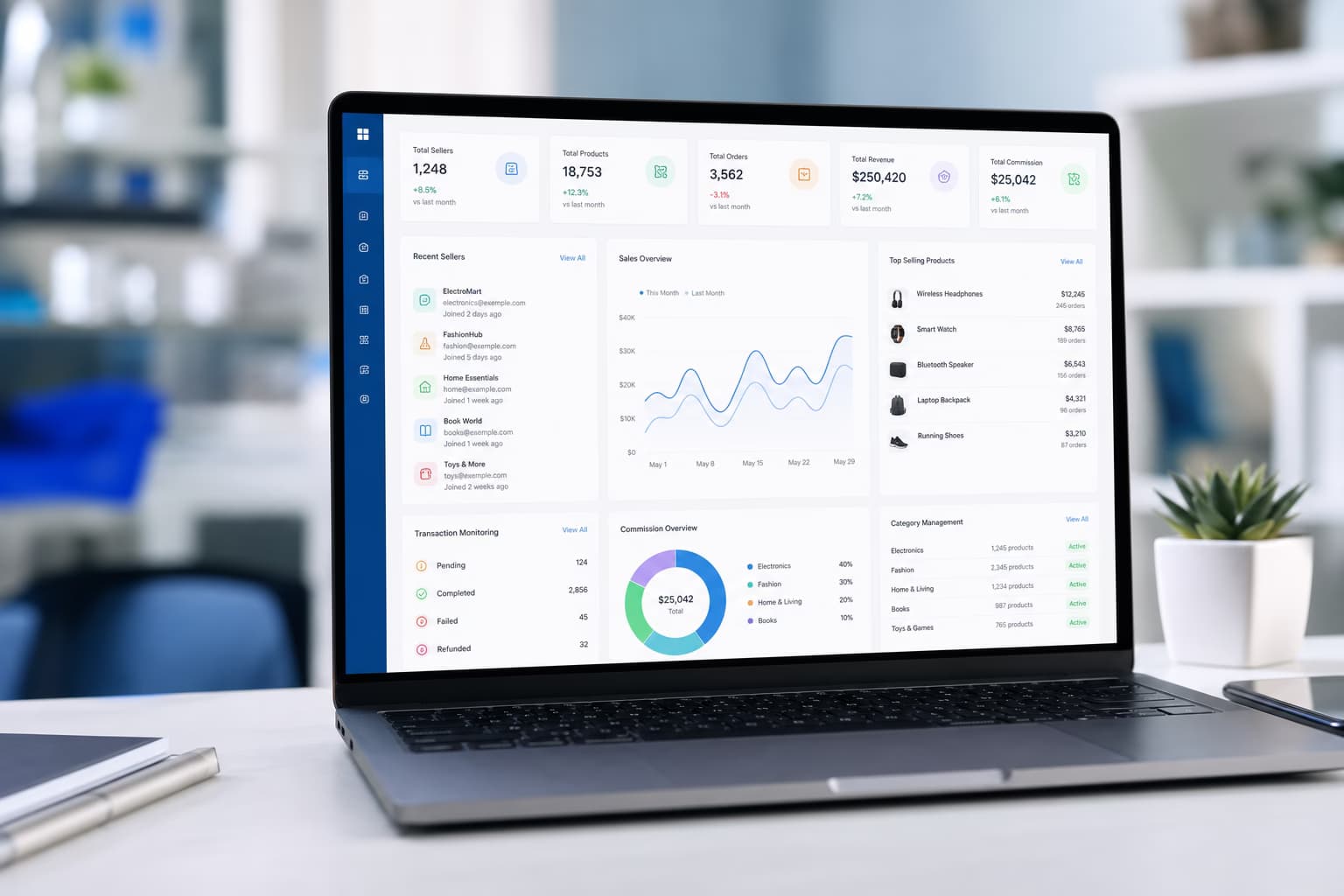
Marketplace Platform Development

Multi-vendor marketplace with vendor management, split payment, and review system.

Marketplace Platform Development

Marketplace Platform Development

Why Build Your Own Marketplace Platform?

Amazon, eBay, Etsy – marketplaces dominate e-commerce. They benefit from the network effect: more sellers bring more variety, more variety attracts more buyers, more buyers attract more sellers. But you don't have to sell on third-party platforms or send your merchants there.

With your own marketplace platform, you control the customer experience, the data, and the terms. You set the rules, you retain the customer relationship, and you earn from every transaction – without giving 15% to Amazon.

We develop multi-vendor marketplaces for various business models: B2B procurement platforms for industrial products, niche marketplaces for specialized audiences, service marketplaces for freelancers, or regional platforms for local commerce. With vendor self-service, automated commission billing, and review system – all tailored to your specific business model.

Platform Features

Multi-Vendor System

Multiple sellers with their own shops, products, dashboards, and individual branding options.

Vendor Onboarding

Self-registration, verification (KYC), individual terms, automated contract processing.

Split Payment

Automatic distribution: seller share, your commission, taxes – with Stripe Connect or PayPal.

Review System

Product and seller reviews, verified purchases, moderation of fake reviews.

Moderation

Product approval, dispute management, fraud detection, quality control.

Platform Analytics

GMV, take rate, top sellers, conversion, retention – all key metrics for your platform business.

Logistics Integration

Fulfillment by Marketplace, shipping label generation, tracking, returns management.

Search & Filter System

Faceted search, categories, attributes, sorting – optimized for thousands of products.

Marketplace Types

Product Marketplace

Physical products from multiple retailers – like Amazon Marketplace or Etsy.

Service Marketplace

Connecting service providers – like Fiverr, Upwork, or TaskRabbit.

B2B Procurement

Industrial products, MRO, components – like Amazon Business or Thomasnet.

Niche Marketplace

Specialized in a specific industry or product category – often higher margins.

Monetization Models

Commission Model

Percentage fee per sale (typically 10-20%). You earn when sellers sell.

Listing Fees

Fixed price per listed product. Generates revenue regardless of sales success.

Subscription Model

Monthly fee for sellers (e.g. $29/month). Predictable, recurring revenue.

Hybrid

Combination of base fee and reduced commission. Balances risk and revenue.

Our Approach

Marketplaces are complex projects. We recommend an MVP approach: start lean, learn fast.

1

Business Model

Define marketplace type, monetization, target audiences, and differentiation.

2

MVP Scope

Identify core features for launch – start lean, learn fast.

3

Development

Build the platform, integrate payment, onboard first vendors.

4

Launch & Growth

Go-to-market, vendor acquisition, buyer marketing, iterative improvement.

Advantages of Custom Development

No ongoing revenue share to SaaS providers
Full control over platform and data
Custom business logic and commission models
Unlimited vendors and products at no additional cost
Integration into your existing infrastructure
Scalable for millions of transactions

What Does a Marketplace Platform Cost?

Marketplaces are complex projects – but with an MVP approach you can launch quickly.

  • MVP Marketplace: €50,000 – €100,000 plus VAT – vendor portal, product catalog, checkout, simple payout
  • Full Platform: €100,000 – €250,000 plus VAT – reviews, moderation, analytics, mobile
  • Enterprise: €250,000+ plus VAT – B2B features, fulfillment, internationalization, AI search

MVP Approach Recommended

Start with an MVP for €50,000–80,000: core features, 10-20 vendors, real transactions. Learn what vendors and buyers actually need. Then expand iteratively. This is more cost-effective and efficient than a big-bang launch.

Important: The Chicken-and-Egg Problem

The biggest challenge with marketplaces isn't the technology, but the chicken-and-egg problem: vendors want buyers, buyers want selection. We also advise you on your go-to-market strategy.

Build your own marketplace or use an existing platform?

Compare platform commissions with the investment in a custom marketplace solution.

Calculate ROI

Frequently Asked Questions

How does the payment processing work?

We use Stripe Connect or PayPal Commerce Platform for split payments. The buyer pays, Stripe automatically splits: vendor share, your commission, and applicable taxes. Payouts to vendors occur automatically based on defined rules.

How are vendors verified?

Depending on requirements: from simple email verification through business registration checks to full KYC (Know Your Customer) with identity verification. Stripe and PayPal handle KYC compliance for payments.

Which technology do you recommend?

For most marketplaces: React/Next.js frontend, Node.js or Python backend, PostgreSQL database, Elasticsearch for search. For very high volume, potentially microservices. No Shopify/WooCommerce base – they're not built for that.

Discuss Your Marketplace Idea

Let's talk about your platform vision – free and without obligation. We'll help you find the right business model and optimal MVP scope.

Faster Clarity

Let's sort out scope, risks, and quick wins.

Ideal when you need to make decisions fast – without months of groundwork.

30 min strategy call – 100% free & non-binding

Marketplace Platform Development | Multi-Vendor Marketplace