Accessibility in the Web: Why Accessibility 2026 is mandatory
Accessibility is no longer a 'Nice-to-have'. With the European Accessibility Act (EAA), it becomes a legal obligation. We show how to make your website accessible to everyone.

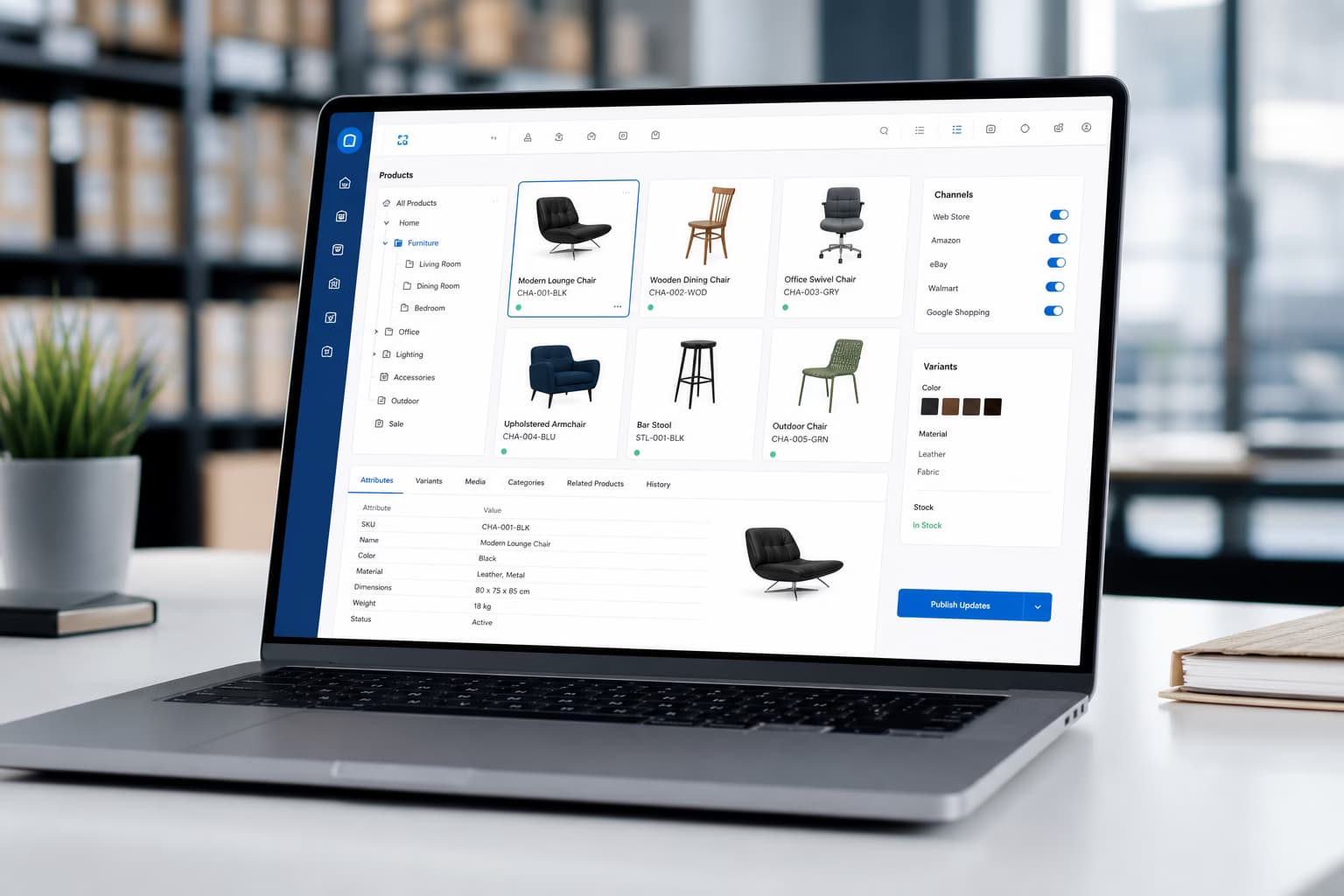
Interactive product catalog with 3D visualization, configurator, and AR preview.
Digital Product Catalog with 3D
PDFs and static images no longer sell. Customers expect interactive product experiences – they want to rotate, zoom, configure, and see the product in their own space. A digital product catalog with 3D visualization increases the conversion rate by up to 40% and significantly reduces returns, because customers know what they're getting.
Especially for complex products like furniture, machinery, building products, or configurable items, 3D is a game-changer. Instead of elaborate showroom visits or endless catalogs, customers can explore, configure, and purchase on their own – 24/7, from anywhere.
We develop product catalogs with 3D configurators that seamlessly integrate into your web shop and PIM system. With Augmented Reality, customers can see the sofa in their own living room or place the machine in the production hall – directly in the browser, without app installation. The configuration data can be passed directly to your production – from click to order.
“PIM starts with canonical product IDs—variants without SKU discipline are the fastest path to wrong stock.”
Thorsten Frieling, Senior Developer & Project Manager, Groenewold IT Solutions
360° views, zoom, rotate, exploded views – experience products interactively instead of just viewing images.
Colors, sizes, materials, options – customers configure their product themselves and see the result live.
Place products in your own space via Augmented Reality – on iPhone, iPad, and Android without an app.
Faceted search with filters for technical attributes, dimensions, materials, price ranges.
Manage thousands of variants efficiently: color/size matrix, dependent options, exclusions.
Import product data from SAP, Akeneo, Pimcore, or your own PIM – automatic synchronization.
Interactive points on the 3D model for feature explanations, technical details, cross-selling.
Seamlessly transfer configuration to Shopify, Magento, WooCommerce, or your custom shop.
Sofa in 50 fabrics, cabinet in 3 sizes, custom kitchen – all configurable in 3D.
Present complex systems, machines, and components interactively, explain technical details.
Clothing with color variants, personalization (embroidery, print), virtual try-on.
Visualize wheels on your own car, configure tuning parts, plan accessories.
Premium products in detailed view, engraving preview, material and stone selection.
Windows, doors, facades – enter dimensions, choose options, calculate price.
A 3D catalog is more than technology – it's about product experience and data flow.
Capture product portfolio, variants, configuration logic, and data sources.
Clarify 3D model creation or procurement, quality levels, performance requirements.
Build catalog, implement configurator, integrate PIM/shop.
Import product data, test, optimize, train sales and customers.
We rely on proven, performant technologies for 3D on the web.
Powerful WebGL library for 3D graphics in the browser – well documented, large community.
Google component for 3D models and AR – easy to integrate, good mobile performance.
Microsoft framework for complex 3D scenes – great for product configurators with many options.
Standard format for 3D models on the web – compact, fast, supported by all viewers.
Costs depend on product quantity, configuration complexity, and 3D model creation.
3D model creation should be considered separately. Options: convert CAD data (if available), scan products (photogrammetry), or have models created by 3D artists. Cost: €200–2,000 per product, depending on complexity. We're happy to connect you with specialized partners.
With a 10% higher conversion rate and 1,000 visitors/month with an average cart value of €100, you gain 10 additional sales = €1,000/month = €12,000/year. A project in the calculator range pays for itself in just over 3 years – conservatively estimated.
Is a digital product catalog worth it?
Calculate the ROI: higher conversion and fewer returns vs. development investment.
Let's talk about your products – free and without obligation. We'll show you how a 3D catalog can boost your conversion.
FAQ
The product configurator cost calculator gives EUR 10,710 – 236,964 excl.
VAT as its non-binding overall range. Search, filters, configuration rules, 3D or AR and PIM or ERP integration determine the concrete result; we scope these drivers in a short workshop.
Yes.
We connect to PIM, ERP and shop systems so product data stays in sync and the catalog always shows current prices and availability.
Yes.
We implement 3D visualisation and AR previews so complex products can be explored interactively on web and mobile.
We build configurators for complex products (e.g.
variants, options, rules) so customers can configure and request quotes or orders from the catalog.

Often from CAD data (STEP, IGES), which we optimise for the web.
Alternatively: photogrammetry (scanning), 3D modelling by artists or purchasing stock models as a base. We advise on what makes the most sense for your product range.
With optimised models (LOD, compression), WebGL and modern caching, 3D models load in 1–3 seconds.
AR works natively on current iOS and Android devices without an app.
Yes, based on selected options, materials, dimensions and quantities.
Price logic can be arbitrarily complex—tiered pricing, discounts, surcharges. Integration with ERP for real-time pricing is possible.
Four checks: the source, attributes, channels and approval.
1. Name the source
One system leads item and price. The others read.
2. Limit attributes
Required fields per product group. One field for everything does not make items comparable.
3. Choose channels
Shop, marketplace or print. Each channel gets a derivation, not its own maintenance.
4. Set approval
Who publishes an item and who blocks a variant.
A product catalogue gets expensive when attributes, variants and channels do not share one item number. Approval for product catalogue should therefore depend on a measurable baseline, an accountable business owner, and a clear target. The HowTo block on this page describes delivery; this section is only for the project decision.
Browse all solutions by use case, industry, and application type. For our service portfolio, see Services; for in-depth topic articles, see Topics.
Key terms are explained in our IT Glossary. For a non-binding discussion about product catalogue or a proposal, please contact us.
Articles that complement this solution.

Accessibility in the Web: Why Accessibility 2026 is mandatory
Accessibility is no longer a 'Nice-to-have'. With the European Accessibility Act (EAA), it becomes a legal obligation. We show how to make your website accessible to everyone.

AI in web development: curse or blessing?
Are web developers replaced by AI? Or are we going to be super-codern? A realistic assessment of the role of ChatGPT, Copilot and Co. in 2026.

Career as a web developer: From Junior to CTO
How does the career path of a developer look? What skills do you need for the ascent? And how do you negotiate your salary? A guide for your ascent.