
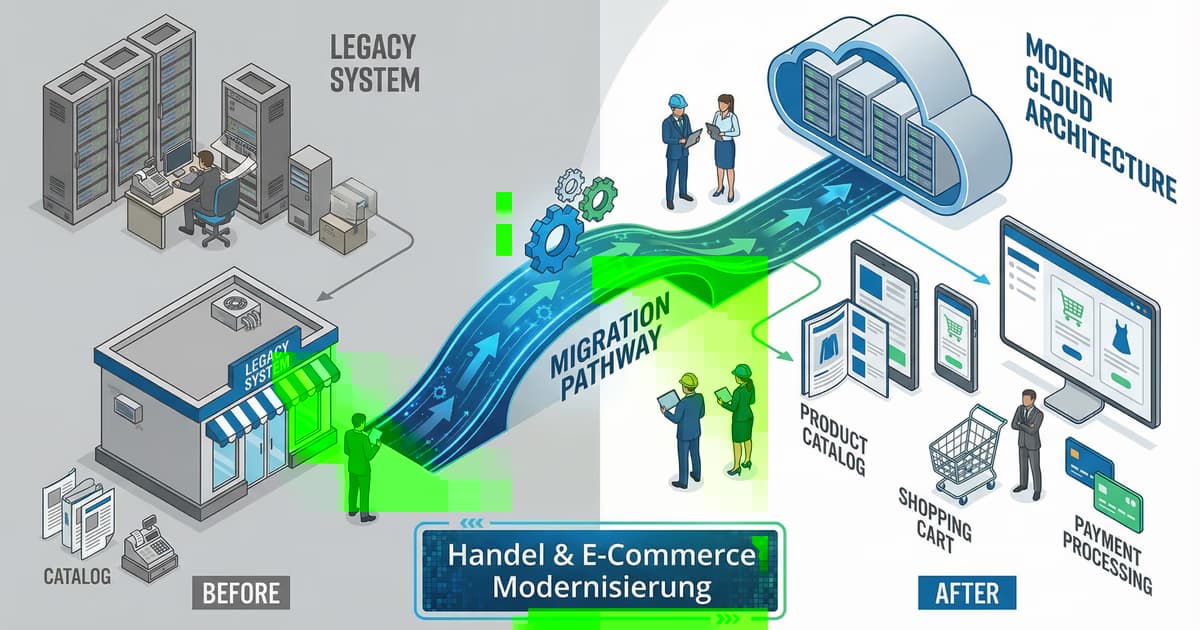
The energy and supply industry (EVU) is at a historic turning point. The Energiewende, driven by political requirements, technological progress and changing customer requirements, requires unprecedented agility and innovative capability. But this transformation is often slowed down by an invisible but powerful brake: Legacy systems. These old systems, which have been the backbone of supply companies for decades, are more than ever an obstacle to the necessary digital evolution. The Legacy Moderation is therefore not only an option but a strategic necessity to ensure the future viability and competitiveness in a rapidly changing market.
In this comprehensive guide, we examine why the dissolution or modernization of these outdated IT infrastructures is crucial for energy suppliers and city works, which concrete advantages it offers and which applications release the greatest potential.
The challenge: Why legacy systems in the energy industry become a risk
Legacy systems are usually monolithic applications written in outdated programming languages (such as COBOL or PL/I) and run on no longer contemporary hardware or operating system platforms. In the context of energy and water supply, these systems lead to specific and critical problems.
High operating costs and inefficiency
The ** maintenance of Legacy-IT** is extremely costly. The Total Cost of Ownership (TCO) is steadily increasing as spare parts for the hardware are difficult to find and the licenses for the old systems are often expensive. Added to this is the effort for manual troubleshooting and the complexity of the interfaces to modern systems. This inefficient IT infrastructure binds capital that is urgently needed for innovation.
Lack of scalability and flexibility
The dynamics of the energy market require rapid adjustments. New business models, such as decentralised production, Smart Metering and the integration of renewable energies, place enormous demands on IT. Legacy systems, however, are often not designed for processing large amounts of data (big data) or rapid scaling. You can hardly or not support new regulatory requirements or the connection to modern cloud platforms, which massively impedes the digital transformation in the EVU.
Regulatory complexity and compliance
The energy industry is one of the most regulated industries. Changes in laws and regulations, such as the MaBiS requirements (market communication for accounting and accounting purposes) or the requirements of the ** Act on the digitization of the energy transition**, often require profound adjustments to the core systems. In legacy systems, these adjustments are time-consuming, fe
About the author
Groenewold IT Solutions
Softwareentwicklung & Digitalisierung
Praxiserprobte Einblicke aus Projekten rund um individuelle Softwareentwicklung, Integration, Modernisierung und Betrieb – mit Fokus auf messbare Ergebnisse und nachhaltige Architektur.
Related topics:
Read more
Related articles
These posts might also interest you.
Legacy Systems in the Financial Sector: Compliance and Security
Learn why legacy systems for banks and insurance companies are a ticking time bomb and how secure and compliant modernization can be achieved.
9 February 2026
LegacymodernizationLegacy-Modernization: How to make old systems fit for the future
Legacy systems are often the backbone of a company – but also a growing risk. Outdated technologies, lack of documentation and dependency on special knowledge make maintenance expensive and further development difficult. This Gui...
30 January 2026
LegacymodernizationThe Future of Money: How App Development Revolutionizes Financial Services and Banks
The financial world is undergoing profound change. Driven by technological innovations and changed customer expectations, **App development has played a central role in financial services & banks**. What once...
28 January 2026
Free download
Checklist: 10 questions before software development
What to clarify before investing in custom software – budget, timeline, requirements and more.
Get the checklist in a consultationRelevant next steps
Related services & solutions
Based on this article's topic, these pages are often the most useful next steps.