
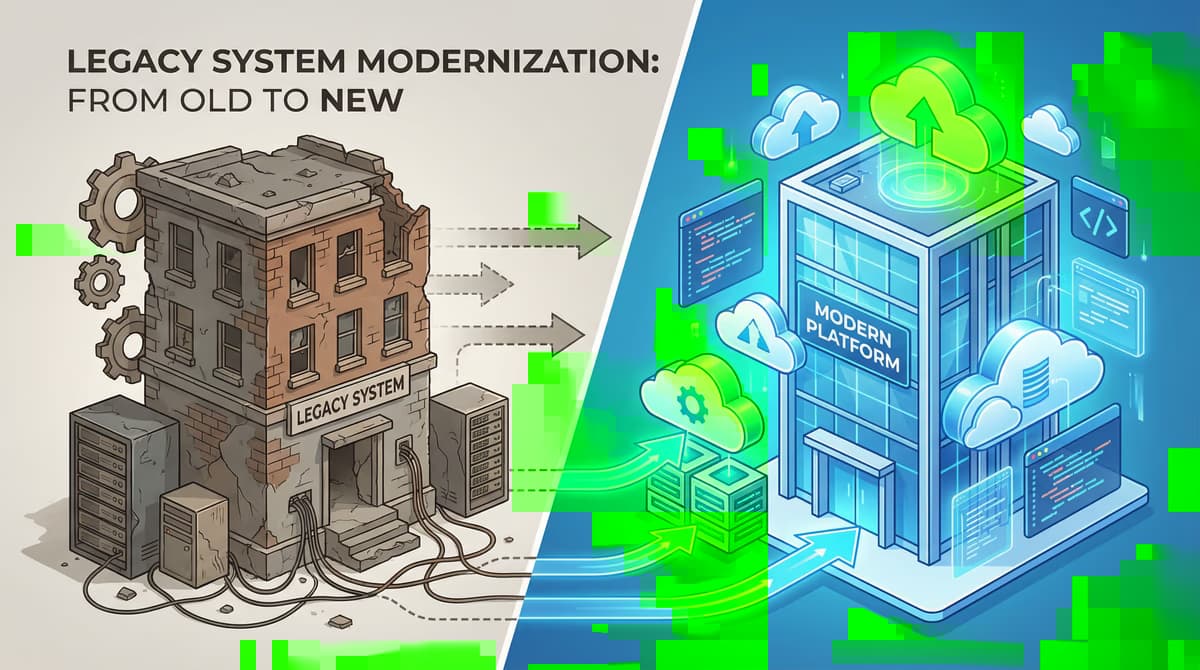
Software Migration: How to minimize downtime for a smooth transition
*February 2026 *
A Software migration is a necessary step for many companies to remain competitive, increase efficiency and benefit from modern technologies. But the fear of long downtimes and the associated business losses many decision-makers hold back. However, a carefully planned and carried out migration can reduce downtime to an absolute minimum. In this post, you will learn which strategies and methods have proven themselves in practice to implement a Software migration successfully and with minimal interruptions.
The challenge: Downtime in software migration
Every minute your systems are not available, costs money and can impair your customers' confidence. With a software migration a certain amount of downtime is often unavoidable, but the goal must be to keep it as short as possible. The complexity of modern IT landscapes, dependencies between different systems and large amounts of data are just a few of the challenges it needs to tackle.
Typical causes for long downtime
- **An inadequate analysis of existing systems and dependencies often leads to unforeseen problems during migration.
- "Big Bang" approach: The attempt to migrate all systems and data at once involves a high risk and often leads to long downtimes in case of problems.
- Short tests: Unreasonable tests before the actual migration can cause errors to be discovered only in live mode.
- Data loss or inconsistency: Data transmission errors can lead to inconsistencies, the correction of which is time-consuming.
Strategies for minimizing downtime
A successful Software migration with minimal downtime requires a combination of strategic planning, the right tools and a step-by-step approach. Below we present the most proven methods.
1. Detailed planning and analysis
The foundation for successful migration is already laid in the planning phase. A comprehensive analysis of your existing IT infrastructure is essential to identify all dependencies between applications, databases and system components. Create a detailed roadmap that maps the entire migration process, including schedule, responsibilities and milestones.
Choosing the Right Migration Strategy
Instead of a risky "big-bang" approach, the ** incremental migration** has proven to be significantly more risky and efficient. In this method, systems and data are gradually migrated, allowing better control and lower risk of failure. A parallel operation of old and new system during
About the author
Groenewold IT Solutions
Softwareentwicklung & Digitalisierung
Praxiserprobte Einblicke aus Projekten rund um individuelle Softwareentwicklung, Integration, Modernisierung und Betrieb – mit Fokus auf messbare Ergebnisse und nachhaltige Architektur.
Related topics:
Read more
Related articles
These posts might also interest you.
Onshore vs. Offshore: 3 reasons why local development provides better ROI
The hourly rate is only half the truth. We show why onshore development in Germany has its nose at speed, quality and ROI.
18 February 2026
Software developmentCrowdfunding for software projects: A promising alternative?
In the dynamic world of software development, securing financing is often one of the largest obstacles for innovative projects. Traditional ways such as bank loans or venture capital are...
16 February 2026
Software developmentAgile vs. Waterfall: What method fits your project?
A detailed comparison between agile methods (Scrum, Kanban) and the traditional waterfall model. Learn the strengths, weaknesses and when which method is best suited.
16 February 2026
Free download
Checklist: 10 questions before software development
What to clarify before investing in custom software – budget, timeline, requirements and more.
Get the checklist in a consultationRelevant next steps
Related services & solutions
Based on this article's topic, these pages are often the most useful next steps.