As of: 19 June 2026 · Reading time: 4 min
Key takeaways
- The term "technical debt" is ubiquitous in software development.
- Similar to financial debt, they can accumulate over time and develop a project...
The term "technical debt" is ubiquitous in software development. Similar to financial debt, they can accumulate over time and develop a project...
“Good software is not an accident—it comes from a structured development process with clear quality standards.”
– Björn Groenewold, Managing Director, Groenewold IT Solutions
Code reviews are the most effective weapon against technical debt: they catch quality issues before merge, promote uniform coding standards, and prevent shortcuts from becoming long-term architectural problems.
Automated linting tools complement the human review process.
Code reviews: A strong weapon in the fight against technical debt
The term "technical debt" is ubiquitous in software development. Similar to financial debts, they can accumulate over time and considerably slow down and increase the further development of a project. But there are effective strategies to manage this invisible load and keep the code base healthy. One of the most effective methods is regular code reviews. In this post, we will examine how code reviews help to proactively identify and reduce technical debt.
What are technical debts exactly?
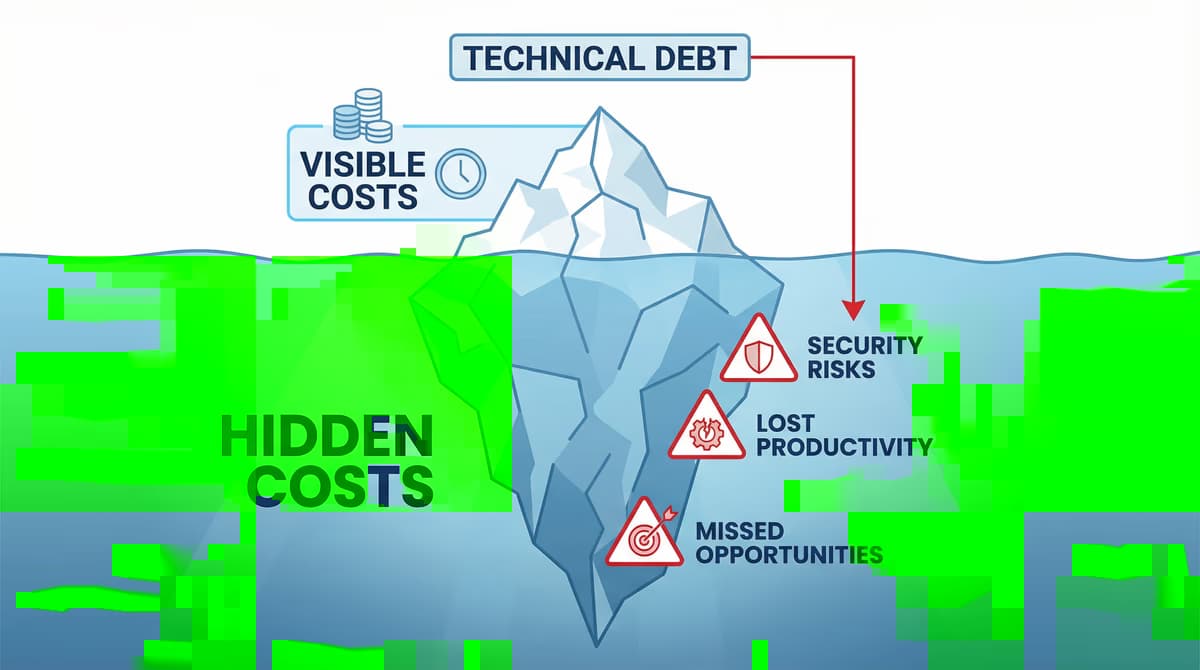
The term of technical debt, coined by Ward Cunningham, describes the implicit costs incurred by reworking on a software, because one has opted for a simple but suboptimal solution instead of choosing a better but more elaborate approach.
These "debts" must eventually be "refunded", usually by refactoring the code, which costs additional time and resources.
One can imagine it like a loan: one gets an advantage in the short term (faster delivery), but later has to pay interest in the form of increased maintenance, lower stability and slower development.
Types and causes of technical debt
Short: Executive answer: The term "technical debt" is ubiquitous in software development.
Executive answer: The term "technical debt" is ubiquitous in software development.
Decision-makers exploring Code reviews: A strong weapon in the fight against technical debt can use AI & Machine Learning, Cost Calculator: AI Development, Solution: Legacy Reduction sowie Legacy Modernisation as structured entry points.
It is roughly differentiated between ** desired** and ** unintended** technical debt.
Proven debts are deliberately accepted to comply with a tight deadline, for example, or to receive a fast market feedback for a new feature.
However, this decision should be documented and linked to a clear plan for the later elimination.
Unintentional debts often arise unn through lack of experience, inadequate communication in the team or lack of standards. The main causes are manifold:
- Time pressure: Fast, often dirty solutions are preferred to keep dates.
- Deficient knowledge: Developers may not know the best practices, design patterns or the subtleties of the programming language used.
- **Old technology:**The technology used is no longer contemporary, is no longer supported and makes maintenance and extension more difficult.
- Selective documentation: Changes are difficult to understand and implement, leading to inconsistent implementations.
- Inadequate tests: Without a solid network of automated tests, refactoring becomes risky, which leads to the necessary improvements being postponed.
Regardless of their origin, technical debts lead to a lower development speed, increased susceptibility to errors and decreasing motivation in the team. It is therefore crucial to establish strategies for technical debt.
The central role of code reviews
Code reviews are a systematic process, be
References and further reading
Short: The following independent references complement the topics in this article:
The following independent references complement the topics in this article:
- Bitkom – German digital industry association
- German Federal Office for Information Security (BSI)
- European Commission – Digital strategy
- MDN Web Docs (Mozilla)
- W3C – World Wide Web Consortium
Frequently Asked Questions (FAQ)
What is this article about: “Code reviews: A strong weapon in the fight against technical debt”?
This post explores Code reviews: A strong weapon in the fight against technical debt from the perspective of requirements, typical pitfalls, and sensible next steps.
In short: The term "technical debt" is ubiquitous in software development. Similar to financial debt, they can accumulate over time and develop a project...
Who benefits most from the content described here?
Useful for project leads and product owners in Software development who must choose between standard software, custom development, and integration.
How does this topic fit into an IT or digital strategy?
Technically and organizationally, alignment with experienced partners pays off — from requirements to operations; start with the [services overview](/en/services/software-development). For multi-system landscapes, [IT consulting and architecture](/en/services/it-consulting) helps align vendors and internal teams.
What are sensible next steps if we need support?
A practical next step: book a consultation and clarify which MVP or pilot fits your team and landscape.
About the author

Managing Director of Groenewold IT Solutions GmbH and Hyperspace GmbH
Since 2009 Björn Groenewold has been developing software solutions for the mid-market. He is Managing Director of Groenewold IT Solutions GmbH (founded 2012) and Hyperspace GmbH. As founder of Groenewold IT Solutions he has successfully supported more than 250 projects – from legacy modernisation to AI integration.
Blog recommendations
Related articles
These posts might also interest you.

Build developer team vs. commission agency: The right choice for your software project
The decision whether a company builds an internal team for the development of its software or commissions an external agency is of strategic importance. Both models, **Inhouse vs....

Outsourcing Trends 2026: What changes for your business
The world of IT is changing rapidly, and thus also the way companies approach their software development projects. While some companies continue to rely on internal teams, discover...
Nearshore Trends 2026: New markets and developments in IT services
The global IT landscape is undergoing a steady change that forces companies to continuously adapt their business strategies to remain competitive. One of the central...
Free download
Checklist: 10 questions before software development
Key points before you start: budget, timeline, and requirements.
Get the checklist in a consultationRelevant next steps
Related services & solutions
Based on this article's topic, these pages are often the most useful next steps.
Related services
Related solutions
Cost calculators
More on Software development and next steps
This article is in the Software development topic. In our blog overview you will find all articles; under category Software development more posts on this subject.
For topics like Software development we offer matching services – from app development and AI integration to legacy modernisation and maintenance. We describe typical use cases under solutions. Our cost calculators give initial estimates. Key terms are in the IT glossary. Books and long-form guides appear on the publications page; deeper articles live under topics.
If you have questions about this article or want a non-binding discussion about your project, you can book a consultation or reach us via contact. We usually respond within one working day.