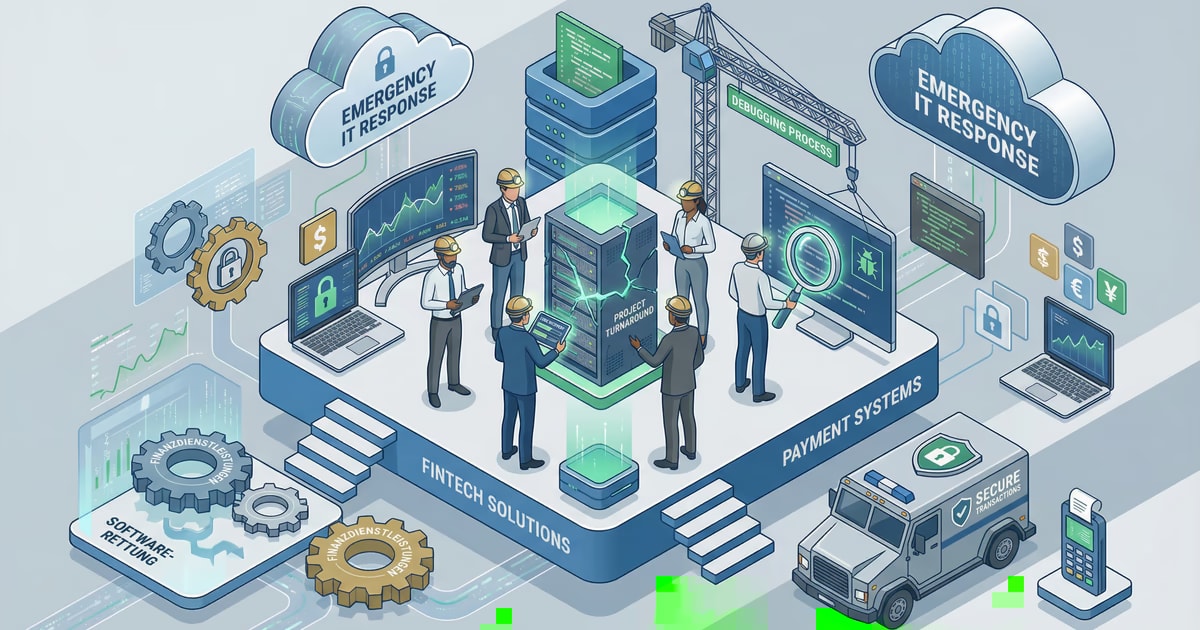
As of: 19 June 2026 · Reading time: 4 min
Key takeaways
- The financial world is an ecosystem based on **confidence**, **precision** and above all on **functional technology**.
- Banks and financial service providers manage billions of transactions, sensitive customer data and must also ...
The financial world is an ecosystem based on **confidence**, **precision** and above all on **functional technology**. Banks and financial service providers manage billions of transactions, sensitive customer data and must also ...
“In fifteen years we have not seen a project that could not be rescued—the question is whether the effort pays off.”
– Björn Groenewold, Managing Director, Groenewold IT Solutions
Software maintenance for financial services & banks: The invisible life insurance for your core business
Software rescue for financial service providers stabilizes business-critical core and billing systems that must function flawlessly from a regulatory perspective.
The process includes code audit, security vulnerability analysis, performance stabilization, and creation of a roadmap for gradual modernization while maintaining BaFin compliance.
The financial world is an ecosystem based on confidence, precision and above all on functional technology.
Banks and financial service providers manage billions of transactions, sensitive customer data and must meet the strictest regulatory requirements.
In this high-risk environment, the IT infrastructure is not only a supporting tool, but the Heartpiece of the entire business operation. But what happens when this heartpiece gets stuck?
If historically grown, complex software systems – the so-called Legacy systems – reach their limits, become inefficient or even fail?
The answer is often the Software-Rettung, a specialized IT-performance that is launched in the financial industry for the invisible life insurance for the core business.
This detailed article highlights why software maintenance for financial services and banks is not only an option but a strategic necessity.
We describe the specific challenges of the industry, the decisive advantages of professional refurbishment and present specific applications that make up the difference between stagnation and future-proof competitiveness.
The critical challenge: Why financial IT calls for salvation (H2)
Short: Executive answer: The financial world is an ecosystem based on confidence, precision and above all on functional technology.
Executive answer: The financial world is an ecosystem based on confidence, precision and above all on functional technology.
When planning Software maintenance for financial services & banks: The invisible… from idea to delivery, AI & Machine Learning, Cost Calculator: AI Development, Discover solutions sowie Software Maintenance offer practical next steps on our site.
The IT landscape in banks is often a patchwork of systems developed and linked for decades.
These Legacy systems are functional, but they bring a number of problems that can be existential in the modern digital financial market.
1. Regulatory pressure and compliance traps (H3)
Short: The financial sector is subject to constant changes in regulations.
The financial sector is subject to constant changes in regulations. Laws such as MiFID II, PSD2, GDPR and DORA (Digital Operational Resilience Act) in the EU place enormous demands on IT systems.
Outdated software is often not flexible enough to implement these changes quickly and cost-effectively.
** Problem:** Manual adjustments are error-prone and time-consuming.
**Risk:**High fines, damage to reputation and loss of operating licences.
2. Vulnerabilities and Cyber threats (H3)
Short: Banks are the primary goal of cyber attacks.
Banks are the primary goal of cyber attacks. Legacy software, which is no longer actively maintained or based on outdated programming languages, offers attackers a larger attack area.
The digital resilience (Operational Resilience) is directly linked to the state of the software.
** Problem:** Outdated security mechanisms and missing patches.
Risk: Data leaks, financial losses due to fraud and massive loss of confidence among customers.
3. Inefficiency and high operating costs (H3)
Short: Maintenance and operation of old systems are often extremely expensive.
Maintenance and operation of old systems are often extremely expensive. Specialized staff for outdated programming languages (e.g. COBOL) is rare and expensive. Slowly prevent
References and further reading
Short: The following independent references complement the topics in this article:
The following independent references complement the topics in this article:
- Bitkom – German digital industry association
- German Federal Office for Information Security (BSI)
- European Commission – Digital strategy
- MDN Web Docs (Mozilla)
- W3C – World Wide Web Consortium
Frequently Asked Questions (FAQ)
What is this article about: “Software maintenance for financial services & banks: The invisible life insurance for y…”?
Here we cover Software maintenance for financial services & banks: The invisible life insurance for y… — focused on architecture, process, and business outcomes.
In short: The financial world is an ecosystem based on confidence, precision and above all on functional technology.
Banks and financial service providers manage billions of transactions, sensitive customer data and must also ...
Who benefits most from the content described here?
Typical readers are business and IT leaders in Software-Rettung who want to secure quality, security, and maintainability over the long term.
How does this topic fit into an IT or digital strategy?
In a digital strategy, prioritize stable core processes first, then extensions. See also professional software development and consulting. For multi-system landscapes, IT consulting and architecture helps align vendors and internal teams.
What are sensible next steps if we need support?
If you need support with design, delivery, or modernization: schedule an appointment or outline your project via contact.
About the author

Managing Director of Groenewold IT Solutions GmbH and Hyperspace GmbH
Since 2009 Björn Groenewold has been developing software solutions for the mid-market. He is Managing Director of Groenewold IT Solutions GmbH (founded 2012) and Hyperspace GmbH. As founder of Groenewold IT Solutions he has successfully supported more than 250 projects – from legacy modernisation to AI integration.
Blog recommendations
Related articles
These posts might also interest you.
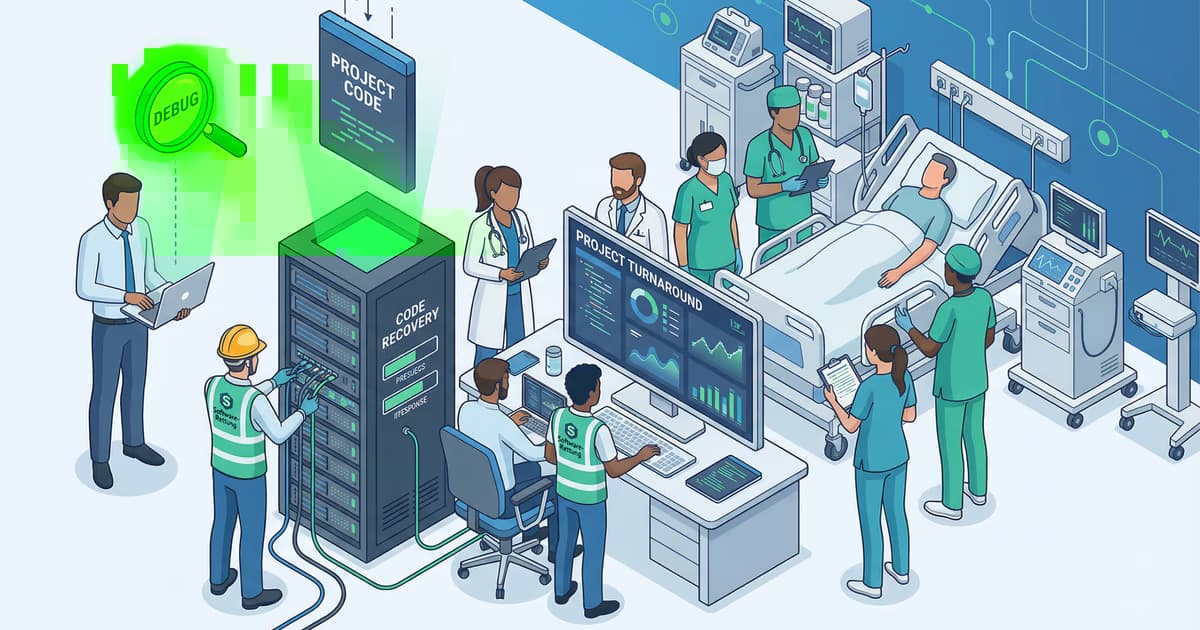
Software maintenance for healthcare: How clinics and practices stabilize their critical IT systems and make them future-proof
Digitization has revolutionized healthcare. What was primarily an administrative support is today the backbone of patient care. Modern clinics and medical practices are unthinkable without efficient…
Software maintenance for energy & supply: How EVUs modernize their legacy systems in a future-proof manner
The energy and supply industry is facing the greatest transformation of its history. The Energiewende requires energy supply companies (EVUs) not only to switch to decentralised and renewable sources…
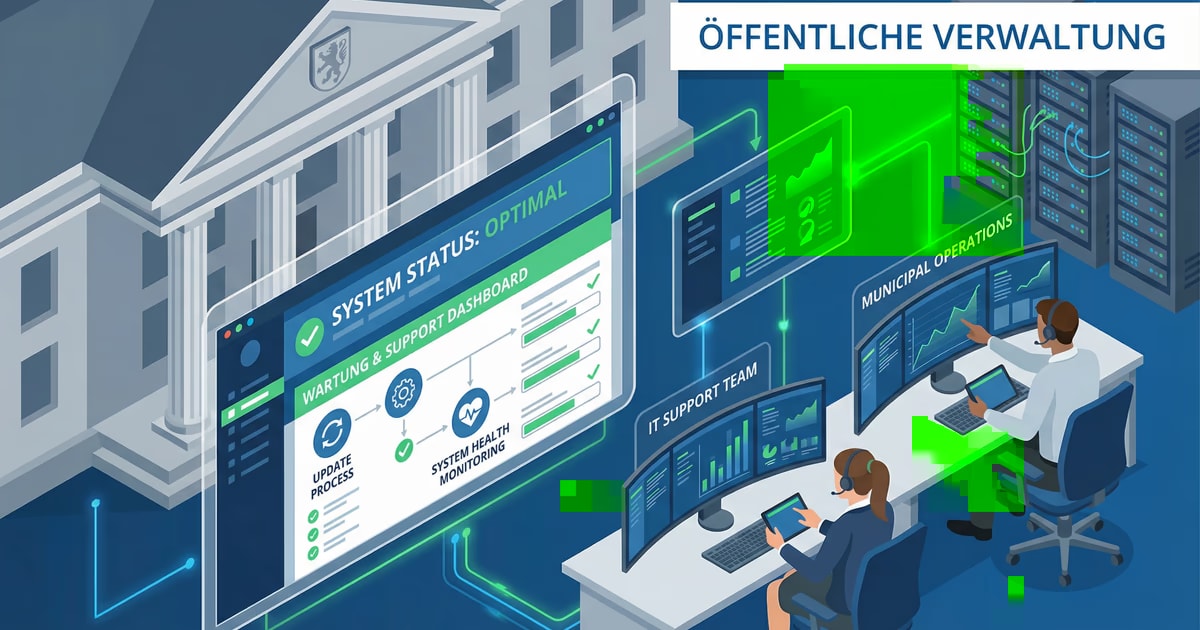
Software maintenance for public administration: How old systems lead to digital sovereignty
Public administration in Germany is facing one of the biggest challenges of its recent history: comprehensive digitalization. While the online access law (OZG) gives the clear order, administrative…
Free download
Checklist: 10 questions before software development
Key points before you start: budget, timeline, and requirements.
Get the checklist in a consultationRelevant next steps
Related services & solutions
Based on this article's topic, these pages are often the most useful next steps.
Related services
Related solutions
More on Software-Rettung and next steps
This article is in the Software-Rettung topic. In our blog overview you will find all articles; under category Software-Rettung more posts on this subject.
For topics like Software-Rettung we offer matching services – from app development and AI integration to legacy modernisation and maintenance. We describe typical use cases under solutions. Our cost calculators give initial estimates. Key terms are in the IT glossary. Books and long-form guides appear on the publications page; deeper articles live under topics.
If you have questions about this article or want a non-binding discussion about your project, you can book a consultation or reach us via contact. We usually respond within one working day.