
As of: 19 June 2026 · Reading time: 5 min
Key takeaways
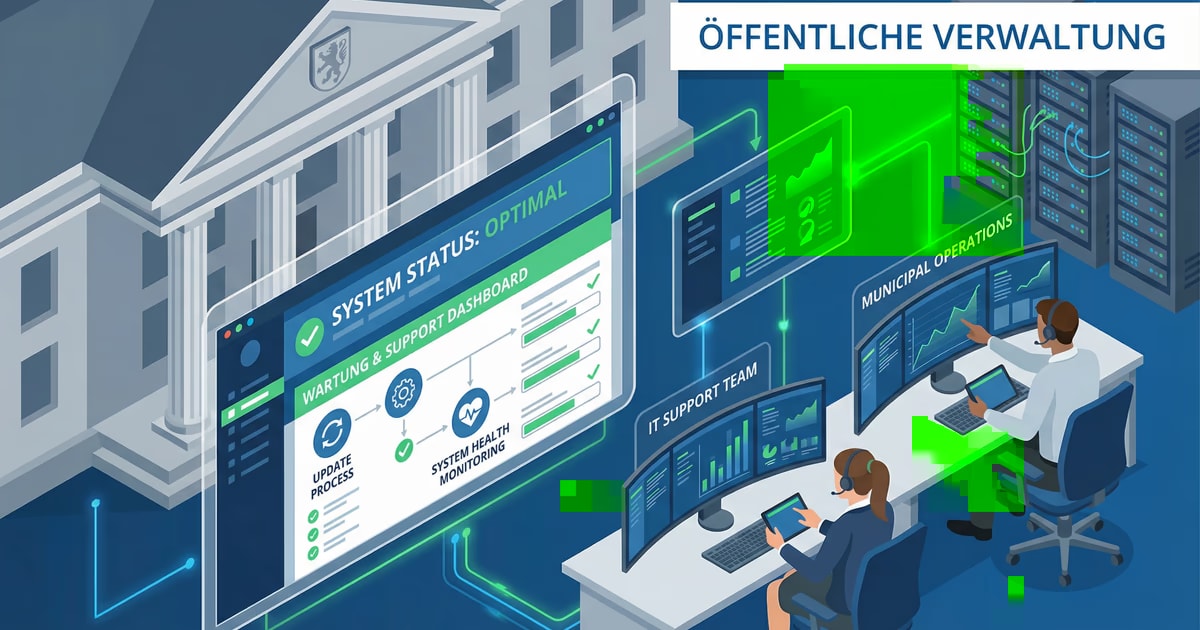
- ** Public administration** in Germany is facing one of the biggest challenges of its recent history: comprehensive **digitalization**.
- While the online access law (OZG) gives the clear order, administrative services to...
** Public administration** in Germany is facing one of the biggest challenges of its recent history: comprehensive **digitalization**. While the online access law (OZG) gives the clear order, administrative services to...
“In fifteen years we have not seen a project that could not be rescued—the question is whether the effort pays off.”
– Björn Groenewold, Managing Director, Groenewold IT Solutions
Author: Björn Groenewold | Published: 9 February 2026
"In fifteen years we have not seen a project that could not be rescued — the question is whether the effort pays off." — Björn Groenewold, Managing Director, Groenewold IT Solutions
The Digital Challenge Facing Municipalities
Short: Executive answer: Public administration in Germany is facing one of the biggest challenges of its recent history: complete digitalization.
Executive answer: Public administration in Germany is facing one of the biggest challenges of its recent history: complete digitalization.
When planning Software maintenance for public administration: How old systems lead… from idea to delivery, AI & Machine Learning, Cost Calculator: AI Development, Discover solutions sowie Software Maintenance offer practical next steps on our site.
Germany's Online Access Act (OZG) requires administrative services to be offered digitally. Many municipalities are failing to meet this requirement.
The reason is not a lack of willingness — it is outdated legacy systems. These systems form the backbone of administrative processes.
At the same time, they block the modernisation that OZG demands.
Software maintenance for public administration is not a complete system replacement. It is a strategic, incremental approach. It preserves the expertise embedded in legacy systems while making the IT infrastructure sustainable.
Four Problems Created by Legacy Systems in Administration
Short: Many critical administrative processes — registration offices, budget management, social services — run on software from the 1980s and 1990s.
Many critical administrative processes — registration offices, budget management, social services — run on software from the 1980s and 1990s. These systems create four concrete problems:
1. High Maintenance Costs
Short: Maintaining COBOL and PL/I systems requires specialists who are expensive and scarce.
Maintaining COBOL and PL/I systems requires specialists who are expensive and scarce. The cost per change request is high. The risk of introducing errors is also high.
2. Security Vulnerabilities
Short: Older architectures receive no security updates.
Older architectures receive no security updates. They are vulnerable to modern cyberattacks. GDPR compliance becomes extremely difficult without current software.
3. Poor Interoperability
Short: Legacy systems are often monolithic.
Legacy systems are often monolithic. They cannot communicate with modern APIs. Connecting administrative services across federal and state levels requires expensive workarounds.
4. Operational Risk
Short: A critical system failure can paralyze an entire administration.
A critical system failure can paralyze an entire administration. Citizens cannot access services. Staff cannot perform their work. Recovery takes days, not hours.
Why OZG Digitalisation Fails Without Backend Modernisation
Short: The OZG requires more than online forms.
The OZG requires more than online forms. It requires the underlying processes to be digitalized too.
When a modern digital frontend connects to an outdated, inefficient backend, the result is a slow and error-prone system. Citizens experience this as poor service, even though the frontend looks modern.
IT modernisation in municipalities is the necessary foundation for meeting OZG objectives. It is not optional.
The Software Rescue Approach for Public Administration
Short: A structured rescue programme uses proven techniques to modernise without replacing:
A structured rescue programme uses proven techniques to modernise without replacing:
- Security patching: Critical vulnerabilities are closed immediately without touching the core system
- API wrappers: Modern interfaces are placed in front of legacy systems, enabling digital services without backend replacement
- Strangler pattern migration: New modules replace legacy functions piece by piece, over a defined timeline
- Documentation: Undocumented legacy code is analysed and documented, reducing dependency on individual specialists
The Path to Digital Sovereignty
Short: Digital sovereignty means that a municipality controls its own IT.
Digital sovereignty means that a municipality controls its own IT. It is not dependent on a single vendor or a single specialist who knows the system.
Software rescue creates this independence step by step.
The goal is a documented, maintainable, and secure IT infrastructure — one that meets OZG requirements and can evolve.
References and Further Reading
- Bitkom — German digital industry association
- German Federal Office for Information Security (BSI)
- European Commission — Digital strategy
About the Author: Björn Groenewold (Dipl.-Inf.) is Managing Director of Groenewold IT Solutions GmbH. Since 2012, he has supported over 250 projects — from legacy modernization to AI integration.
Frequently Asked Questions (FAQ)
What is this article about: “Software maintenance for public administration: How old systems lead to digital soverei…”?
Here we cover Software maintenance for public administration: How old systems lead to digital soverei… — focused on architecture, process, and business outcomes.
In short: ** Public administration** in Germany is facing one of the biggest challenges of its recent history: complete digitalization.
While the online access law (OZG) gives the clear order, administrative services to...
Who benefits most from the content described here?
Typical readers are business and IT leaders in Software-Rettung who want to secure quality, security, and maintainability over the long term.
How does this topic fit into an IT or digital strategy?
In a digital strategy, prioritize stable core processes first, then extensions. See also professional software development and consulting. For multi-system landscapes, IT consulting and architecture helps align vendors and internal teams.
What are sensible next steps if we need support?
If you need support with design, delivery, or modernization: schedule an appointment or outline your project via contact.
References and further reading
Short: The following independent references complement the topics in this article:
The following independent references complement the topics in this article:
About the author

Managing Director of Groenewold IT Solutions GmbH and Hyperspace GmbH
Since 2009 Björn Groenewold has been developing software solutions for the mid-market. He is Managing Director of Groenewold IT Solutions GmbH (founded 2012) and Hyperspace GmbH. As founder of Groenewold IT Solutions he has successfully supported more than 250 projects – from legacy modernisation to AI integration.
Blog recommendations
Related articles
These posts might also interest you.
Software maintenance for healthcare: How clinics and practices stabilize their critical IT systems and make them future-proof
Digitization has revolutionized healthcare. What was primarily an administrative support is today the backbone of patient care. Modern clinics and medical practices are unthinkable without efficient…
Software maintenance for energy & supply: How EVUs modernize their legacy systems in a future-proof manner
The energy and supply industry is facing the greatest transformation of its history. The Energiewende requires energy supply companies (EVUs) not only to switch to decentralised and renewable sources…
Software maintenance for real estate management: How to make your legacy systems sustainable
The real estate industry is facing a fundamental change. Increased regulatory requirements, pressure on sustainability and the need to meet tenant expectations in the digital age require real estate…
Free download
Checklist: 10 questions before software development
Key points before you start: budget, timeline, and requirements.
Get the checklist in a consultationRelevant next steps
Related services & solutions
Based on this article's topic, these pages are often the most useful next steps.
Related services
Related solutions
More on Software-Rettung and next steps
This article is in the Software-Rettung topic. In our blog overview you will find all articles; under category Software-Rettung more posts on this subject.
For topics like Software-Rettung we offer matching services – from app development and AI integration to legacy modernisation and maintenance. We describe typical use cases under solutions. Our cost calculators give initial estimates. Key terms are in the IT glossary. Books and long-form guides appear on the publications page; deeper articles live under topics.
If you have questions about this article or want a non-binding discussion about your project, you can book a consultation or reach us via contact. We usually respond within one working day.