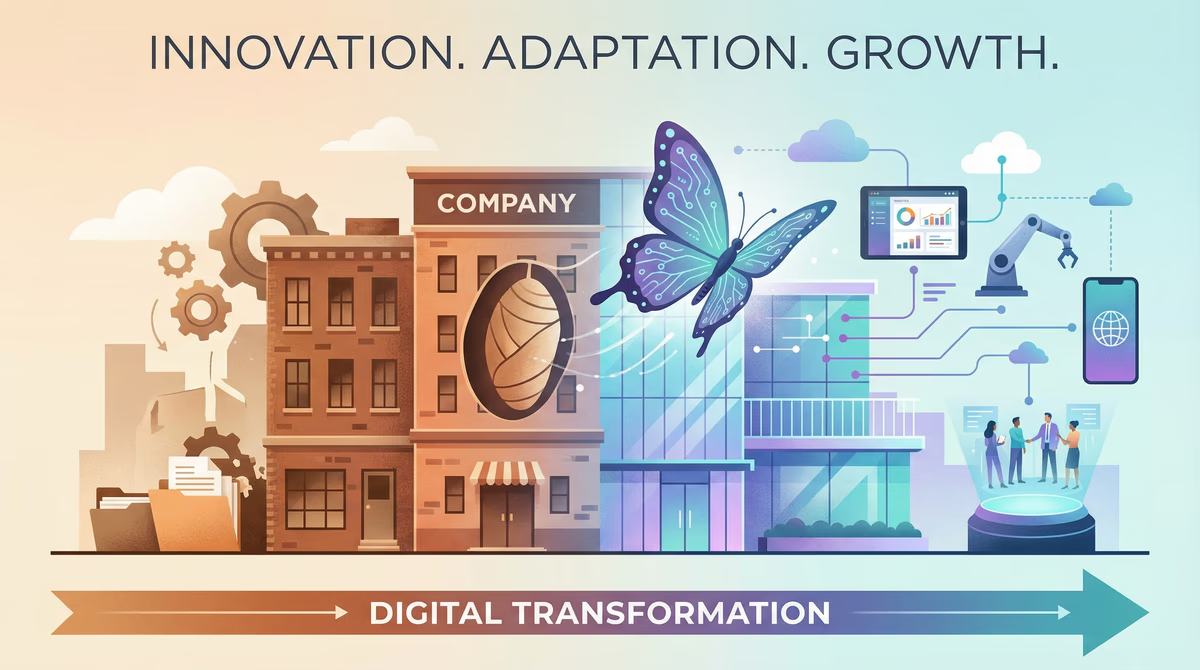
Software development
Digitization in the middle class: How to measure your success
Digitization is no longer a trend for medium-sized enterprises, but a need to remain competitive. But how to measure the success of Digitalisie...

Custom software development for mid-market companies in Germany needs a partner with a clear process, realistic budgets and explicit acceptance criteria – when you commission bespoke software, you get scope, fixed-price options and milestones from one team.
Projects are staffed from our German locations — see all delivery locations or jump to Hamburg, Munich or Berlin.
Before you engage
This page focuses on team, delivery and execution for custom software development for mid-market companies. The software & platforms service overview routes you to specialist pages such as having a web application developed, app development for mid-market companies or MVP development for fast validation. The SME software development section covers requirements, budget control, integrations and transferable operations for companies with 20 to 500 employees. Strategic depth and related topics live in the software development topics pillar. Ballpark budgets sit in the software development costs; make-or-buy trade-offs are clarified in custom vs standard software. Proof from delivered browser projects is available in web-app references. For an overview of deeper content, use the topics overview.
Project references
Documented examples with transparent evidence types — browse matching references or open the full case study.
Custom software becomes worthwhile when spreadsheets, manual handovers and disconnected systems repeatedly create cost or errors. We model the business rules that standard products cannot cover, while retaining proven ERP, CRM and commerce platforms wherever they remain economical. This keeps the scope focused on operational value rather than rebuilding standard functions.
We compare licence cost, customisation limits, integration effort and long-term ownership. A targeted MVP for business validation can test the riskiest workflow before a larger investment. Where an ERP remains the right core, APIs and bounded extensions protect upgradeability.
Stable SME software needs clear ownership for master data, releases and support. Versioned interfaces replace fragile CSV handovers, while migration rules and reconciliation reports make cutovers repeatable. Our API integration service connects ERP, CRM, production and customer portals without creating a new silo.
Development from Leer, East Frisia, means direct contacts, transparent milestones and contracts under German law. Source code, architecture decisions, automated tests and operational runbooks remain transferable. Your team can continue independently, appoint another provider or retain us for structured software maintenance.
We prioritise releases by reduced processing time, fewer errors and lower manual effort. The software development cost guide provides realistic budget bands; the roadmap then assigns acceptance criteria and operating costs to each stage instead of hiding them in a single project estimate.
Bespoke development is justified when business rules, data flows or integrations create measurable value and standard software would require permanent workarounds. Simple approvals or infrequent workflows may be better served by configuration or low-code. We document that decision before committing a delivery budget.
Self-service, status information and customer-specific workflows.
Approvals, order control and cross-department operations.
Business rules around Odoo, Microsoft, DATEV or industry systems.
Service and production workflows with offline or device access.
Governed data models instead of scattered spreadsheets and Access files.
Rule-based processing, interfaces and traceable exception handling.
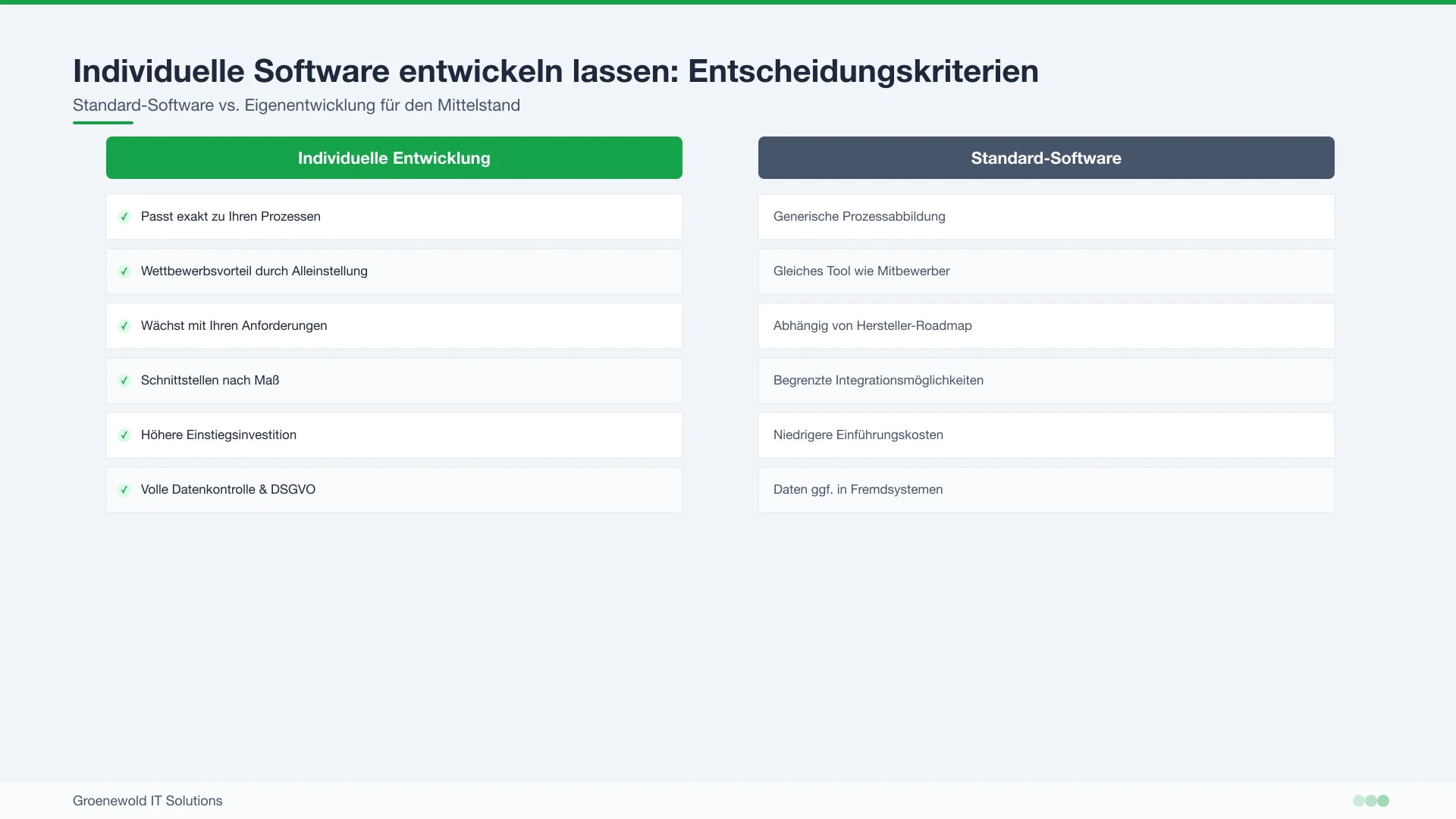
Use standard software
Choose it when processes are common, upgradeability matters and configuration covers the requirement.
Adapt the existing core
Add bounded interfaces, screens or industry rules while keeping ERP ownership and updates clear.
Build bespoke software
Use it when the process differentiates the business or coordinates several systems and data owners.
Leadership, business owners and IT agree a baseline, target KPIs, acceptance criteria and internal responsibilities before development. Requirement changes then enter a prioritised backlog with visible impact on budget and timing.
Guide · Software development cluster
This guide pulls together the decisions mid-market leadership and IT must take together: when does bespoke software pay off? Where do standard ERP or SaaS suffice? How do you budget without a black box? And how do you hand over to operations without Excel and email becoming the "integration layer" again? We write from project experience in Germany (Made in Germany, Leer/Lower Saxony) and link every chapter to a dedicated topic article in the software-development cluster so you can drill down on demand.
The thread: bespoke software earns its keep where value creation hits limits of standard products, media breaks, or shaky integration stability. This 2026 guide sequences cost, technology, quality, integration and operations into an intelligible path—so you avoid double-budgeting once in configuration and again in shadow tools—and ensures your architecture can grow when the organisation scales. The linked articles are not a substitute for a workshop with your context, but they give you the vocabulary and checkpoints expected in RFPs, funding applications and internal approvals. Where benchmarks are industry-specific, we avoid pseudo-precise percentages; instead you get levers and review routines you can defend.
Bespoke software is the right lever when media breaks, duplicate maintenance or special-case logic create recurring cost — not when a standard product already covers ~80% of value-add cleanly. In the mid-market the business case is measurable benefit per release versus spreadsheet workarounds; it should combine one-off effort, integration risk and operating cost (TCO) over three to five years.
A pragmatic path often looks like this: clarify processes and data ownership, ship an MVP or integration bridge, and plan operations and quality from day one. That sequence avoids expensive "big rebuilds" that business teams never adopt. All eleven deep dives below follow that logic — from custom versus standard software to cloud, on-premises or hybrid operating models.
Each line leads to a standalone article under /en/topics/software-development/… — unique content, aligned to this pillar. Treat the list as a table of contents and deepening path. Order is deliberately flexible: some teams start with costs and the custom/standard trade-off, others with integration or operations — often where pain is acute. What matters is that strategy, quality or hosting do not stay permanently hollow; gaps there almost always produce expensive rework after go-live.
In 2026 three constraints show up more often in procurement and board reporting: first, cyber resilience and evidence (including NIS-2 for in-scope organisations); second, documented data lineage for supply-chain and quality; third, pressure to adopt AI-assisted tooling sensibly — without shadow IT. Bespoke software is often the hinge between an ERP core and customer demands: it encodes domain rules precisely, exposes APIs and prepares quality data so it stays auditable.
Mid-market teams remain tight on IT headcount and calendar time. That is why we prioritise roadmaps by damage reduction and contribution margin — not the loudest feature wish. The deep dive on SME digitalisation strategy matches that prioritisation lens.
Standard software compresses industry best practices — quick to procure, often well documented, continuously evolved by the vendor. Bespoke development wins where competitive advantage comes from differentiated processes: special manufacturing, batch logic, partner networks or regulatory variants that resist clean configuration. The most expensive mistake is "too bespoke too early" or "standard too late" — both inflate TCO.
For a defensible decision, put interface cost, licence trajectory and release cadence on one page. Our article Custom vs. standard software works through that matrix without marketing fluff — including when a combination of ERP standard and domain-specific extension delivers the best economics.
Projects become expensive when scope and data quality stay fuzzy or integrations "ride along mentally" but never land in the backlog. Serious drivers are: number of coupled systems, history and migration, performance targets, and non-functional needs such as high availability and observability. Naming those levers lets you release budget in stages — aligned to shippable increments.
For orientation without a sales buzzword list, use the cost hub software development — costs and scenarios and the ROI page ROI for custom software. The in-depth article on costs of custom software development explains the logic behind ranges and assumptions — before numbers in Excel harden into contracts.
Agility in the mid-market is not an ideology — it is risk reduction: short cycles, visible increments and clear acceptance lower the odds of shipping something that does not match daily work. The disciplined link between product ownership, test cases and deployment matters: CI/CD is not a nice-to-have; it is how you hand over safely.
Read more in Agile software development process. Teams with little Scrum experience should also scan our methodology and approach.
Framework debates (React, .NET, Python, Flutter …) calm down once staffing, operability and your integration landscape are explicit. The stack must fit your interfaces, hosting constraints and in-house skills — not one developer's favourite tool. Long term, maintainability wins: clear layering, automated tests, documented APIs.
See technology selection and connect it with later operating choices in cloud, on-premises or hybrid.
Minimum Viable Product means the smallest shippable slice that tests a real hypothesis — whether field engineers actually use an app, or whether sales is unblocked by a Kanban for specials. An MVP does not replace a full ERP role; it validates assumptions early and cheaply. That limits damage from mis-investment, especially when departments disagree on how the process "really" works.
We unpack the approach in What is an MVP? alongside the service page MVP development.
Mid-market IT rarely fails for lack of ideas — it fails on prioritisation: too many parallel initiatives, weak master-data governance, unclear success metrics. A lean digitalisation strategy orders measures by benefit, risk and dependency — and prevents tool sprawl. The link to bespoke software is intentional build where integration and domain logic deliver the largest leverage.
The article SME digitalisation strategy provides a framing read; for ERP solution spaces add the business perspective from ERP for SMEs.
Misalignment comes from implicit assumptions: "we have always done it this way" or "the ERP must store it somewhere". Solid user stories, acceptance criteria and a shared domain model prevent expensive rework. Workshops should make edge cases and measurable outcomes explicit — especially for bespoke software where domain logic is the core.
Go deeper in requirements management for SMEs. Larger ERP environments also benefit from engaging system integration.
In many mid-market analyses integration effort is the biggest surprise after kick-off: duplicate logic, delayed events, batch windows and permissions across boundaries. API-first thinking does not mean "everything microservices" — it means clear contracts, idempotency and monitoring so CSV duct tape ends.
Read interfaces and system integration and — where helpful — our glossary entry on interfaces / integration.
Quality is not a project-end checkbox — it is recurring investment: automated regression near interfaces, targeted manual tests for domain edges, and acceptance scenarios finance and compliance actually understand. The more complex the integration, the more you need trustworthy test data and clear success criteria per release.
The article on QA and testing for bespoke software maps the test pyramid for SMEs; the cost page QA & testing helps with budgeting.
Go-live is not project end — operations, monitoring and coherent incident handling decide long-term acceptance. A viable model names budget for updates, dependency care and evolution; technical debt becomes visible and prioritised instead of silently postponed.
See maintenance and continuous improvement and compare operating patterns with software maintenance & care.
Where data lives, latency requirements and in-house ops skill often shape architecture more than licence price alone. Hybrid patterns are common in the mid-market: core-adjacent systems on-prem or with a German host, scalable services in the public cloud — connected via secured APIs and explicit responsibility boundaries.
Contextualise with cloud, on-premises or hybrid; for privacy engineering add GDPR-compliant software development and GDPR compliance costs from a management angle.
Mid-market digitalisation can be supported by funding programmes — provided the project narrative, milestones and evidence are solid. We help you orient via funding consulting; details remain case-specific and should tie to internal financial planning.
Many projects slip because purchasing, business, IT and the vendor leave responsibilities fuzzy. Sound governance names business-side prioritisation via product ownership, IT-side architecture and security boundaries, and vendor transparency on effort, risk and release dependencies. Without that split, workshops collide on assumptions and the backlog turns political instead of factual.
Product owners in the mid-market are often double-booked — deliberate relief helps: decision proxies, documented process owners per domain, and a weekly steering forum with a fixed time box so focus stays on the increment that moves revenue or cost. The spoke on requirements management condenses the content side.
ERP often remains the system of record for master data and finance; bespoke layers attach where special processes or device coupling do not fit the standard cleanly. The critical artefact is a written boundary: what does ERP author versus the satellite system? Who coordinates releases when data models shift? Unclear ownership creates duplicate care, contradictory workflows and expensive emergency scripts.
A practical integration board covers events, polling and batch — with SLAs, monitoring and clear recovery. Technically the spokes on interfaces and quality assurance combine; economics ties back to custom vs. standard and cost logic.
In discrete manufacturing batch sizes, lots and machine events meet ERP orders. Bespoke software often delivers fine-grained coupling to measurement and control technology plus end-to-end history for claims and audits. Standard reports rarely suffice when customers expect traceability to the raw batch. An MVP can start with the most critical machine park — enough to test hypotheses on peaks and utilisation before the second plant follows (see MVP).
Retail fights for stock truth across branches, warehouse and online. Bespoke layers often orchestrate reservations, transfers and pricing logic idempotently and traceably. Cloud scale may suit frontends and checkout while sensitive conditions stay internal — cloud / on-prem / hybrid framing prevents hidden latency and compliance traps.
Project and service organisations need transparent capacity, contract boundaries and escalation paths. Bespoke software can connect forecasting, skill matching and ticketing — but only if requirements and KPI definitions are co-authored with finance. An iterative rollout with an agile process reduces the risk of reports that look polished but lack operational value.
Migration is rarely a one-off CSV import. Duplicate rules, history, tax keys and master-data lifecycles decide success. The more parallel sources you run, the earlier you should define test slices and conflict strategies before the first productive postings. Bespoke software acts as a quality and transformation layer — not a magic button.
Connect this workstream to the spoke on interfaces and foundations from technology selection. Where data was historically "adjusted", expect a cleansing track — it belongs in scope and budget, not a footnote buffer.
For bespoke software, role models, least privilege and audit trails belong in early sprints — not "phase 2". APIs should be authenticated, rate-limitable and observable; logging must respect privacy and retention. That is not a luxury list — it is table stakes when suppliers or end customers ask for evidence.
Go deeper via our IT security service page and the cluster on security by design. For the mid-market regulatory view on NIS-2 use NIS-2 for SMEs.
Performance is a second-order feature — until it is not: seasonal peaks, concurrent bookings or large imports can collapse response times. Early load profiles, measurement points and a simple capacity model belong in architecture — especially for mobile workforces or field teams.
The operating layer ties to hosting choices and maintenance budget from maintenance and evolution. Without monitoring and escalation paths, even good software loses organisational trust.
The question is rarely "either internal or external" — it is which competencies must live permanently in-house: domain knowledge, approvals, operations. Partners bring velocity, broader tech coverage and engineering QA. What matters are crisp interfaces: repositories, CI/CD, documentation and shared incident playbooks.
We deliberately position as a development team in Germany — for direct reachability, predictable contracting and traceable delivery on-site and remotely. Search intents such as "custom software development Germany" or "IT solutions for SMEs Germany" reflect that expectation: controlled delivery instead of undocumented heroes.
Technical KPIs (latency, error rate, deployment frequency) must link to business KPIs (cycle time, scrap, contribution per order) — otherwise you optimise metrics nobody funds. A starter set might include share of automated postings, reduction of manual Excel hops, or time from order intake to shipping release. Every metric needs a data source and an owner.
Strategic embedding of those figures sits in digitalisation strategy; operational measurability connects to tests and QA.
A demo wins a meeting; production-grade software wins under load, with flaky networks and when second-line support closes an incident without guesswork. We deliberately separate proof-of-concept, pilot and production release — each stage has different quality bars and documentation duties. Mixing POC and production invites expensive refactors right before go-live.
For mid-market first movers a pilot with a bounded user group is often the right middle step — measurability before a broad rollout. MVP logic in MVP explained describes that path; the curve into routine care sits in maintenance and evolution.
User adoption is rarely pure intuition: new screens change habits and KPI ownership. Short role-based scenarios, training blocks and a defined hypercare window after go-live secure the transition from project mode to line operations. Without that glue, adoption stalls and tickets pile up with "worked the old way".
Documentation must speak to operations: who may configure, who deploys, how do you roll back? The same principles apply as in agile delivery and quality from the QA spoke.
Fixed price stabilises budget when scope and acceptance are crisp; time & materials fits exploration or when data and interfaces still need discovery. Hybrids combine workshops with subsequent fixed-price increments — a workable middle ground for mid-market programmes. Transparency matters: what happens when a third-party API changes? Who owns delays from data migration?
Economic framing lives in software development costs; commercial model choice also couples to requirements management and release cadence from the agile process.
Every platform has a lifecycle: runtime versions, framework releases and OS patches. Bespoke software must budget "keeping it alive" — not only "build once". That spans dependency graphs in repositories as well as commercial components. A clear renew/replace regime prevents security updates from becoming executive fire drills.
Anchor the technical foundation in technology selection; operating and cost consequences follow in maintenance and, for hosting, cloud vs. on-prem.
Customers and regulators increasingly ask for evidence on data provenance and processing steps. Bespoke software can deliver audit trails, digital signatures and revision-safe workflows — if processes are modelled up front. Interfaces to suppliers and logistics partners are often the longest pole; surfacing risks early in an integration board matters (see interfaces).
Vendors ship configurators and partner modules — yet special cases hit limits when rules span domains or vendor release cadence misses your market window. Compare total cost of ownership and upgrade paths, not licence rows alone. Our spoke on custom vs. standard software structures that trade-off without dogma.
For ERP ecosystems add comparisons and industry pages such as Odoo vs SAP and our Odoo services — orientation only, never a substitute for your domain workshop.
Successful mid-market programmes rarely end at one release; they grow into a system of core platform, integrations and analytics. A multi-year roadmap links strategic initiatives (analytics, AI-assisted assistance) with technical debt reduction. Portfolio steering is summarised in digitalisation strategy; execution cadence follows agile delivery.
Innovation needs protected budgets and explicit stop/go criteria. A sandbox can be a separate tenant, a feature-flag pilot or a time-boxed beta — as long as production data stays safe and rollbacks are a button press, not a weekend war room. That discipline connects MVP thinking with operational reality: learn fast without betting stability.
Pair this with MVP and testing so experiments do not become untested production load.
Concretely for mid-market organisations: a small pilot budget with clear promotion criteria into the product system, documented data migration out of experiments, and a communicated rollback path. The sandbox must not become a permanent shadow environment — after validation, apply the same architectural rigour as any other release (integrations, observability, permissions). Innovation stays planable instead of destabilising production.
Customers and employees expect explainable data use. For bespoke software that means consent, purpose limitation, minimal storage and traceable logs are part of the design — not a detached policy PDF. For analytics and scoring, favour explainable models and human checkpoints before automation runs in production.
Useful complements include GDPR compliance costs and the glossary entry GDPR; technical depth in GDPR from a technical angle.
Open standards (HTTP, OAuth, OpenAPI) lower integration cost and ease future vendor moves. Deliberate API design avoids implicit coupling: versioning, deprecation paths and consumer contracts should be documented. That maintainability shows up directly in maintenance budgets.
For deeper API topics see REST vs GraphQL and API security; for SME context the cluster spoke interfaces for SMEs remains the compact entry point.
Software scales faster than organisations mature: more users arrive while reporting and compliance expectations rise. A healthy approach names capacity limits early — moderated feature gates, explicit priorities and second-line escalation. Without those mechanics teams ship features operations cannot absorb.
Organisational embedding maps to requirements management and release cadence from the agile process.
Bespoke software in the mid-market always sits inside strategy, organisation and operations. Commissioning "just the tool" without integration and ops planning shifts cost — it does not erase it. Treat the eleven spokes as a checklist: have you clarified cost logic, architecture, quality, integration and run-state? If a thread is missing, jump to the linked article and close the gap before budget locks.
We support you from first orientation through stable operations — pragmatic workshops, tangible deliverables and documented handovers. This 2026 guide restates the thread: measurability, transparency and a Made-in-Germany partnership as a durable foundation for your bespoke software.
Use these points to steer governance forums — not as a formal specification. The goal is to avoid false certainty and align on whether bespoke software is the dominant lever or whether integration and core configuration should lead. Capture master data policy, interface ownership and realistic hypercare in writing.
If fields stay empty, prioritise clarification before signature — the eleven spokes exist to close gaps systematically instead of buying emergency rescue mid-flight.
Additional value comes when you walk the checklist with sales, production or service — not IT alone. That grounds expected productivity gains in concrete screens, interfaces and reports instead of slides alone. Document chosen priorities; they anchor later scope conversations and multi-year investment rationale.
IT contracts should name IP, licence models, acceptance rules and liability caps — not only hourly rates. Processing agreements, subprocessors and support windows matter whenever personal data is involved; our page on GDPR-compliant development supports technical checklists but does not replace counsel. For AI-specific regulatory trends compare against our hub AI for business.
We build bespoke software Made in Germany — with named contacts, documented quality and clear handover into your operations. Use this guide as a conversation starter: which of the eleven deep dives is most urgent for you? Book an initial consultation, or start structured via the project check. For the full software portfolio, our software development overview remains the technical reference — alongside this mid-market guide for 2026.

„Custom software needs clear architecture, tests, and handover. Otherwise the project never gains audit-ready assurance—it only accumulates more code.“

Off-the-shelf software often can't meet your company's specific needs. We build custom software that fits your requirements exactly.
From idea to finished app, we guide you through the whole process. We use modern tech and proven methods to deliver solid, long-lasting solutions.
Software is essential for every business. Standard packages can be cheap and quick. But they often don't fit your real needs.
Custom software is built for your company. It matches your goals and workflows. Main advantages:
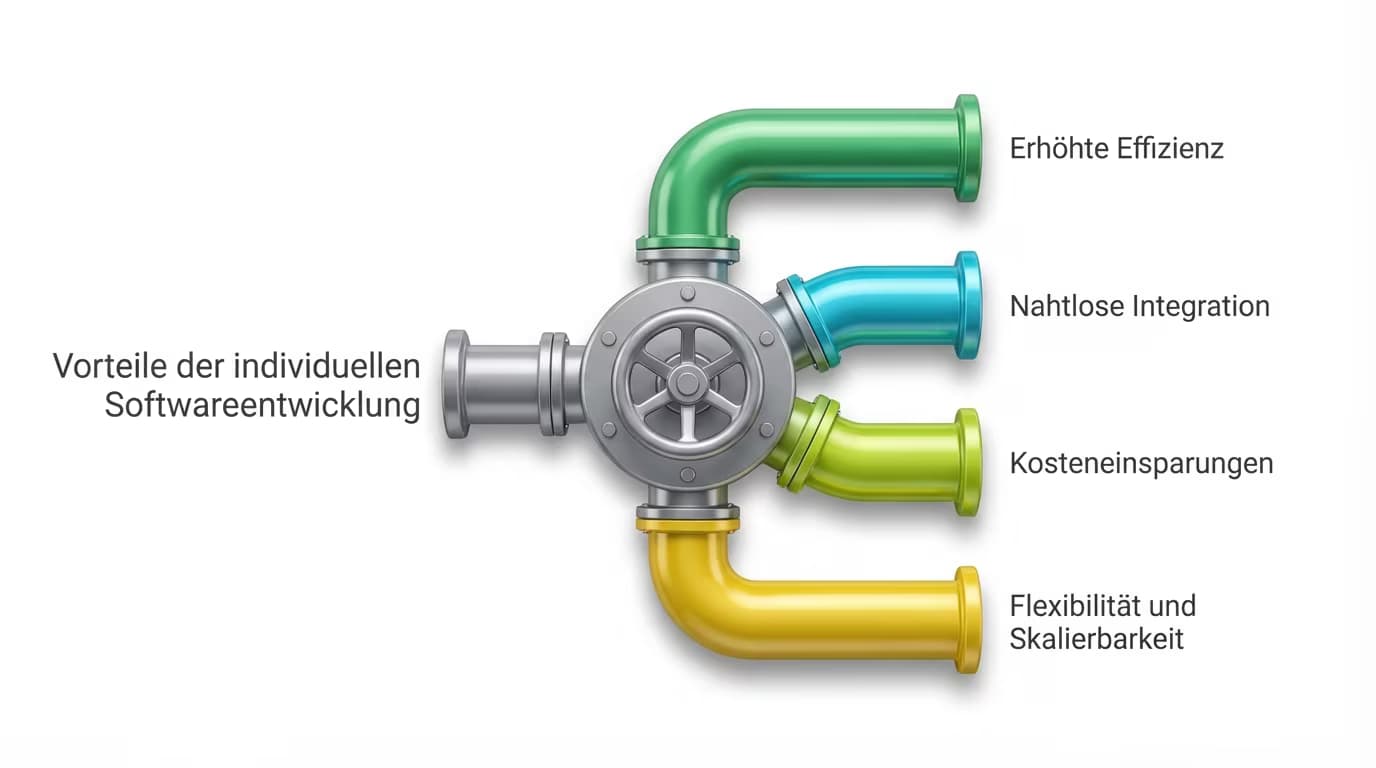
Key benefits of custom software development at a glance
1. Tailor-Made Solutions
Perfect fit for your needs
Custom software is built around your workflows. Standard software often forces you to change how you work. We do the opposite: we design the system to match you.
2. Efficiency and Productivity
Automation and time savings
Custom software automates repetitive tasks. You save time and resources. Your team can focus on work that really adds value.
3. Competitive Advantage
Stand out from the competition
Custom software lets you offer features your competitors don't have. When your market or needs change, we can adapt or extend your system quickly.
4. Scalability and Flexibility
Software that grows with your company
Standard software often can't scale. When you grow or things change, you hit limits. Custom software grows with you and adapts to new needs.
5. Smooth Integration
One platform for your processes
Many companies struggle with scattered IT systems. Custom software plugs into your existing systems. You control everything from one place. Teams work better together and get more done.
6. Stronger Security
Protection built for your company
Cyber attacks and data leaks are common. Security matters. Custom software is built for your security needs. We add the right safeguards and reduce risks.
7. Lower Costs in the Long Run
A worthwhile investment
Custom software can cost more at first. Over time it often saves money. Standard software needs costly add-ons, upgrades and licenses as you grow. Custom solutions are built to fit your company from day one. You save time and money and get better performance.
Custom software brings clear benefits over standard packages. You get better efficiency, a real edge over competitors, and systems that work together. In the long run you often save money too.
Do you have needs that no standard product fits? Custom software is built around your processes and supports your goals.
Your benefits at a glance
According to the software development cost calculator, the non-binding project orientation is EUR 10,332 – 372,623 excl. VAT. The range runs from a simple internal specialist tool to a complex B2B SaaS platform with integrations, migration, compliance, extras and accelerated delivery. A binding offer follows the requirements analysis. Solution type, user scale, business logic, integrations, migration, compliance and quality level determine the scenario.
MVP/Prototype: 4-12 weeks. Production solution: 3-6 months. Complex enterprise software: 6-18 months. Agile methods deliver early usable results.
Frontend: React, Next.js, Vue.js, Angular. Backend: .NET, Node.js, Python, Java. Mobile: Flutter, React Native, Swift, Kotlin. Databases: SQL Server, PostgreSQL, MongoDB. Cloud: Azure, AWS, Google Cloud.
Yes, Privacy by Design is standard. We implement encryption, access controls, audit logs and deletion concepts. Hosting on German/EU servers is possible.
Yes, you receive the complete source code, documentation and knowledge transfer. If needed, we train your team. You are not dependent on us.
A product owner and business decision-makers must prioritise scope, explain rules, provide realistic test data and approve increments on time. We own technical delivery and make risks visible, but business acceptance and product priorities remain with your organisation. Timeline and outcome cannot be guaranteed without that participation.
Key criteria include domain competence, proven reference projects, transparent communication, full-service delivery from concept to operations and long-term maintainability. A software developer for the mid-market should document scope, fixed-price options and integration responsibility—not only hourly rates. Check acceptance criteria per sprint, documentation, GDPR compliance and handover to your IT. As a software developer focused on mid-sized businesses in East Frisia, Germany, we cover the full custom software lifecycle from one partner: analysis, architecture, delivery, interfaces and operations Made in Germany.
Standard vendors ship a fixed product with configuration options; a software developer for custom software models processes, data flows and interfaces to fit. That pays off when ERP, CRM or industry tools leave gaps, regulation requires bespoke development or scale goes beyond off-the-shelf modules. Clear scope boundaries, architecture before the first sprint and an operating model after go-live matter. We combine both pragmatically: where standard software is enough, we integrate it; where it is not, we build custom software with documented releases and maintainable code.
They can be sufficient for a small user group, infrequent cases and simple rules without critical integrations. Bespoke software becomes relevant when concurrent work, permissions, auditability, data quality or stable ERP and CRM interfaces are business-critical.
New requirements are assessed for value, dependencies and their effect on budget and timing. The product owner then reprioritises the backlog or approves a documented change with separate acceptance criteria; the committed release scope is not silently expanded.
A business product owner with decision authority, an IT and privacy contact and key users for reviews and acceptance are usually sufficient. They do not need to work full-time on the project, but must provide data access, scheduled feedback and timely decisions.
Advisory work is connected directly to a delivery-capable engineering team. Decisions become testable prototypes, interface contracts, automated tests and production releases. Source code, architecture records and runbooks remain transferable to your organisation.
A defined business problem, known user groups, access to process owners and an initial success metric are enough. Discovery adds the system landscape, data sources, risks and acceptance criteria; a complete specification is not required before the first workshop.
Use custom software to make your company future-proof.
Get started nowWe deliver web, desktop, mobile, database and backend work plus interfaces—conception through QA into production, aligned with your domain and internal IT.
Web Applications
Modern, scalable web applications for complex business processes that work optimally on all devices.
Desktop Applications
Powerful desktop software for Windows, macOS and Linux with intuitive user interface.
Mobile Apps
Native and hybrid apps for iOS and Android that make your business processes mobile.
Database Applications
Efficient database solutions for the secure management and analysis of your company data.
Backend Systems
Powerful and scalable backend solutions for your applications and services.
API Development
Integration and networking of your systems through customized interfaces.
Five phases take you from requirements to deployment; MVPs can go live in weeks, enterprise programmes with integrations span quarters—with transparent reviews and approvals.
Requirements Analysis
We analyze your requirements and define the goals and scope of the project together.
Conception
We create a detailed concept and define the architecture and design of the solution.
Development
We develop the software using agile methods and keep you continuously informed about progress.
Quality Assurance
We thoroughly test the software to ensure it meets all requirements and works flawlessly.
Deployment & Support
We implement the solution in your environment and provide continuous support and maintenance.

Ready for Your Project?
From the first idea to the finished solution – we accompany you with experience and expertise.

„Agile delivery needs visible increments and regression tests—otherwise "almost done" stretches across quarters without a safe release.“
We pick stacks by domain, operations, maintainability and team fit—not hype alone: React, .NET, PHP, Go (Golang), Delphi, Swift, Kotlin and Node.js are deliberate choices per project.
 React
React Angular
 Node.js
 Python
 Java
Java C#
C# PHP
PHPWe are happy to advise you on your individual software project. Contact us for a non-binding initial consultation or schedule an appointment directly.

Building custom software is fundamentally different from configuring off-the-shelf products. Every line of code we write addresses a specific business requirement that generic tools cannot solve. Our development teams in Germany work closely with stakeholders to translate complex workflows into clean, maintainable applications. Whether you need an internal operations platform or a customer-facing portal, we architect solutions that reflect how your organization actually works rather than forcing you into predefined templates.
Technology choices matter enormously in custom development, and we refuse to take a one-size-fits-all approach. For data-intensive backends we often reach for .NET or Python, while React and Next.js power our frontend experiences. Mobile projects leverage Flutter or React Native depending on platform requirements. The key is selecting the right stack for your specific constraints around performance, team expertise, and long-term maintainability rather than chasing the latest trend.
Quality assurance is woven into every phase of our development process, not bolted on at the end. We practice continuous integration with automated testing pipelines, peer code reviews, and staged deployments that catch issues before they reach production. This discipline means fewer emergency patches after launch and more predictable release cycles. Our clients appreciate that thorough QA actually accelerates delivery over time by preventing the costly rework that plagues hastily built systems.
Working with a German development partner offers tangible advantages beyond time zone convenience. Data protection regulations like GDPR are second nature to our teams, and we design privacy-compliant architectures from day one. Our contracts follow German commercial law, providing clear IP ownership and liability frameworks. For companies that value transparent communication, reliable delivery schedules, and engineering rigor, partnering with Groenewold IT Solutions means getting enterprise-grade software without enterprise-grade bureaucracy.
Choosing the right software architecture is crucial for long-term maintainability and scalability. Depending on requirements, we employ proven patterns such as Domain-Driven Design for complex business domains, microservices for independently scalable modules, or monoliths for rapid MVPs. From the start, we consider aspects like multi-tenancy for SaaS architectures and message queues for asynchronous communication in distributed systems. For dedicated reviews, target architectures and exit strategies we offer a standalone service page on software architecture consulting.
Quality is not a step at the end of the development process – it accompanies every phase. Through Test-Driven Development, our developers write automated tests before the actual code. Systematic code reviews ensure that every change is reviewed by at least one additional developer. In staging environments, we test every release under production-like conditions before it is automatically delivered via CI/CD pipelines.
Modern software development does not end with writing code. We use Docker containers and Kubernetes for reproducible, scalable deployments. With Infrastructure as Code, your server environments are versioned and recoverable at any time. And through zero-downtime deployment, we ensure that updates are applied without interrupting ongoing operations – a critical factor for business-critical applications that need to be available around the clock.
Further reading
In-depth articles and research framing
Custom vs. standard software →Decision support before you engage
Web-app references →Proof from browser-based delivery
Software development costs →Ranges, drivers and calculator context
Related Services
Automate business processes with RPA & APIs
Database Solutions →SQL, NoSQL & vector databases for your applications
API Development →Connect systems with REST, GraphQL & microservices
Enterprise Software Development →Scalable systems and integrations for large organisations
GDPR-compliant Software Development →Privacy-by-design applications built to EU data protection rules
Python Development →Backends, automation and data solutions with Python
Alongside custom software development, these pages add depth for stakeholders who want articles, ERP context, APIs and mobile/web angles before a workshop or proposal.
Custom software development for mid-market companies in Germany pays off when standard products only fit approximately and interfaces, compliance or domain logic slow operations down. As a trusted partner for Custom Software Development in Germany, we deliver reliable solutions for local and international SMEs. In international tenders we respond as Custom Software Development Germany: documented interfaces, traceable architecture decisions and GDPR-aligned delivery instead of opaque offshore hand-offs.
Tailor-made software solutions for your individual requirements. Scalable, secure and maintainable – developed in Germany.
This page is the primary entry for broad custom software search (mid-market, fixed-price delivery). Browser-based business applications belong on web app development; iOS/Android apps on app development. Early validation often starts with MVP development.
Shops, CMS and ERP topics are covered via online shop creation, CMS & e-commerce platforms and Odoo ERP & CRM. Overview: Software & Platforms.
Service overview: Software & platforms (overview)
Use our funding calculator to see which government grants may apply to your project.
Björn Groenewold – Managing Director
Service cluster
Related services for Software & platforms: choose the right delivery route
Custom software is the foundation—combined with mobile solutions and platforms it creates real business value.
Related topics
Complementary services from other areas
These services are frequently requested together with Custom Software Development or complement it thematically.
Integration & interfaces: find the right entry point
Data & analytics: analysis, BI or database engineering?
IT consulting strategy: roadmaps & digitalisation
On the scheduling page, pick a free slot for a 30-minute intro call about Software Development – straightforward next steps.
Free & non-binding · 30-minute intro call
Book next available slotFirst-party evidence
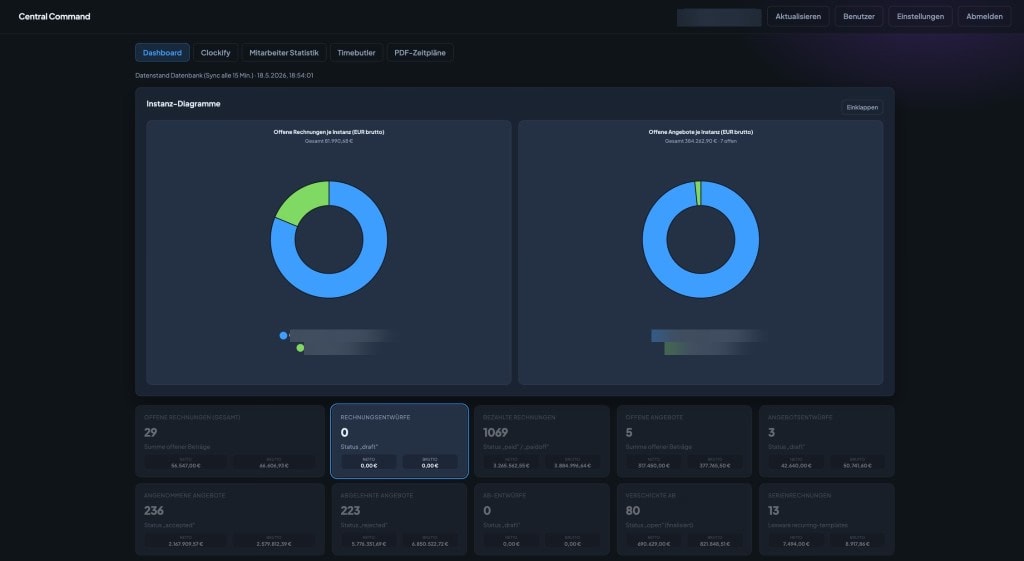
This in-house product brings Lexware, Clockify and Timebutler data into one interface. Its evidence comes from our own back-office operation and is labelled as an in-house case.
Evidence type: In-house product built by Groenewold IT Solutions. Reviewed: 2026-09-08.
Read the documented case studyFrom the field: Central Command – Lexware, Clockify & Timebutler (in-house). All references.

Use our interactive calculator for a first budget indication—free and non-binding.
Thorsten Frieling – Projektmanagement
Our topic overview links related articles and entry points alongside this service page.
Recent articles from our blog that match this service.
Digitization in the middle class: How to measure your success
Digitization is no longer a trend for medium-sized enterprises, but a need to remain competitive. But how to measure the success of Digitalisie...
Digital Transformation: Leadership and Change Management as key to success
Digital transformation is more than just the introduction of new technologies. It is a profound change process that affects companies of all sizes. Especially for small and...
Digital Transformation: The Power of Partnerships and Ecosystems
Digital transformation is no longer an option for small and medium-sized enterprises (SMEs), but a need to remain competitive. But the way to the digital future...