
As of: 23 September 2026 · Reading time: 7 min
Key takeaways
- A MVP is not a cheap product – it is a smart product.
- Who defines the minimum in the right place saves development budget and quickly learns what users really want.
- Costs, procedures and the most common errors in MVP development.
A MVP is not a cheap product – it is a smart product. Who defines the minimum in the right place saves development budget and quickly learns what users really want. Costs, procedures and the most common errors in MVP development.
“Digitalization is not an IT project—it is a business strategy.”
– Björn Groenewold, Managing Director, Groenewold IT Solutions
MVP: What it costs and how to get it right
MVP stands for minimum Viable Product – a term used in startup pitches and product planning is often incorrect. A MVP is not the cheapest one can build.
It is the product with the smallest size that gives real user benefits and generates real feedback.
This article explains what a MVP really is, what it costs and how to design the development process. This means the MVP becomes a successful product.
What a MVP is – and what is not
A MVP is not a cheap product – it is a smart product.
If you want to develop MVP: As far as it costs and how to plan it correctly from idea to rollout, you will find appropriate entry on our website with individual software development, cost calculator: software development and explore solutions.
A MVP is:
- Yes. The smallest sensible version of a product that can use real users with real tasks.
- A tool for learning: what assumptions about user behavior and value promises are correct?
- Yes. A risk-reducing first step before full development effort is invested.
A MVP is not:
- Yes. A semi-finished product with all planned features, but cheaper.
- Yes. A prototype or Wireframe (this is a proof of concept, not a MVP).
- An excuse to accept bad UX ("is just a MVP")
- Always cheaper than complete development – a MVP must fulfill the core function perfectly.
The most famous MVP understanding: You want to build a car. A MVP is not the first wheel or the first chassis – but a skateboard.
Something functionally fulfills the core of the user promise ("from A to B"), even if it is still far from the target product.
When is a MVP the right decision?
MVP is useful if:
- Yes. Market or user behaviour is not yet sufficiently validated.
- Yes. The risk of a fully built product without feedback is too high.
- Yes. You want to quickly market and iterate.
- Investors or stakeholders need first user evidence.
MVP is less useful if:
- Yes. The market and needs are very well known (then can be built directly larger).
- Force regulatory needs to a minimum extent already broad.
- Yes. Internal enterprise software (here more agile phases than MVP concept).
What a MVP costs: Realistic classification
Short: MVP budgets vary greatly depending on product type, complexity and team.
MVP budgets vary greatly depending on product type, complexity and team. Orienting tensions for the German market (external development team, not offshore):
| MVP type | Price range (net) | Typical runtime |
|---|---|---|
| Simple web app (CRUD, 2–3 core functions) | 15,000–40.000 € | 6–12 weeks |
| Mobile app (iOS or Android, clear use case) | 25,000–70.000 € | 8–16 weeks |
| Platform MVP (marketplace, B2B portal) | 40.000–120.000 € | 12–24 weeks |
| AI-supported MVP | 30,000–100,000 € | 10–20 weeks |
What drives the price: number of user roles, integrations with external systems, authentication logic, mobile and web parallel development, complex domain logic, regulatory needs.
What lowers the price: Clear, priority scope, an skilled product owner as client, no "nice to have" features, use of open source components where reasonable.
The right scope: How the "Minimum" is defined
Short: The most difficult thing about an MVP is the scoping decision.
The most difficult thing about an MVP is the scoping decision. What features are really minimal? A proven method:
User Stories: Who are the users? What do they want to achieve? Design the most important 5–10 user stories for each user type.
Priorize for "must have" / "should have" / "could have": Must-haves are the MVP-scope. Everything else comes after that.
Critical user path: Which path through the application must work perfectly so that a user experiences value? This path is the MVP core.
Cut tests: For each planned feature ask: "If we leave this feature, a user can still experience the core value?" Yes → leave. No → keep.
The development process: Agil, but structured
A good MVP process with an external development partner:
Week 1–2: Discovery & Scope Workshop Record needs, define user roles, prioritize user stories, outline technical architecture, agree final MVP scope.
Week 3–4: Design & Prototype UX concept and clickable prototype – before the start of development. Better base, previous problems detected.
Week 5–10: Development in Sprints Two-week development cycles. After each sprint: demosession, feedback, adaptation. No feature "desked" in a long development tunnel.
Week 11–12: Testing & Launch Preparation Bugfixing, performance tests, deployment preparation, onboarding first users.
After launch: Iterations The MVP is not an end station. User behavior and feedback will create priorities for the next development cycles.
Typical errors that make MVPs expensive or useless
Short: Scope Creep in Discovery.
Scope Creep in Discovery. Each stakeholder adds features. At the end, the "MVP" is a complete product with a twelve-month development period.
Consistent prioritization and no-seed is a core competence of the Product Owner.
No real user test. A MVP that is in-house tested but never shown real users does not provide real feedback. Early, targeted user testing is mandatory.
Technical abbreviations that will later be expensive. Sometimes fast learning justifies fast technology.
But if code quality and architecture are so bad at the MVP that the code has to be completely rewritten, the MVP was more expensive than he had to be.
No plan for the step after MVP. What happens after the MVP? When is enough learned to scale? Without a roadmap, you will remain in MVP mode.
MVP and funding
MVP developments can be eligible in certain constellations – especially if innovations or research aspects are included.
Programmes such as EXIST (for start-ups from universities), the ZIM (Central Innovation Programme mid-sized firms) or country programmes may be relevant.
More on this in the field fund advice.
Conclusion
Letting an MVP develop is an investment decision that wants to be well prepared.
The scope must be clearly and consistently reduced to the minimum, the development process must incorporate feedback plans. And the MVP plan must be present.
Anyone who does this right gets valuable market knowledge for €20,000-50,000 – instead of building a product that no one needs for €200,000.
Our team supports MVP development projects from the first scope definition to the productive launch.
Frequently Asked Questions (FAQ)
Can you build a MVP with no code tools?
Yes, for certain product types. Bubble, Webflow, Glide or Adalo enable functional MVPs without classical development.
The border: complex business logic, scalable architecture and deep system integrations quickly encounter no-code boundaries.
How long should you watch with the MVP user before continuing to build?
Rule of thumb: 4–8 weeks with real users until behavior patterns become visible. Qualitative interviews supplement usage data.
Early pivot decisions based on fewer users are a common mistake.
Who should be Product Owner at the MVP?
Ideally, someone from the company who has authority and knows the target group. External Product-Owner support is possible, but the internal business context is difficult to replace.
What happens to the MVP code after launch?
With good quality development: it is the basis for all further iterations. In case of technical debt from the MVP: refactoring phase before the next expansion stage.
Check with the development partner what quality standards apply to the MVP.
Technical sources and further links
The following separate references complement the grouping on the topics of this Article:
- Bitkom – Digital Economy Association.
- BSI – Federal Office for Information Security.
- European Commission – Digital Strategy.
- MDN Web Docs (Mozilla)
- W3C – World Wide Web Consortium.
"AI in mid-sized firms is worthwhile where measurable processes and clean data bases exist – the pilot must have a clear criterion of success."
— *Björn Groenewold, Managing Director, Groenewold IT Solutions *
About the author

Managing Director of Groenewold IT Solutions GmbH and Hyperspace GmbH
Since 2009 Björn Groenewold has been developing software solutions for the mid-market. He is Managing Director of Groenewold IT Solutions GmbH (founded 2010) and Hyperspace GmbH. As founder of Groenewold IT Solutions he has successfully supported more than 250 projects – from legacy modernisation to AI integration.
Blog recommendations
Related articles
These posts might also interest you.
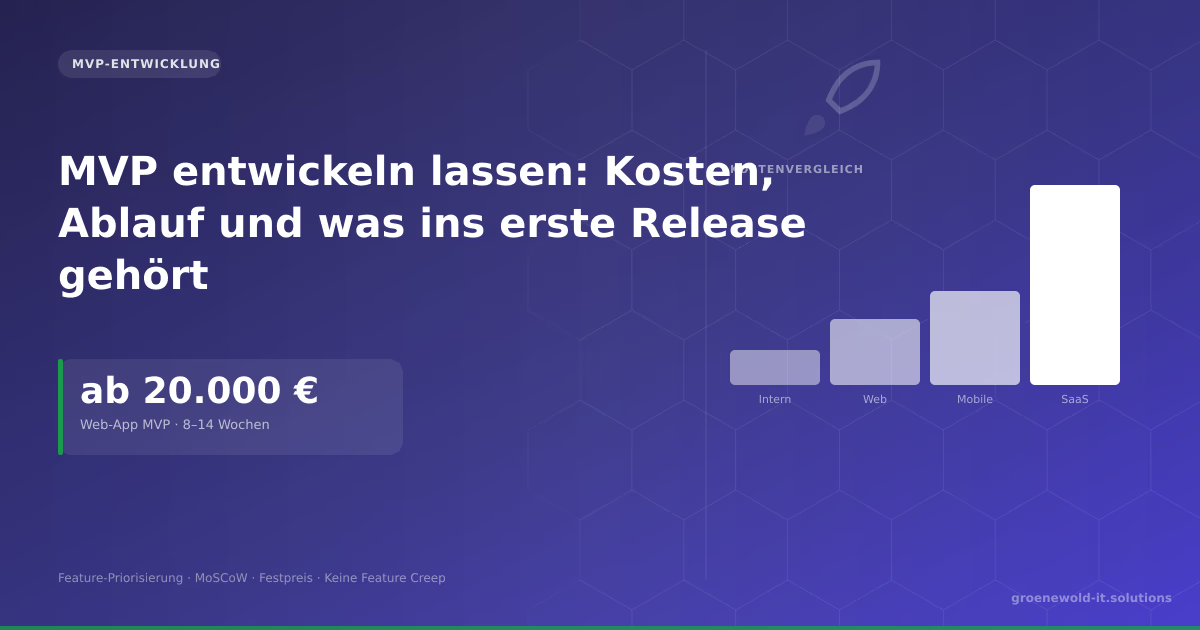
Having an MVP Developed: Costs, Process and What Belongs in the First Release
A web app MVP costs €20,000 to €45,000 and is ready in 8–14 weeks. This article explains what a real MVP is (and not), the Must/Should/Could method and frequent errors that blow up the budget.

From the idea to the MVP in 12 weeks: A realistic schedule
Twelve weeks from the first briefing to the productive MVP – is that realistic? Yes, if scope, process and decision speed are correct. This post shows week after week what happens when and what…

Digitization in the middle class: The right technology selection as a success factor
Digitization is no longer an option for small and medium-sized enterprises (SMEs), but a need to compete. But Digitalization in the middle class is...
Free download
Checklist: 10 questions before software development
Key points before you start: budget, timeline, and requirements.
Get the checklist in a consultationRelevant next steps
Related services & solutions
Based on this article's topic, these pages are often the most useful next steps.
Related services
Related solutions
Cost calculators
Practical next steps after Having an MVP Developed: What It Costs and How to Get It Right
Having an MVP Developed: What It Costs and How to Get It Right addresses a practical choice for product and IT teams. Start with one clear goal: align software scope, technical risk, and business value before the next investment.
Check the current process, the data involved, and the result users need. Then record the main risks and define a small first step. This keeps the decision easy to review and gives your team a shared basis.
For implementation support, our custom software development connects the article's guidance with architecture, delivery, and stable operations. Engineering and project ownership stay with our team in Leer, Germany.
This post belongs to MVP-Entwicklung. Browse the related MVP-Entwicklung articles or use the English software blog for other topics.
When budget is the next question, the software cost calculators provide planning ranges. The IT glossary explains key terms, while in-depth technology guides cover wider decisions.
If the topic affects a live project, book a technical consultation or send the context through our project contact form. We usually reply within one working day.