
As of: 4 May 2026 · Reading time: 3 min
Key takeaways
- In today's fast-paced digital landscape, companies are faced with a decisive choice in the development of software: to build an internal team or to develop a new...
In today's fast-paced digital landscape, companies are faced with a decisive choice in the development of software: to build an internal team or to develop a new...
“Good software is not an accident—it comes from a structured development process with clear quality standards.”
– Björn Groenewold, Managing Director, Groenewold IT Solutions
In today's fast-paced digital landscape, companies are faced with a decisive choice in [software development](/services/software development): Should they build an internal team or outsource development to an external partner?
Both models, Inhouse vs Outsourcing Software Development, have their own advantages and disadvantages. While in-house development promises full control and deep integration into corporate culture, outsourcing attracts with cost savings and access to a global talent pool.
But what if there was a way to combine the strengths of both approaches and to minimize the respective weaknesses?
Hybrid development teams come into play here, a flexible and increasingly popular model that promises to unite the best of both worlds.
What are hybrid development teams?
A hybrid development team is a strategic mix of internal employees (the core team) and external experts that are temporarily or project-based. These external forces may be freelancers, agency staff or consultants.
They work seamlessly with the internal team to achieve common goals.
This model allows companies to use their existing internal resources and their domain knowledge and, at the same time, recourse to specialized expertise, new perspectives and flexible scalability of external developers.
Essentially, it is about creating a tailor-made “dream team” that is precisely tailored to the specific requirements and the respective phase of a project, rather than relying on a rigid staff structure.
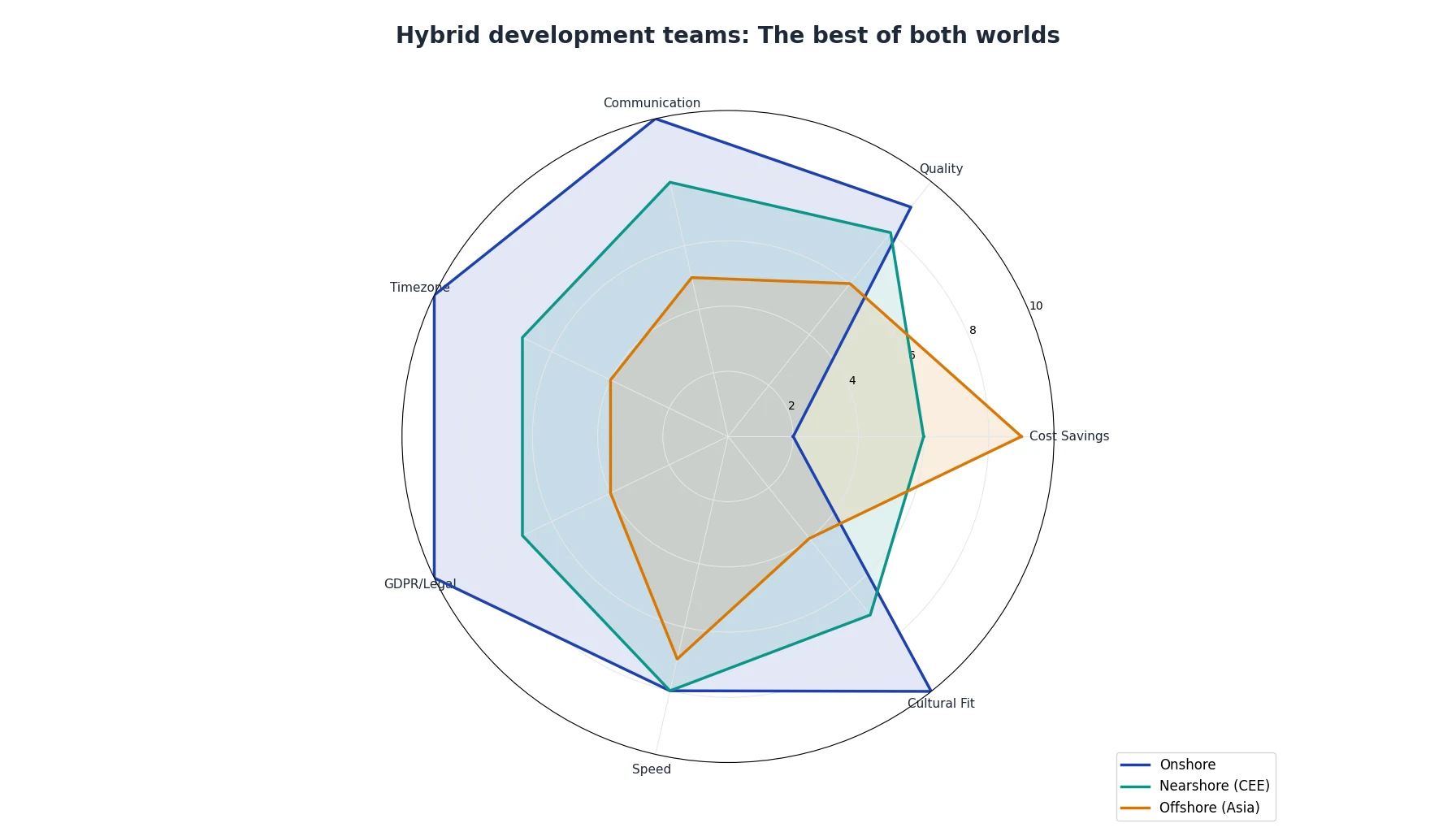
Inhouse vs. Outsourcing: A Brief Overview
Short: To fully grasp the strategic brilliance of the hybrid model, it is essential to understand the fundamental differences and compromises of traditional approaches.
To fully grasp the strategic brilliance of the hybrid model, it is essential to understand the fundamental differences and compromises of traditional approaches.
The decision between in-house and outsourcing is rarely black and white and depends on a variety of factors such as budget, schedule, project complexity and long-term corporate strategy.
| Criterion | Inhouse Development | Software Outsourcing | | :--- | :-- | :-- | | | | | | | | | | | | | | | | | | | | | | | | | | | | | | | | | | | | | | | | | | | | | | | | | | | | | | | | | | | | | | | | | | | | | | | | | | | | | | | | | | | | | | | | | | | | | | | | | | | | | | | | | | | | | | | | | | | | | | ** Control | Maximum, direct control over all aspects of the project, processes and team. | Low direct control; Control takes place via contracts and SLAs. | ** Costen | High initial and ongoing fixed costs (consumers, social benefits, office, equipment). | Lower and more variable costs; Payment per project or per hour. | ** Flexibility | Low flexibility in personnel changes; long-term adjustment and incorporation processes. | High flexibility in the fast scaling of the team up or down. | ** Expertise | Limited to the knowledge and skills of the fixed internal team. | Almost unlimited access a
References and further reading
Short: The following independent references complement the topics in this article:
The following independent references complement the topics in this article:
- Bitkom – German digital industry association
- German Federal Office for Information Security (BSI)
- European Commission – Digital strategy
- MDN Web Docs (Mozilla)
- W3C – World Wide Web Consortium
> "ERP programmes rarely fail on software selection; they fail on unclear process ownership." > > — Björn Groenewold, Managing Director, Groenewold IT Solutions
About the author

Managing Director of Groenewold IT Solutions GmbH and Hyperspace GmbH
Since 2009 Björn Groenewold has been developing software solutions for the mid-market. He is Managing Director of Groenewold IT Solutions GmbH (founded 2012) and Hyperspace GmbH. As founder of Groenewold IT Solutions he has successfully supported more than 250 projects – from legacy modernisation to AI integration.
Blog recommendations
Related articles
These posts might also interest you.

Minimize outsourcing risks: strategies for successful partnerships
The decision to outsource IT projects or entire business areas is a decisive step for many companies to increase efficiency and focus on their own core business.

State support for digitalization: your guide in the jungle
> The following blog post is an AI-generated design based on the information and requirements provided. Human review and adaptation is recommended.
What is offshore development?
> # Offshore development: opportunities and risks in detail > > In today's globalized economy, companies are constantly looking for ways to work more efficiently, reduce costs and equal...
Free download
Checklist: 10 questions before software development
Key points before you start: budget, timeline, and requirements.
Get the checklist in a consultationRelevant next steps
Related services & solutions
Based on this article's topic, these pages are often the most useful next steps.
Related services
Related solutions
More on Software development and next steps
This article is in the Software development topic. In our blog overview you will find all articles; under category Software development more posts on this subject.
For topics like Software development we offer matching services – from app development and AI integration to legacy modernisation and maintenance. We describe typical use cases under solutions. Our cost calculators give initial estimates. Key terms are in the IT glossary. Books and long-form guides appear on the publications page; deeper articles live under topics.
If you have questions about this article or want a non-binding discussion about your project, you can book a consultation or reach us via contact. We usually respond within one working day.