As of: 3 September 2026 · Reading time: 4 min
Key takeaways
- In today's digitalized business landscape, the right software is often the decisive factor for growth and competitiveness.
- Medium-sized companies are facing a...
In today's digitalized business landscape, the right software is often the decisive factor for growth and competitiveness. Medium-sized companies are facing a...
“Good software is not an accident—it comes from a structured development process with clear quality standards.”
– Björn Groenewold, Managing Director, Groenewold IT Solutions
For SMEs, the choice between in-house development and outsourcing is a question of strategic positioning.
In-house secures control and domain knowledge, outsourcing delivers room to adapt and access to expert technologies.
A hybrid model with an internal core team and external specialists often provides the best balance.
Inhouse vs. Outsourcing: The right choice for software development in the middle class
In today's digitalized business landscape, the right software is often the decisive factor for growth and market strength. Midsize companies are facing a strategic direction.
Should software development be in-house struggled with their own team or is the outsourcing to an external specialist the better way?
This decision between Inhouse vs Outsourcing Software Development has far-reaching effects for the cost, quality and strategic orientation of the company.
In this post, we illuminate both models, show case studies from the middle class and give a decision-making aid.
What does in-house development mean?
In today's digitalized business landscape, the right software is often the decisive factor for growth and market strength.
For Inhouse vs. Outsourcing: The right choice for software development in…, see Cost Calculator: Software Development und Our Development Process on our website for rollout paths and planning.
In-house development means the construction and employment of a separate team of software developers directly within the company.
These employees are permanently employed and work exclusively on their employer's projects.
This model offers a number of benefits, such as full control over development processes and deep integration into corporate culture.
Direct and direct communication promotes a common understanding and a strong identification with the corporate goals.
However, this approach also involves considerable challenges. The cost of salaries, social benefits and the provision of modern jobs can greatly burden the budget.
In addition, recruiting qualified developers in a competitive market is a long and resource-intensive process.
A team once built can also be easily adapted to a fluctuating project needs. This can lead to lack of room to adapt.
The alternative: Outsourcing software development
Outsourcing means to assign the development tasks to an external service provider.
This can range from the outsourcing of custom projects to the transfer of the entire IT department.
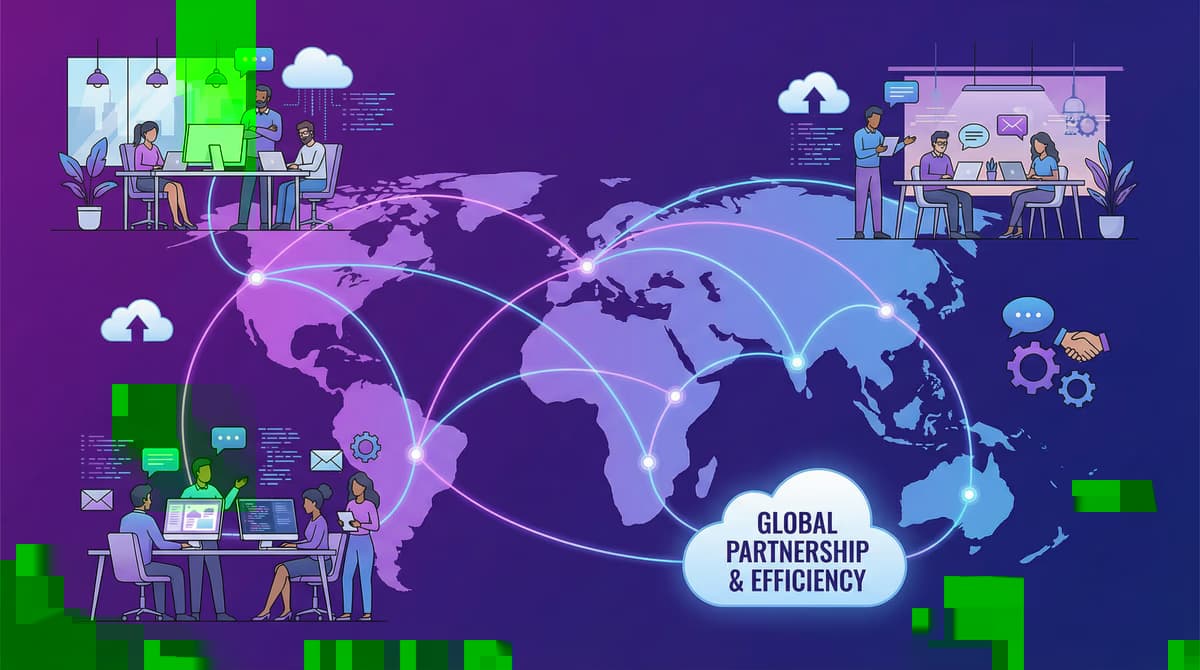
The greatest advantage is often the major cost savings, as external service providers can benefit from economies of scale and cheaper wage structures.
Companies also get access to a global pool of talents and special knowledge that may not exist in-house.
Room to adapt is another decisive plus. Teams can be scaled quickly depending on the project phase and needs without having to make long-term commitments.
However, there are also risks to this. Teamwork across different time zones and cultures can lead to communication problems.
A lack of direct control and distance from the project can also affect the quality and safety of sensitive business data.
Case studies from the middle class
To make the theory more tangible, we consider zwe
References and further reading
The following separate references complement the topics in this article:
- Bitkom – German digital industry association.
- German Federal Office for Information Security (BSI).
- European Commission – Digital strategy.
- MDN Web Docs (Mozilla)
- W3C – World Wide Web Consortium.
Frequently Asked Questions (FAQ)
What is this article about: “Inhouse vs. Outsourcing: The right choice for software development in the middle class”?
This post explores Inhouse vs. Outsourcing. The right choice for software development in the middle class from the perspective of needs, typical pitfalls. And sensible next steps.
In short. In today's digitalized business landscape, the right software is often the decisive factor for growth and market strength. Midsize companies are facing a...
Who benefits most from the content described here?
Useful for project leads and product owners in Software development who must choose between standard software, custom development, and integration.
How does this topic fit into an IT or digital strategy?
Technically and organizationally, alignment with experienced partners pays off — from requirements to operations; start with the [services overview](/en/services/software-development). For multi-system landscapes, [IT consulting and architecture](/en/services/it-consulting) helps align vendors and internal teams.
What are sensible next steps if we need support?
A practical next step: book a consultation and clarify which MVP or pilot fits your team and landscape.
About the author

Managing Director of Groenewold IT Solutions GmbH and Hyperspace GmbH
Since 2009 Björn Groenewold has been developing software solutions for the mid-market. He is Managing Director of Groenewold IT Solutions GmbH (founded 2010) and Hyperspace GmbH. As founder of Groenewold IT Solutions he has successfully supported more than 250 projects – from legacy modernisation to AI integration.
Blog recommendations
Related articles
These posts might also interest you.

How to connect your company systems for sustainable success
In today's business world marked by digital transformation, data is the undisputed elixir of life of every company. They are the basis for innovation, efficiency and sound...

Venture Capital for Software Development: Opportunities and Risks
In the dynamic world of software development, access to capital is often the decisive factor that decides on the success or failure of an innovative start-up. One of the famous...
Software funding in the middle class: practical examples and success factors
Digitization poses major challenges to small and medium-sized enterprises (SMEs), but also offers immense opportunities. One of the central hurdles is often Software Financing. How...
Free download
Checklist: 10 questions before software development
Key points before you start: budget, timeline, and requirements.
Get the checklist in a consultationRelevant next steps
Related services & solutions
Based on this article's topic, these pages are often the most useful next steps.
Related services
Related solutions
Cost calculators
Practical next steps after Inhouse vs. Outsourcing: The right choice for software development in the middle class
Inhouse vs. Outsourcing: The right choice for software development in the middle class addresses a practical choice for product and IT teams. Start with one clear goal: align software scope, technical risk, and business value before the next investment.
Check the current process, the data involved, and the result users need. Then record the main risks and define a small first step. This keeps the decision easy to review and gives your team a shared basis.
For implementation support, our custom software development connects the article's guidance with architecture, delivery, and stable operations. Engineering and project ownership stay with our team in Leer, Germany.
This post belongs to Software development. Browse the related Software development articles or use the English software blog for other topics.
When budget is the next question, the software cost calculators provide planning ranges. The IT glossary explains key terms, while in-depth technology guides cover wider decisions.
If the topic affects a live project, book a technical consultation or send the context through our project contact form. We usually reply within one working day.