
As of: 4 May 2026 · Reading time: 3 min
Key takeaways
- Digitization has long since captured all areas of our society – including public administration.
- From the digital application of a new identity card to electronic...
Digitization has long since captured all areas of our society – including public administration. From the digital application of a new identity card to electronic...
“Good software is not an accident—it comes from a structured development process with clear quality standards.”
– Björn Groenewold, Managing Director, Groenewold IT Solutions
[Software development](/services/software development) for the public sector: Special features and requirements
Short: Digitization has long since captured all areas of our society – including public administration.
Digitization has long since captured all areas of our society – including public administration.
From the digital application of a new identity card to the electronic tax declaration: Modern software solutions are the key to more efficient, citizen-friendly and transparent management processes.
But the ** software development for the public sector** is not an ordinary IT project. It is subject to unique framework conditions and presents developers with special challenges.
In this article we highlight the specific requirements and peculiarities to be observed in the development of software for authorities and state institutions.
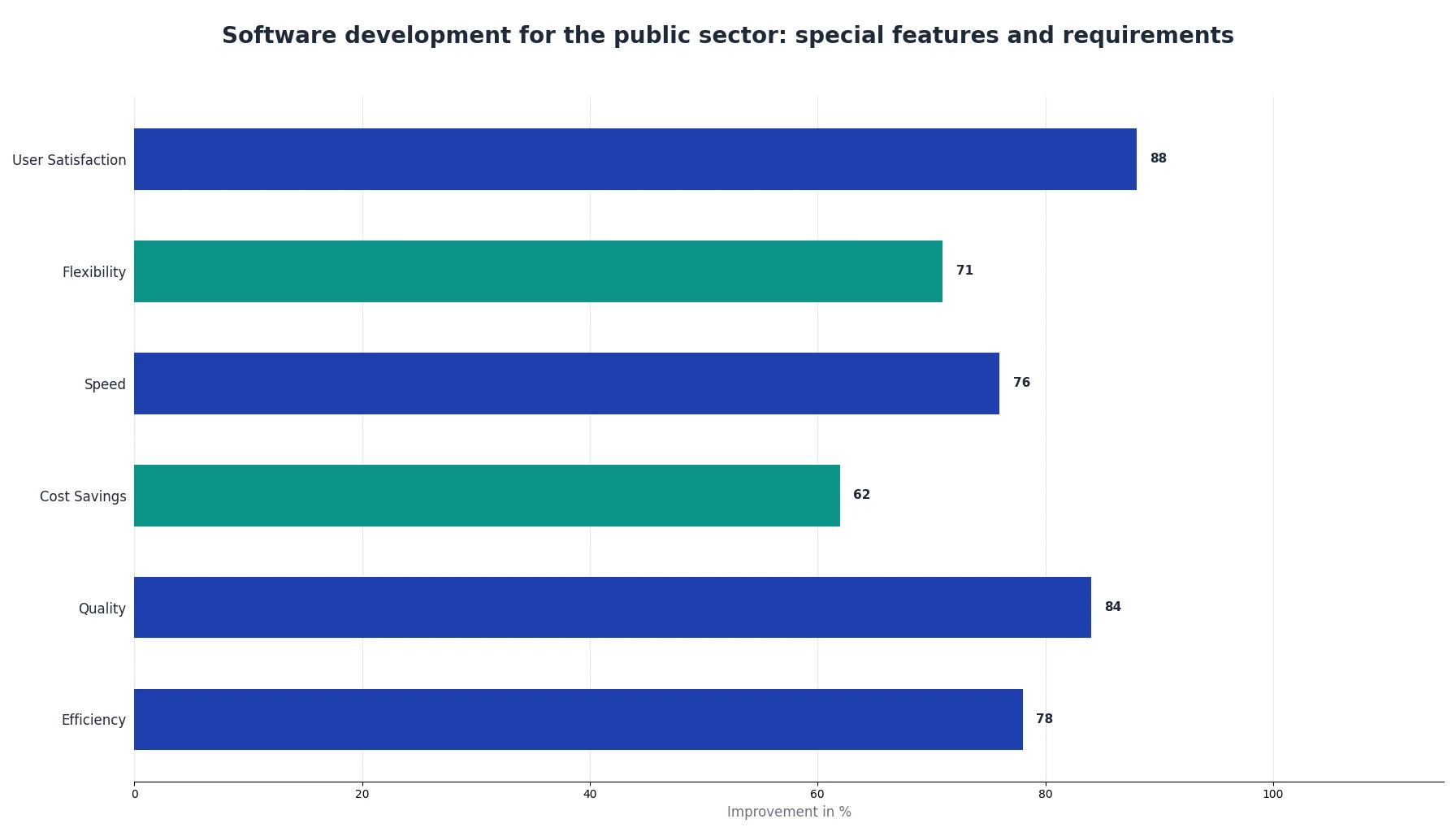
The uniqueness of the public sector
Short: In contrast to the private sector, the public sector operates in a highly regulated environment.
In contrast to the private sector, the public sector operates in a highly regulated environment. Legal requirements, complex hierarchies and long-term decision-making processes shape everyday life.
Software must not only be functional, but must seamlessly integrate into existing administrative structures and address a broad, heterogeneous user group – from administrative staff to citizens of all age and technology levels.
This uniqueness leads to a catalogue of requirements that goes far beyond purely technical aspects.
Special requirements for software development
Short: Anyone who develops software for the public sector must meet a variety of specific requirements.
Anyone who develops software for the public sector must meet a variety of specific requirements. These can be divided into four central areas:
Security and privacy
Protection of sensitive civil and administrative data is a top priority. State IT systems are an attractive target for cyber attacks, which is why IT security requirements are extremely high.
Developers must strictly comply with the requirements of the General Data Protection Regulation (GDPR) and national laws such as the BSI Act. The principle “Security by Design” is not an option here, but a necessity.
This means that security aspects must be integrated from the start into the entire [development process](/services/software development), from architecture to implementation and regular security tests.
Accessibility and usability
Public services must be accessible to all citizens. Digital offers are no exception here.
According to the Barrier-free Information Technology Regulation (BITV 2.0), public websites and mobile applications must be designed so that they can be fully used by people with disabilities.
This includes aspects such as a clear structure, simple language, customizable font sizes and compatibility with screen readers. A high usability also ensures that the software can be used intuitively and efficiently by all users, making the app
Sources: Unless cited inline, market figures and percentages are for orientation; see public sources such as Bitkom (2025) and Destatis. Project budgets and examples: Groenewold IT Solutions, internal reporting 2026.
References and further reading
Short: The following independent references complement the topics in this article:
The following independent references complement the topics in this article:
- Bitkom – German digital industry association
- German Federal Office for Information Security (BSI)
- European Commission – Digital strategy
- MDN Web Docs (Mozilla)
- W3C – World Wide Web Consortium
"AI in mid-sized companies works when processes are measurable and data is trustworthy—a pilot without a success metric is theatre."
— Björn Groenewold, Managing Director, Groenewold IT Solutions
About the author

Managing Director of Groenewold IT Solutions GmbH and Hyperspace GmbH
Since 2009 Björn Groenewold has been developing software solutions for the mid-market. He is Managing Director of Groenewold IT Solutions GmbH (founded 2012) and Hyperspace GmbH. As founder of Groenewold IT Solutions he has successfully supported more than 250 projects – from legacy modernisation to AI integration.
Blog recommendations
Related articles
These posts might also interest you.

E-Government: Modern software solutions for authorities
Digitization has captured almost all areas of life and does not stop before public administration. Under the heading E-Government, a profound change takes place, ...
MVP budget correctly calculate: A guide for founders
For start-ups and established companies that want to validate a new digital product idea, the minimum Viable Product (MVP) is a decisive first step. A MVP allows it to be...
The true cost of a MVP: Hidden expenses and how to avoid them
The development of a minimum Viable Product (MVP) has become a popular strategy for start-ups and established companies to make a product idea quickly and cost-effective at the...
Free download
Checklist: 10 questions before software development
Key points before you start: budget, timeline, and requirements.
Get the checklist in a consultationRelevant next steps
Related services & solutions
Based on this article's topic, these pages are often the most useful next steps.
Related services
Related solutions
Cost calculators
More on Software development and next steps
This article is in the Software development topic. In our blog overview you will find all articles; under category Software development more posts on this subject.
For topics like Software development we offer matching services – from app development and AI integration to legacy modernisation and maintenance. We describe typical use cases under solutions. Our cost calculators give initial estimates. Key terms are in the IT glossary. Books and long-form guides appear on the publications page; deeper articles live under topics.
If you have questions about this article or want a non-binding discussion about your project, you can book a consultation or reach us via contact. We usually respond within one working day.