As of: 19 June 2026 · Reading time: 5 min
Key takeaways
- Learn how agile methods help with software recovery.
- Scrum, Kanban and best practices for saving failed projects.
Learn how agile methods help with software recovery. Scrum, Kanban and best practices for saving failed projects.
“Proactive maintenance costs a fraction of what an unplanned outage causes.”
– Björn Groenewold, Managing Director, Groenewold IT Solutions
Why Agile Methods Help With Software Maintenance
Short: Executive answer: Learn how agile methods help with software recovery.
Executive answer: Learn how agile methods help with software recovery.
When planning Agiles project management in software maintenance from idea to delivery, Cost Calculator: AI Development, Discover solutions, Software Maintenance sowie Cost Calculator: Software Maintenance offer practical next steps on our site.
Software maintenance is not a linear project. New issues appear unpredictably. Requirements evolve. Systems must remain stable while being improved.
Agile frameworks are well-suited to this environment. They provide structure without rigidity. They create transparency without bureaucracy.
Six Reasons Why Agility Helps
Short: Software maintenance projects that struggle typically share the same problems.
Software maintenance projects that struggle typically share the same problems. Agile methods address each one:
- Unclear project status — Short iterations create rapid transparency; everyone knows what is being worked on this week
- Lost stakeholder confidence — Regular demonstrations with working software restore trust faster than status reports
- Unknown technical risks — Iterative development surfaces hidden problems before they become critical
- Unmotivated teams — Self-organization and sprint autonomy increase engagement
- Scope creep — A prioritized backlog keeps the team focused on what matters most
- Knowledge gaps — Retrospectives create structured learning after each cycle
Scrum for Software Maintenance Projects
Adapting Scrum for Maintenance Context
Short: Standard Scrum uses two-week sprints focused on feature delivery.
Standard Scrum uses two-week sprints focused on feature delivery. For maintenance projects, adapt the framework:
- Shorten sprints to one week during crisis stabilization
- Define "Definition of Stable" before pursuing new features
- Reserve 20–30% of sprint capacity for unplanned issues
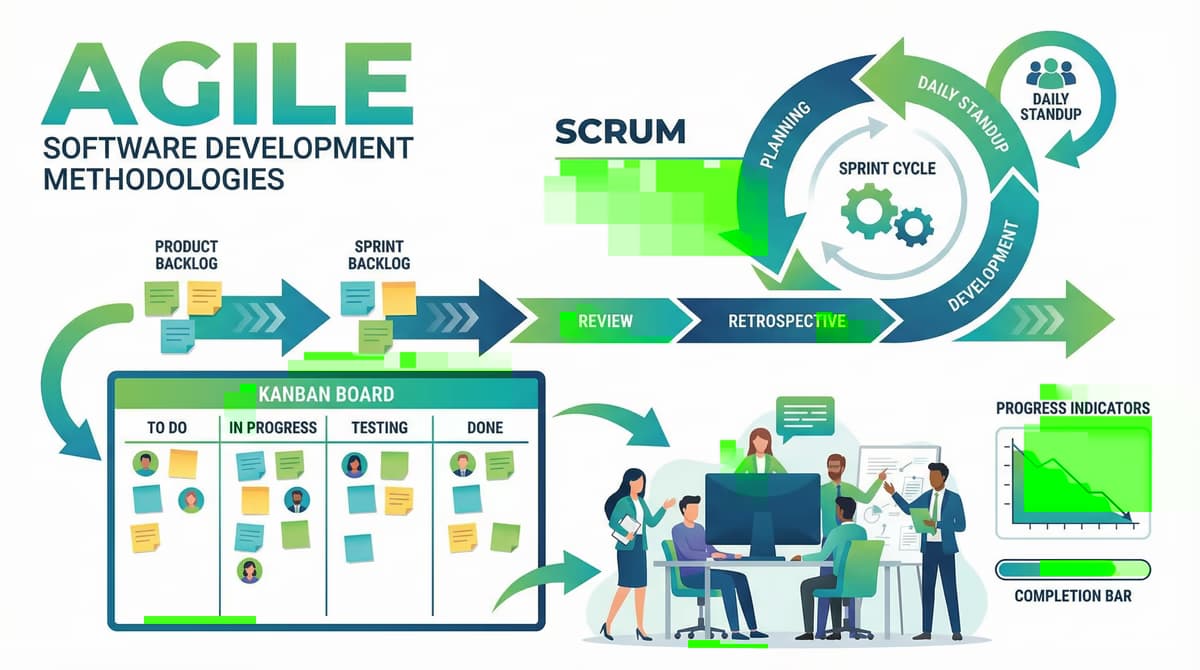
The Four Scrum Events in Maintenance
Short: Sprint Planning — The team selects the most critical items from the backlog.
Sprint Planning — The team selects the most critical items from the backlog. For maintenance, this includes both planned improvements and known issues.
Daily Standup — 15-minute daily sync: what was done, what is planned today, what is blocked. Keeps the team aligned without long meetings.
Sprint Review — Show working software to stakeholders at the end of each sprint. Show what was stabilized or improved — not just what was fixed.
Retrospective — After each sprint: what worked, what did not, what changes next sprint. This is where teams learn.
Stabilization Before Features
Short: In maintenance rescue situations, stability comes first.
In maintenance rescue situations, stability comes first. Establish a "Definition of Stable" — agreed criteria for when the system is stable enough to begin feature development.
Without this boundary, maintenance and feature work compete for the same capacity, and neither is done well.
Kanban for Continuous Maintenance
When Kanban Fits Better Than Scrum
Kanban suits maintenance environments where:
- The scope of work is unclear at the start
- New tasks arrive continuously and unpredictably
- There is no clear sprint-end delivery expectation
The Three Kanban Principles for Maintenance
Short: WIP limits — Limit the number of tasks in progress simultaneously.
WIP limits — Limit the number of tasks in progress simultaneously. This prevents the team from spreading too thin. A task in progress should be finished before a new one starts.
Swimlanes — Separate stabilization work from new development on the same board. This makes the allocation of effort visible and prevents maintenance from being crowded out by feature requests.
Metrics — Track Lead Time (from task creation to completion) and Cycle Time (from task start to completion). Improving these numbers is the goal.
Five Critical Agile Practices for Maintenance Teams
- Daily standups — 15 minutes, every day, same time. Not optional during active stabilization.
- Retrospectives — Not optional when projects have problems. Problems without reflection repeat.
- Timeboxing — Discussions without a time limit become blockers. Define the box, make the decision, move on.
- Prioritized backlog — Everything is not equally urgent. Someone must make the call.
- Continuous integration — Automated tests catch regressions before they reach users.
Three Common Mistakes in Agile Maintenance Projects
- Using "agile" to justify absent planning — Agile means iterative and adaptive, not unstructured. A maintenance backlog without priorities is not agile. It is chaos with a label.
- Extending sprint duration — Longer sprints reduce feedback frequency. They delay the discovery of problems. If two weeks is too long, go to one week.
- Retrospectives without action — A retrospective that identifies problems but produces no changes is a meeting that wastes time. Every retrospective must end with at least one concrete action item assigned to a specific person.
Agile as a Tool, Not a Dogma
Short: Agile methods are tools.
Agile methods are tools. They exist to help teams deliver better results, not to be applied dogmatically.
Adapt the framework to the situation. Shorten or lengthen cycles based on what the project needs. Keep what works. Change what does not.
"Proactive maintenance costs a fraction of what an unplanned outage causes." — Björn Groenewold, Managing Director, Groenewold IT Solutions
Frequently Asked Questions (FAQ)
What is this article about: “Agiles project management in software maintenance”?
This post explores Agiles project management in software maintenance from the perspective of requirements, typical pitfalls, and sensible next steps. In short: Learn how agile methods help with software recovery.
Scrum, Kanban and best practices for saving failed projects.
Who benefits most from the content described here?
Useful for project leads and product owners in Software maintenance who must choose between standard software, custom development, and integration.
How does this topic fit into an IT or digital strategy?
Technically and organizationally, alignment with experienced partners pays off — from requirements to operations; start with the [services overview](/en/services/artificial-intelligence). For multi-system landscapes, [IT consulting and architecture](/en/services/it-consulting) helps align vendors and internal teams.
What are sensible next steps if we need support?
A practical next step: book a consultation and clarify which MVP or pilot fits your team and landscape.
References and further reading
Short: The following independent references complement the topics in this article:
The following independent references complement the topics in this article:
About the author

Managing Director of Groenewold IT Solutions GmbH and Hyperspace GmbH
Since 2009 Björn Groenewold has been developing software solutions for the mid-market. He is Managing Director of Groenewold IT Solutions GmbH (founded 2012) and Hyperspace GmbH. As founder of Groenewold IT Solutions he has successfully supported more than 250 projects – from legacy modernisation to AI integration.
Blog recommendations
Related articles
These posts might also interest you.

Code review: Detecting quality problems early
Learn how code reviews reveal quality problems early. Best practices, checklists and tools for effective code reviews.

Software Rescue: How to bring back failed IT projects
Not every software project runs according to plan. Budget surpasses, missed deadlines or technical dead endes can meet any company. The good news: Most projects can still be saved. This guide will…

Security in software maintenance: How to protect your...
Security is a critical aspect of software maintenance. We will show you the most important safety practices that cannot be missed in any maintenance process.
Free download
Checklist: 10 questions before software development
Key points before you start: budget, timeline, and requirements.
Get the checklist in a consultationRelevant next steps
Related services & solutions
Based on this article's topic, these pages are often the most useful next steps.
Related services
Related solutions
More on Software maintenance and next steps
This article is in the Software maintenance topic. In our blog overview you will find all articles; under category Software maintenance more posts on this subject.
For topics like Software maintenance we offer matching services – from app development and AI integration to legacy modernisation and maintenance. We describe typical use cases under solutions. Our cost calculators give initial estimates. Key terms are in the IT glossary. Books and long-form guides appear on the publications page; deeper articles live under topics.
If you have questions about this article or want a non-binding discussion about your project, you can book a consultation or reach us via contact. We usually respond within one working day.