

As of: 4 May 2026 · Reading time: 3 min
Key takeaways
- In an increasingly digitized world where data are the new gold, the protection of personal data is increasingly focused.
- The General Data Protection Regulation (GDPR) has...
In an increasingly digitized world where data are the new gold, the protection of personal data is increasingly focused. The General Data Protection Regulation (GDPR) has...
“Good software is not an accident—it comes from a structured development process with clear quality standards.”
– Björn Groenewold, Managing Director, Groenewold IT Solutions
*January 2026 *
In an increasingly digitized world where data are the new gold, the protection of personal data is increasingly focused.
The General Data Protection Regulation (GDPR) has created a strict legal framework for this in Europe.
A central concept that companies need to take into account in the development of software and IT systems is "Privacy by Design".
But what is exactly behind it and why is it essential for a DSGVO compliant software?
What is Privacy by Design?
Privacy by Design, i.e. "Data protection through technology design", is an approach in which data protection is integrated from the start into the development of products and services.
Instead of considering data protection as a subsequent supplement, it becomes a fundamental part of the entire development process.
The aim is to act preventively and prevent data breaches before they can arise at all.
This proactive approach was developed by Dr. Ann Cavoukian, a leading Canadian data protection expert, and is based on seven basic principles.
The 7 basic principles of Privacy by Design
Short: These principles serve as a guide for the development of data protection-friendly technologies and processes.
These principles serve as a guide for the development of data protection-friendly technologies and processes. They help anchor the data protection deeply in the system architecture.
| Principle | Description |
|---|---|
| 1. Proactive, non-reactive; preventive, non-responsive | Data protection measures are implemented foresight to prevent data protection incidents instead of responding to them. |
| 2. Data protection as a default setting (Privacy by Default) | Systems are configured from the outset to provide the highest level of data protection. The user does not have to become active himself to protect his data. |
| 3. embedded data protection | Data protection is an integral part of the system and its architecture, no subsequent supplement. |
| 4. Full functionality – positive sum, not zero sum | Data protection and security are not considered as opposites. The aim is to safeguard both the interests of users and the functionality of the system. |
| 5. End-to-end security – protection over the entire life cycle | Personal data is protected across their entire life cycle – from collection to deletion. |
| 6. Visibility and transparency – true openness | The data processing processes are transparent and comprehensible for users. You know what data is being processed and why. |
| 7. Respect for the privacy of users – user centering | User interests and rights are at the centre of attention. The systems are user-friendly and provide users with control options about their data. |
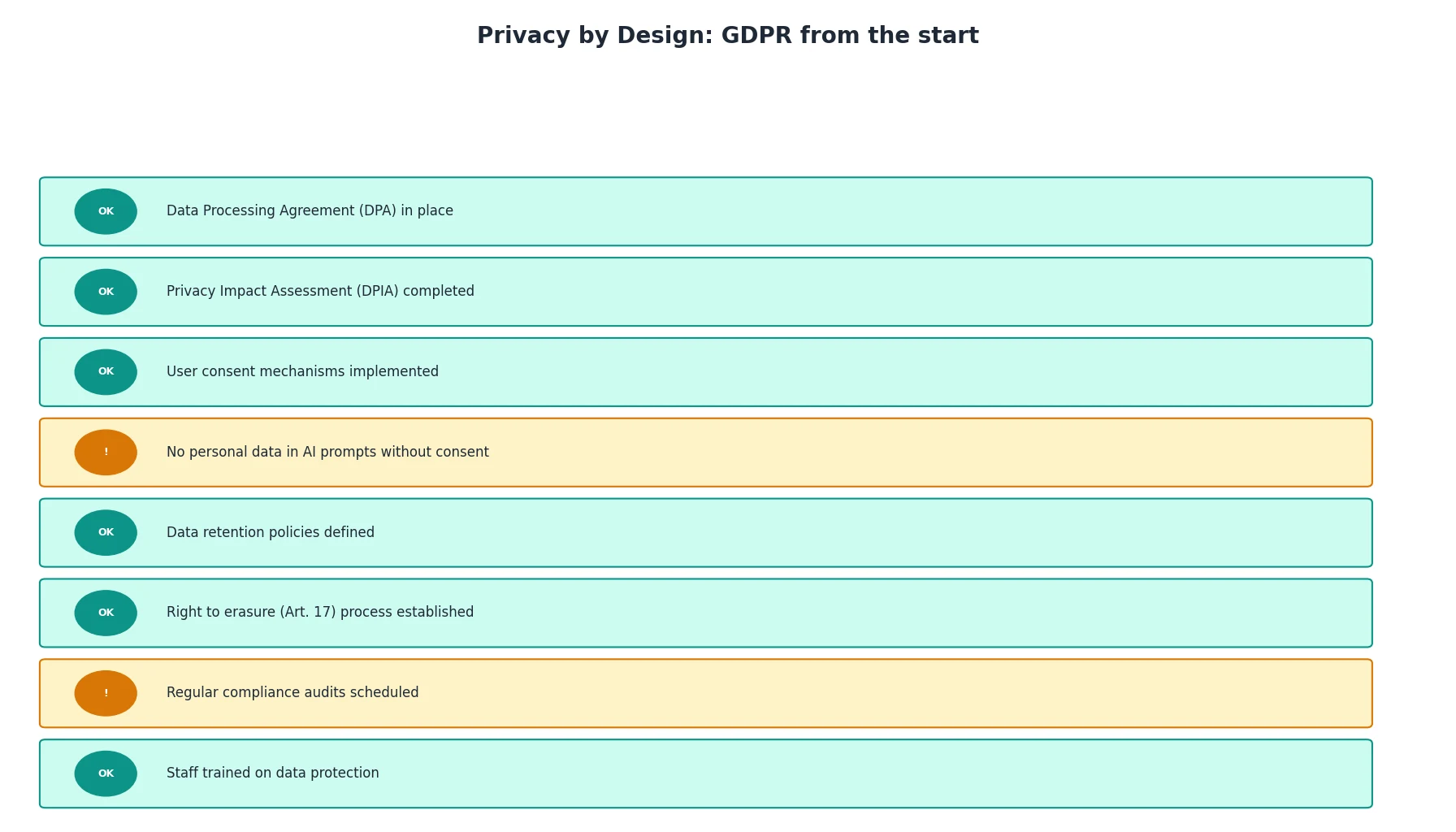
Why is Privacy by Design so for GDPR
References and further reading
Short: The following independent references complement the topics in this article:
The following independent references complement the topics in this article:
- Bitkom – German digital industry association
- German Federal Office for Information Security (BSI)
- European Commission – Digital strategy
- MDN Web Docs (Mozilla)
- W3C – World Wide Web Consortium
"Legacy migration often fails not because of the stack, but because tacit domain knowledge was never captured—budget explicitly for knowledge transfer."
— Björn Groenewold, Managing Director, Groenewold IT Solutions
About the author

Managing Director of Groenewold IT Solutions GmbH and Hyperspace GmbH
Since 2009 Björn Groenewold has been developing software solutions for the mid-market. He is Managing Director of Groenewold IT Solutions GmbH (founded 2012) and Hyperspace GmbH. As founder of Groenewold IT Solutions he has successfully supported more than 250 projects – from legacy modernisation to AI integration.
Blog recommendations
Related articles
These posts might also interest you.
Funding individual software: What options do companies have?
In today's digital landscape, customized software is no longer a luxury for many companies, but a need to remain competitive. Individual software can process...
Software Made in Germany: Why the development site counts
In a globalised world where digital solutions are ubiquitous, companies face the crucial question: where do we get our software? The answer to this question has far...
German software development: quality and reliability that convince
In a digitalized world where software forms the backbone of companies, the quality label "Made in Germany" has long established itself in the IT industry. But what exactly hides...
Free download
Checklist: 10 questions before software development
Key points before you start: budget, timeline, and requirements.
Get the checklist in a consultationRelevant next steps
Related services & solutions
Based on this article's topic, these pages are often the most useful next steps.
Related services
Related solutions
More on Software development and next steps
This article is in the Software development topic. In our blog overview you will find all articles; under category Software development more posts on this subject.
For topics like Software development we offer matching services – from app development and AI integration to legacy modernisation and maintenance. We describe typical use cases under solutions. Our cost calculators give initial estimates. Key terms are in the IT glossary. Books and long-form guides appear on the publications page; deeper articles live under topics.
If you have questions about this article or want a non-binding discussion about your project, you can book a consultation or reach us via contact. We usually respond within one working day.