
Software-Rettung
Digitization has revolutionized healthcare. What was primarily an administrative support is today the **backbone of patient care**. Modern clinics and medical practices are unthinkable without efficient IT systems. Whether Kr...
Many organisations have software that works but they don't know how it will hold up as they grow. A legacy code analysis replaces guesswork with facts. We look at your source code, architecture and infrastructure and find real risks – security holes, old dependencies, and maintainability bottlenecks that slow every new feature.
You get a prioritised action plan, not a generic checklist. You will see which parts are stable, which need work soon and where modernisation pays off most. Refactor, partly rebuild or migrate to a new stack – the analysis gives you the evidence to decide.
Detailed findings with severity ratings, code examples and concrete recommendations
Prioritised action plan with effort estimates, risk levels and quick wins
Whether to refactor, partially rebuild or start fresh – we tell you what makes economic sense
A legacy code analysis is the essential first step before investing in modernisation. By systematically assessing code quality, technical debt and security risks in your existing software systems, we give you the clarity you need to make informed decisions. Our analysis covers architecture, dependencies, test coverage and compliance – resulting in a concrete modernisation roadmap with prioritised actions and effort estimates.
Technical debt accumulates silently. What starts as a shortcut during a sprint becomes an architectural constraint that affects every future change. Our analysis quantifies that debt so you can budget for it and address it strategically rather than reactively. We have assessed codebases in Delphi, Java, .NET, PHP, Python and JavaScript – from monolithic desktop applications to distributed microservice architectures.
Every analysis concludes with a stakeholder presentation where we explain findings in business terms: risk exposure, estimated modernisation effort and the expected return on investment for each recommended action. This ensures both technical teams and decision-makers have a shared understanding of the path forward.
A typical analysis takes two to four weeks depending on the size and complexity of the codebase. Smaller systems with up to 100,000 lines of code can often be assessed within ten working days. We provide a time estimate after an initial scoping call.
No. We work exclusively with your source code repository and build configuration. If relevant, we may request anonymised database schemas or API documentation, but we never require access to live systems or customer data.
You receive a detailed report and a prioritised modernisation roadmap. We present the findings to your team and answer questions. If you decide to proceed with modernisation, we can support the implementation – but there is no obligation. Many clients use the report to brief internal teams or other vendors.
Frequently Asked Questions
A structured review of code quality, architecture, performance and security. You get documented findings with severity, impact and effort estimates, plus a prioritised modernisation roadmap.
Exactly 5 working days from kick-off to presentation. Day 1: access; days 2–4: analysis; day 5: presentation of the risk report.
We offer a fixed price; there are no hidden costs. The exact price is agreed in an initial call.
You receive a detailed report and a prioritised roadmap. We present the findings to your team. If you proceed with modernisation, we can support implementation – with no obligation.

A thorough analysis today prevents costly surprises tomorrow.
Book a callA thorough analysis today prevents costly surprises tomorrow. Let us assess your codebase.
Up to 50% of your investment via BAFA/KfW
Use our funding calculator to see which government grants may apply to your project.
Service cluster
Related services for Integration & Interfaces
Connect systems, stabilize data flows, and gradually modernize legacy – without big-bang risk.
Related topics
Complementary services from other areas
These services are frequently requested together with Legacy Code Analysis or complement it thematically.
Operations, Support & Stabilization
Consulting & Strategy
Legacy Code Analysis is most effective when it is aligned with your business goals, existing systems, and team capabilities. At Groenewold IT Solutions we combine product thinking, clear architecture, and hands-on delivery so that every project delivers measurable value. We address operational, compliance, and performance aspects early so that later releases stay on track.
Our approach to Legacy Code Analysis emphasises transparent backlogs, close collaboration with your stakeholders, and incremental delivery. Whether you need a discovery workshop, an MVP, or a full-scale implementation, we define scope, effort, and success criteria up front. With over 250 completed projects we have the experience to recommend the right level of investment and the right next steps for your situation.
Explore our services overview for the full portfolio, our topic pages for in-depth articles linked to each service, and the IT Glossary for key terms. For books and practical guides by Björn Groenewold, see publications. If you would like to discuss your project, we are happy to clarify scope, priorities, and a realistic timeline in a short consultation.
Decision guidance
Our topic overview links related articles and entry points alongside this service page.
Book a short, no-obligation intro call about Legacy Code Analysis – straightforward next steps.
Recent articles from our blog that match this service.
Digitization has revolutionized healthcare. What was primarily an administrative support is today the **backbone of patient care**. Modern clinics and medical practices are unthinkable without efficient IT systems. Whether Kr...
The energy and supply industry is facing the greatest transformation of its history. The **Energiewende** requires energy supply companies (EVUs) not only to switch to decentralised and renewable sources of production, but also...
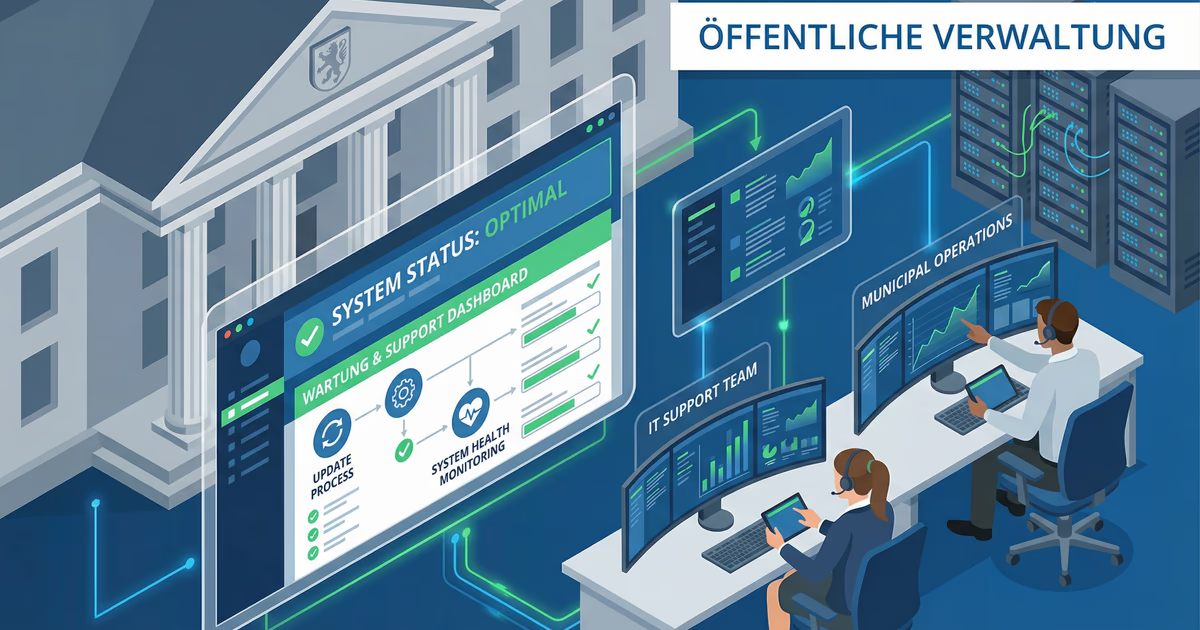
Software maintenance for public administration: How old systems lead to digital sovereignty
** Public administration** in Germany is facing one of the biggest challenges of its recent history: comprehensive **digitalization**. While the online access law (OZG) gives the clear order, administrative services to...