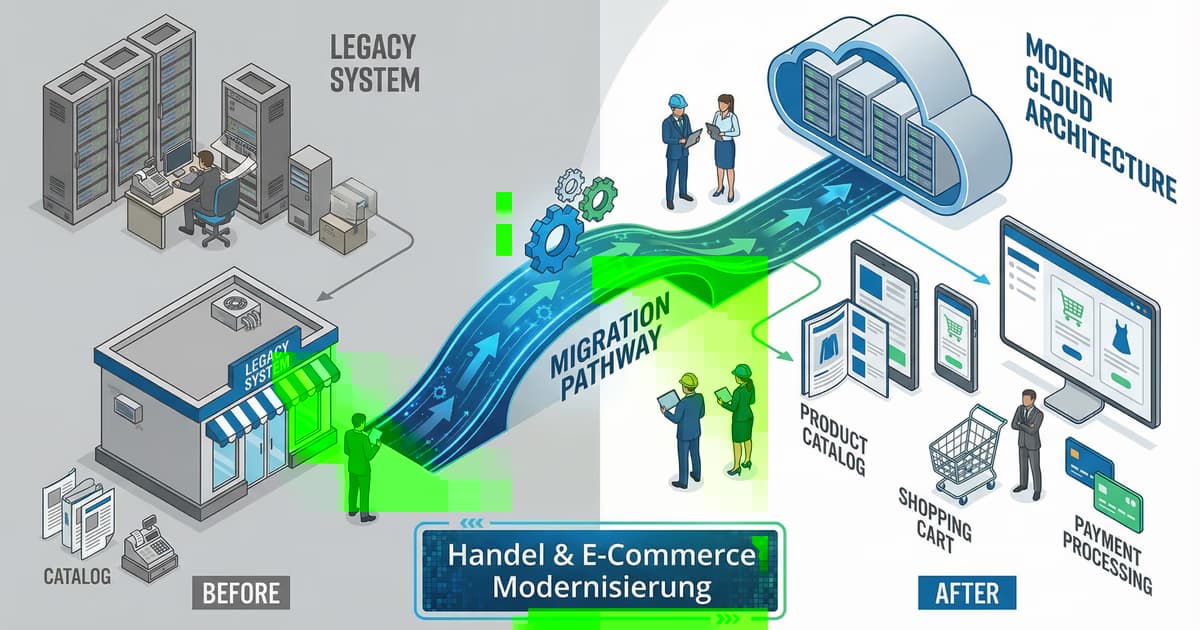
As of: 5 September 2026 · Reading time: 7 min
Key takeaways
- The energy and supply industry is at a historic turning point.
- The energy transition demands unprecedented agility from IT systems.
- Legacy systems create risks that now outweigh their perceived reliability.
The energy and supply industry (EVU) is at a historic turning point. The Energiewende, driven by political requirements, technological progress and changing customer requirements, requires unprecedented agility and...
“The real challenge in legacy modernization is not the code—it is keeping operations running without disruption.”
– Björn Groenewold, Managing Director, Groenewold IT Solutions
Legacy Modernization for Energy & Supply: The Way to Agile Energy Transition
Published: 9 January 2026 | Updated: 6 May 2026 | Reading time: 5 minutes Author: Björn Groenewold | Category: Legacy Modernization
"The real challenge in legacy modernization is not the code — it is keeping operations running without disruption." — Björn Groenewold, Managing Director, Groenewold IT Solutions
Key Takeaways
The energy and supply industry (EVU) is at a historic turning point.
When planning Legacy Modernization for Energy & Supply. The Way to Agile Energy… from idea to delivery, Legacy Modernisation, Cost Calculator. Legacy Modernisation, [Solution.
Legacy Reduction](/en/solutions/legacy-reduction) sowie Monolith vs. Microservices offer practical next steps on our site.
- The energy and supply industry is at a historic turning point.
- The energy transition demands unprecedented agility from IT systems.
- Legacy systems create risks that now outweigh their perceived reliability.
The Challenge: Why Legacy Systems Are a Risk
Short: Energy companies depend on IT systems that control critical infrastructure.
Energy companies depend on IT systems that control critical infrastructure. Grid operators, utilities, and water suppliers all rely on them. Many of these systems were built decades ago.
They feel stable and familiar. But they more often create risks.
High Operating Costs
Short: Legacy IT is expensive to maintain.
Legacy IT is expensive to maintain. Total Cost of Ownership (TCO) rises steadily as systems age. That capital should fund grid modernization — instead it goes to maintenance.
Key cost drivers:
- Spare parts for old hardware are hard to find and expensive.
- Old software licenses cost money despite shrinking usefulness.
- Manual workarounds eat up staff time every day.
- Connecting old and new systems requires custom development and ongoing upkeep.
Lack of Scalability
Short: The energy market is changing fast.
The energy market is changing fast. Legacy systems were not built for today's demands. New business models need IT features that old platforms simply do not have.
Where legacy systems fall short:
- Decentralized production: Thousands of small sources (solar, wind, biogas) need real-time data processing. Legacy systems cannot handle this.
- Smart Metering: Digital meters produce large volumes of data steadily. Legacy systems were built for monthly billing cycles — not this scale.
- Renewable energy integration: Balancing variable generation against demand needs dynamic forecasting. Legacy platforms cannot do this.
- Cloud connectivity: Modern analytics tools run in the cloud. Legacy systems often cannot connect without major custom work.
Regulatory Complexity
Short: The energy sector is heavily regulated.
The energy sector is heavily regulated. New laws demand system changes. Legacy environments make these changes difficult and costly.
Key regulatory pressures:
- MaBiS: Rules for market communication in energy balancing require specific data formats. Legacy systems often need manual workarounds to comply.
- GDEW (Act on Digitization of the Energy Transition): This law requires digital metering and data communication. Legacy systems may not support the required standards.
- GDPR: Customer energy data is personal data. Legacy systems may not support access requests, deletion, or audit trails.
Every new regulation becomes a costly modification project on a legacy platform.
1. What Legacy Modernization Means for Energy Companies
Short: Modernization is not a single project.
Modernization is not a single project. It is a structured process. The goal is to replace or upgrade outdated systems while keeping infrastructure running.
Key goals:
- Replace or extend billing and metering systems for smart meter data volumes.
- Connect Operational Technology (OT) — grid control, SCADA — to modern IT via secure interfaces.
- Build data architectures that support real-time analytics and forecasting.
- Implement APIs for integration with grid operators, regulators, and trading systems.
2. The OT/IT Integration Challenge
Energy companies run two separate technology layers.
- Operational Technology (OT) controls physical infrastructure — grid switching, substation management, pressure monitoring.
- Information Technology (IT) handles billing, CRM, analytics, and reporting.
Legacy systems in both layers often cannot share data directly. Grid events are invisible to billing systems. Consumption data does not reach analytics platforms automatically.
This creates blind spots and manual reconciliation work.
How Modernization Closes This Gap
- Standard data protocols (IEC 61968, IEC 61970, MQTT) let OT and IT communicate.
- Data platforms aggregate and contextualize operational and commercial data.
- APIs give third-party tools secure, structured access to data.
3. Modernization Approaches
Strangler Fig Pattern
Short: New functions are built around the existing system.
New functions are built around the existing system. Each new capability is delivered by a modern component. The legacy system keeps doing what it still does well.
Over time, the legacy system handles less and less. Eventually it can be decommissioned. This approach suits energy companies where continuity is non-negotiable.
API Layer Addition
Short: A middleware layer exposes legacy system data to modern applications via APIs.
A middleware layer exposes legacy system data to modern applications via APIs. Smart Metering platforms, customer portals, and analytics tools connect through these APIs.
The legacy core is not touched.
New services can be delivered at once.
Module-by-Module Migration
Custom business functions are migrated to modern platforms in sequence:
- Billing
- Metering
- Grid management
- Customer portal
Each migration is a contained project with a defined scope. Operations continue across.
4. What IT Managers Need to Assess
Before starting modernization, answer these key questions:
- Which systems control critical grid infrastructure — and what is the downtime risk during migration?
- What data exchange formats do regulators require?
- Where does OT end and IT begin — and what data currently crosses that boundary manually?
- Which compliance deadlines define the modernization timeline?
- What is the realistic budget for a multi-year program?
5. Getting Started
A practical first step:
- Map all current systems — billing, metering, grid control, CRM — and document their dependencies.
- Find the highest-risk legacy system — the one where failure has the greatest operational or compliance impact.
- Assess what data that system holds and what connects to it.
- Design a migration path that keeps operations running across.
- Run a pilot migration of one module with a defined rollback plan.
References and Further Reading
- Bitkom — German digital industry association.
- German Federal Office for Information Security (BSI).
- European Commission — Digital strategy.
- MDN Web Docs (Mozilla)
- W3C — World Wide Web Consortium.
About the Author: Björn Groenewold (Dipl.-Inf.) is Managing Director of Groenewold IT Solutions GmbH and Hyperspace GmbH. Since 2009, he has built software solutions for the mid-market.
He founded Groenewold IT Solutions GmbH in 2012 and has supported more than 250 projects — from legacy modernization to AI integration.
Frequently Asked Questions (FAQ)
What is this article about: “Legacy Modernization for Energy & Supply: The Way to Agile Energy Transition”?
This post explores Legacy Modernization for Energy & Supply. The Way to Agile Energy Transition from the perspective of needs, typical pitfalls. And sensible next steps.
The energy and supply industry (EVU) is at a historic turning point.
The Energiewende, driven by political needs, technical progress and changing customer needs, requires unprecedented agility and...
Who benefits most from the content described here?
Useful for project leads and product owners in Legacy-Modernisierung who must choose between standard software, custom development, and integration.
How does this topic fit into an IT or digital strategy?
Technically and organizationally, alignment with skilled partners pays off — from needs to operations. Start with the services overview.
For multi-system landscapes, IT consulting and architecture helps align vendors and internal teams.
What are sensible next steps if we need support?
A practical next step: book a consultation and clarify which MVP or pilot fits your team and landscape.
The following separate references complement the topics in this article:
About the author

Managing Director of Groenewold IT Solutions GmbH and Hyperspace GmbH
Since 2009 Björn Groenewold has been developing software solutions for the mid-market. He is Managing Director of Groenewold IT Solutions GmbH (founded 2010) and Hyperspace GmbH. As founder of Groenewold IT Solutions he has successfully supported more than 250 projects – from legacy modernisation to AI integration.
Blog recommendations
Related articles
These posts might also interest you.
Legacy-Modernization for Crafts & Services: Your way from the IT-Falle
In an increasingly digitized economy, craft businesses and service companies face the challenge of making their business processes efficient, safe and sustainable. While modern technologies such as…
Legacy Modernization for Financial Services & Banks: The Way to the Digital Future
The financial sector is facing a profound change. Driven by new digital competitors (FinTechs), changing customer expectations and a steadily more complex regulatory system, banks and financial…
Legacy Modernization in Logistics & Transport: The Way to Digital Supply Chain
The logistics and transport industry is the backbone of the global economy. But while the demands on speed, transparency and sustainability are constantly rising, many companies are fighting with an…
Free download
Checklist: 10 questions before software development
Key points before you start: budget, timeline, and requirements.
Get the checklist in a consultationRelevant next steps
Related services & solutions
Based on this article's topic, these pages are often the most useful next steps.
Related services
Related solutions
Related comparison
Cost calculators
Related industries
Practical next steps after Legacy Modernization for Energy & Supply: The Way to Agile Energy Transition
Legacy Modernization for Energy & Supply: The Way to Agile Energy Transition addresses a practical choice for energy providers. Start with one clear goal: reduce legacy risk in controlled steps while daily work and key data remain available.
Check the current process, the data involved, and the result users need. Then record the main risks and define a small first step. This keeps the decision easy to review and gives your team a shared basis.
For implementation support, our legacy software modernization connects the article's guidance with architecture, delivery, and stable operations. Engineering and project ownership stay with our team in Leer, Germany.
This post belongs to Legacy-Modernisierung. Browse the related Legacy-Modernisierung articles or use the English software blog for other topics.
When budget is the next question, the software cost calculators provide planning ranges. The IT glossary explains key terms, while in-depth technology guides cover wider decisions.
If the topic affects a live project, book a technical consultation or send the context through our project contact form. We usually reply within one working day.