As of: 23 September 2026 · Reading time: 4 min
Key takeaways
- A comprehensive guide on Agile software development.
- Learn all about agile methods, MVP, Cloud, AI, legacy systems, DevOps and digital transformation.
A comprehensive guide on Agile software development. Learn all about agile methods, MVP, Cloud, AI, legacy systems, DevOps and digital transformation.
“Good software is not an accident—it comes from a structured development process with clear quality standards.”
– Björn Groenewold, Managing Director, Groenewold IT Solutions
Agile Software development: Scrum, Kanban and Co.
Agile Software development: Scrum, Kanban and Co. simply explained
A complete guide on Agile software development.
Leaders exploring Agile Software Development: Scrum, Kanban and Co. simple... can use View services, Cost Calculator: Software Development sowie Our Development Process as structured entry points.
Room to adapt and speed are crucial in the fast-paced world of technology. Rigid, linear development models belong to the past. The future belongs to agile software development.
But what is hidden behind Buzzwords like Scrum, Kanban and Sprints?
This article demystrates the agile methods and shows how they can help your company develop better software faster.
What is agile software development?
Agile software development is an stepwise approach in which needs and solutions arise through the teamwork of self-organizing, cross-functional teams. Instead of a large "Big Bang".
Release planned in advance, the software is built and delivered in small, functional increments. This allows continuous feedback, quick adjustments and high clarity across the entire process.
The Agile Manifesto: The four guiding principles
The basis of the agile movement is the "Agile Manifesto" formulated in 2001, which highlights four central values:
Individuals and interactions more than processes and tools
Functional software more than complete documentation
Teamwork with the customer more than contract negotiation
React on change more than following a plan
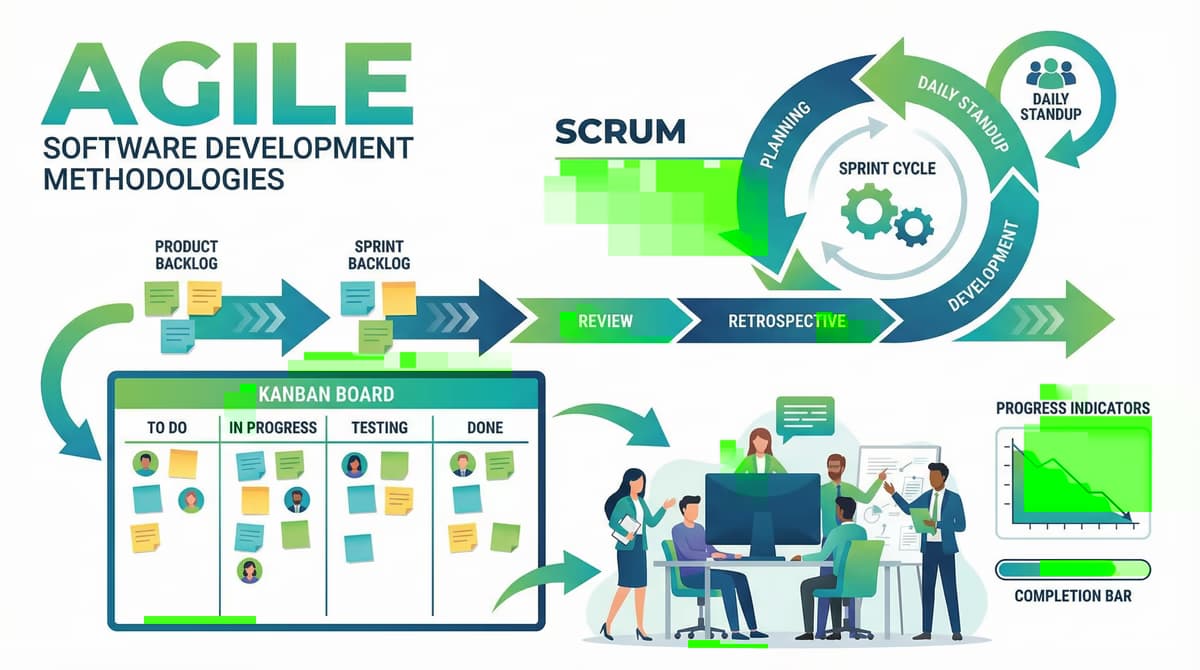
Scrum: The structured sprint
Short: Scrum is the most popular agile framework.
Scrum is the most popular agile framework. It structured the development in fixed periods of time, the so-called Sprints. This usually last 1-4 weeks.
Each sprint has a defined target and provides a potentially deliverable software increment.
The roles in Scrum
Product Owner: Represents the interests of the stakeholders and is responsible for the Product Backlog (the Requirement List).
Scrum Master: Make sure the team complies with the Scrum rules and eliminates obstacles.
Development team: A self-organized team of developers responsible for implementing the needs.
The Scrum events
Sprint Planning: The team plans which tasks will be introduced in the next sprint.
Daily Scrum: A short daily meeting to discuss progress and find obstacles.
Sprint Review: At the end of the sprint, the result is presented to the stakeholders.
Sprint Retrospective: The team reflects on the past sprint and identifies potential for improvement.
Kanban: The visual workflow
Short: Kanban is another agile method that focuses on visualization of the working flow.
Kanban is another agile method that focuses on visualization of the working flow. With a Kanban board, the entire process is presented transparently from idea to completion.
The work is divided into custom tasks (cards) which are divided by different columns
References and further reading
The following separate references complement the topics in this article:
- Bitkom – German digital industry association.
- German Federal Office for Information Security (BSI).
- European Commission – Digital strategy.
- MDN Web Docs (Mozilla)
- W3C – World Wide Web Consortium.
Frequently Asked Questions (FAQ)
What is this article about: “Agile Software Development: Scrum, Kanban and Co. simple...”?
This article sums up practical aspects of Agile Software Development. Scrum, Kanban and Co. simple... for leaders and delivery teams. In short: A complete guide on Agile software development.
Learn all about agile methods, MVP, Cloud, AI, legacy systems, DevOps and digital transformation.
Who benefits most from the content described here?
It is especially relevant for firms in Software development that need reliable systems, clear interfaces, and predictable delivery — from mid-market teams to expert departments.
How does this topic fit into an IT or digital strategy?
You can map the topic to service building blocks such as custom software and delivery support. Architecture reviews and stepwise rollout reduce risk and rework.
For multi-system landscapes, IT consulting and architecture helps align vendors and internal teams.
What are sensible next steps if we need support?
For architecture, rollout, or a second expert opinion, book a free initial consultation — including timeline and interface alignment.
About the author

Managing Director of Groenewold IT Solutions GmbH and Hyperspace GmbH
Since 2009 Björn Groenewold has been developing software solutions for the mid-market. He is Managing Director of Groenewold IT Solutions GmbH (founded 2010) and Hyperspace GmbH. As founder of Groenewold IT Solutions he has successfully supported more than 250 projects – from legacy modernisation to AI integration.
Blog recommendations
Related articles
These posts might also interest you.

Digitization in the middle class: The right technology selection as a success factor
Digitization is no longer an option for small and medium-sized enterprises (SMEs), but a need to compete. But Digitalization in the middle class is...
Digitization in the middle class: How to measure your success
Digitization is no longer a trend for medium-sized enterprises, but a need to remain competitive. But how to measure the success of Digitalisie...
Digital Transformation: Leadership and Change Management as key to success
Digital transformation is more than just the introduction of new technologies. It is a profound change process that affects companies of all sizes. Especially for small and...
Free download
Checklist: 10 questions before software development
Key points before you start: budget, timeline, and requirements.
Get the checklist in a consultationRelevant next steps
Related services & solutions
Based on this article's topic, these pages are often the most useful next steps.
Related services
Related solutions
Cost calculators
Practical next steps after Agile Software Development: Scrum, Kanban and Co. simple...
Agile Software Development: Scrum, Kanban and Co. simple... addresses a practical choice for product and IT teams. Start with one clear goal: align software scope, technical risk, and business value before the next investment.
Check the current process, the data involved, and the result users need. Then record the main risks and define a small first step. This keeps the decision easy to review and gives your team a shared basis.
For implementation support, our custom software development connects the article's guidance with architecture, delivery, and stable operations. Engineering and project ownership stay with our team in Leer, Germany.
This post belongs to Software development. Browse the related Software development articles or use the English software blog for other topics.
When budget is the next question, the software cost calculators provide planning ranges. The IT glossary explains key terms, while in-depth technology guides cover wider decisions.
If the topic affects a live project, book a technical consultation or send the context through our project contact form. We usually reply within one working day.