

As of: 4 May 2026 · Reading time: 3 min
Key takeaways
- In today's globalised world, companies are faced with a strategic decision in software development: Should they plan their development teams locally (Onshore), in nearby countries ...
In today's globalised world, companies are faced with a strategic decision in software development: Should they plan their development teams locally (Onshore), in nearby countries ...
“Good software is not an accident—it comes from a structured development process with clear quality standards.”
– Björn Groenewold, Managing Director, Groenewold IT Solutions
In today's globalised world, companies are faced with a strategic decision in [software development](/services/software development): Should they settle their development teams locally (onshore), in nearby countries (nearshore) or in distant regions (offshore).
Each of these models offers unique advantages and disadvantages that it is necessary to weigh carefully.
This article highlights the differences, analyzes the respective advantages and disadvantages and helps you make a sound decision for your company.
Choosing the right sourcing model is more than just a cost question; it affects the efficiency, product quality and ultimately the success of your entire project.
What is Onshore, Nearshore and Offshore?
Short: Before we enter the direct comparison, it is important to clearly define the terms:
Before we enter the direct comparison, it is important to clearly define the terms:
- Onshore development: The development team will be located in the same country as the contracting company. This ensures maximum cultural and linguistic consistency, minimum temporal differences and simple legal and administrative settlement. The collaboration feels like an extension of your own team.
- Nearshore development: This model shifts the development into a geographically close country with low time shift (typically 1-3 hours). For German companies, this would be countries such as Poland, Romania, Spain or Portugal. The cultural differences are often low and the working hours overlap mostly.
- **Offshore development:**The outsourcing takes place in faraway countries, often on other continents such as Asia or South America. Time shift is significant, which makes real-time communication difficult and requires asynchronous cooperation. Popular offshore targets are India, the Philippines or Vietnam.
The big comparison: Onshore vs. Nearshore vs. Offshore
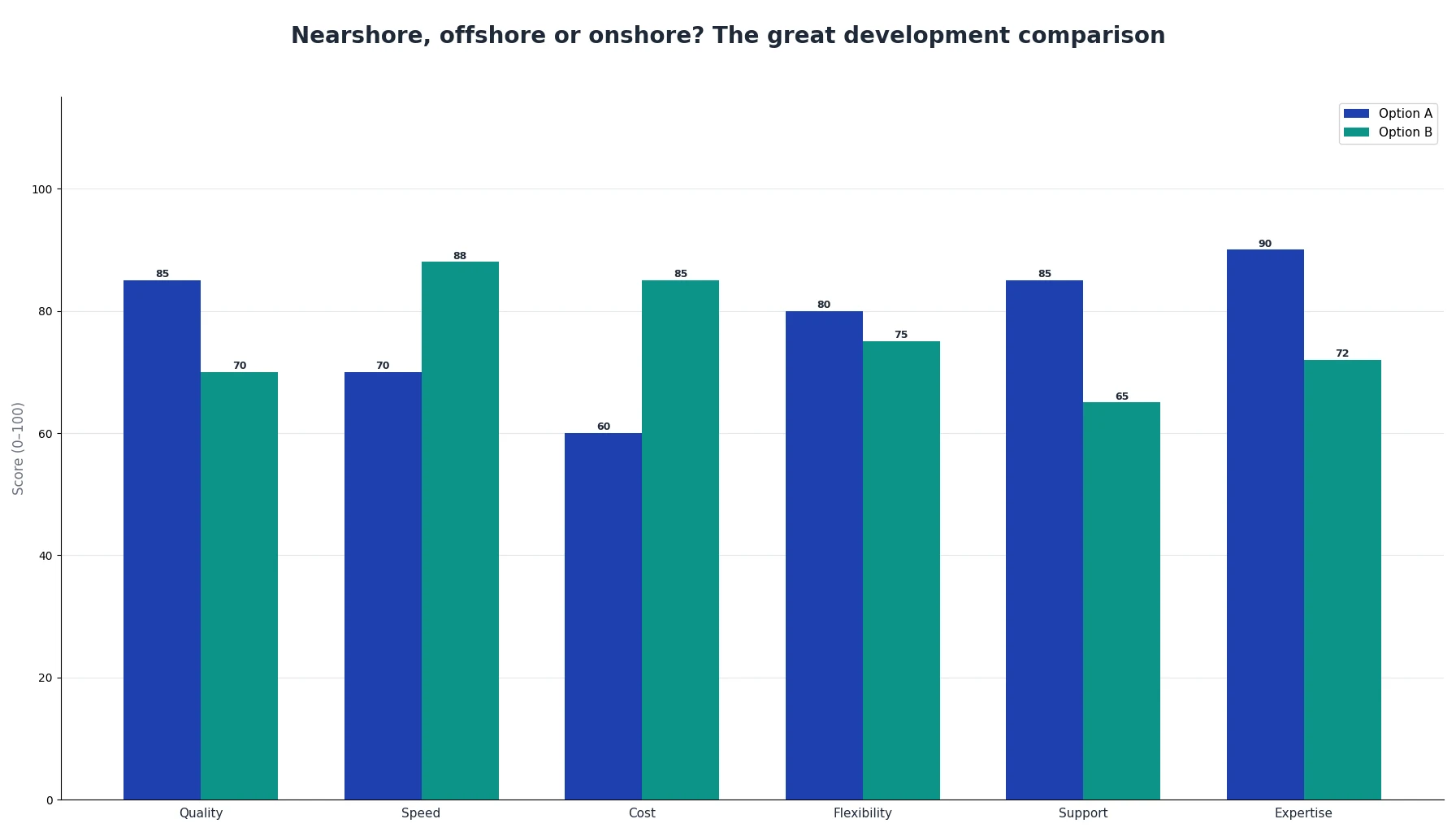
Short: The decision for one of the models depends on different factors, including costs, communication, quality and strategic objectives.
The decision for one of the models depends on different factors, including costs, communication, quality and strategic objectives. The following table gives a detailed overview of the main distinguishing features:
| Criterion | Onshore | Nearshore | Offshore | | :-- | :-- | :-- | :-- | :-- | | | | | | | | | | | | | | | | | | | | | | | | | | | | | Costen High | Moderate | Low | Communication Easy | Moderate | Complex | ** Time shift| No | Gering (1-3h) | High (>4h) | ** Cultural proximity| High | Moderat | Gering | ** ** Travel expenses** | Gering | Moderat | High | ** Talentpool | Limited | Extended | Very large |
Onshore development: quality and proximity have their price
Onshore development offers the simplest and most direct form of cooperation. Since the entire team is in the same country, there are no language barriers or significant cultural differences. Meetings can spo
References and further reading
Short: The following independent references complement the topics in this article:
The following independent references complement the topics in this article:
- Bitkom – German digital industry association
- German Federal Office for Information Security (BSI)
- European Commission – Digital strategy
- MDN Web Docs (Mozilla)
- W3C – World Wide Web Consortium
"Privacy by design is an architecture issue—especially when master data is personal."
— Björn Groenewold, Managing Director, Groenewold IT Solutions
About the author

Managing Director of Groenewold IT Solutions GmbH and Hyperspace GmbH
Since 2009 Björn Groenewold has been developing software solutions for the mid-market. He is Managing Director of Groenewold IT Solutions GmbH (founded 2012) and Hyperspace GmbH. As founder of Groenewold IT Solutions he has successfully supported more than 250 projects – from legacy modernisation to AI integration.
Blog recommendations
Related articles
These posts might also interest you.

German software development: quality and reliability that convince
In a digitalized world where software forms the backbone of companies, the quality label "Made in Germany" has long established itself in the IT industry. But what exactly hides...

Onshore instead of offshore: Why we develop exclusively in Germany
In the globalized world of IT services, companies are often faced with the strategic decision where they can develop their software. The options range from T...
Offshore risks: Why local development is often better
In today's globalised business world, the outsourcing of IT services, in particular software development, has become a common practice. The promise of significant...
Free download
Checklist: 10 questions before software development
Key points before you start: budget, timeline, and requirements.
Get the checklist in a consultationRelevant next steps
Related services & solutions
Based on this article's topic, these pages are often the most useful next steps.
Related services
Related solutions
More on Software development and next steps
This article is in the Software development topic. In our blog overview you will find all articles; under category Software development more posts on this subject.
For topics like Software development we offer matching services – from app development and AI integration to legacy modernisation and maintenance. We describe typical use cases under solutions. Our cost calculators give initial estimates. Key terms are in the IT glossary. Books and long-form guides appear on the publications page; deeper articles live under topics.
If you have questions about this article or want a non-binding discussion about your project, you can book a consultation or reach us via contact. We usually respond within one working day.