Delphi-to-.NET migration with feature parity, data conversion and pilot ops
A Delphi to .NET migration moves proven business logic to C#, VB.NET or Blazor step by step—without big-bang risk and with fully secured data migration.
For mid-sized companies: transparent cut-over planning—no silent production halt – delivery and project ownership from Germany (Leer/East Frisia), named contacts, no offshore guesswork.
- 250+ delivered projects
- 5.0 stars on Google
- 100% engineering in Germany
Why migrate Delphi to .NET?
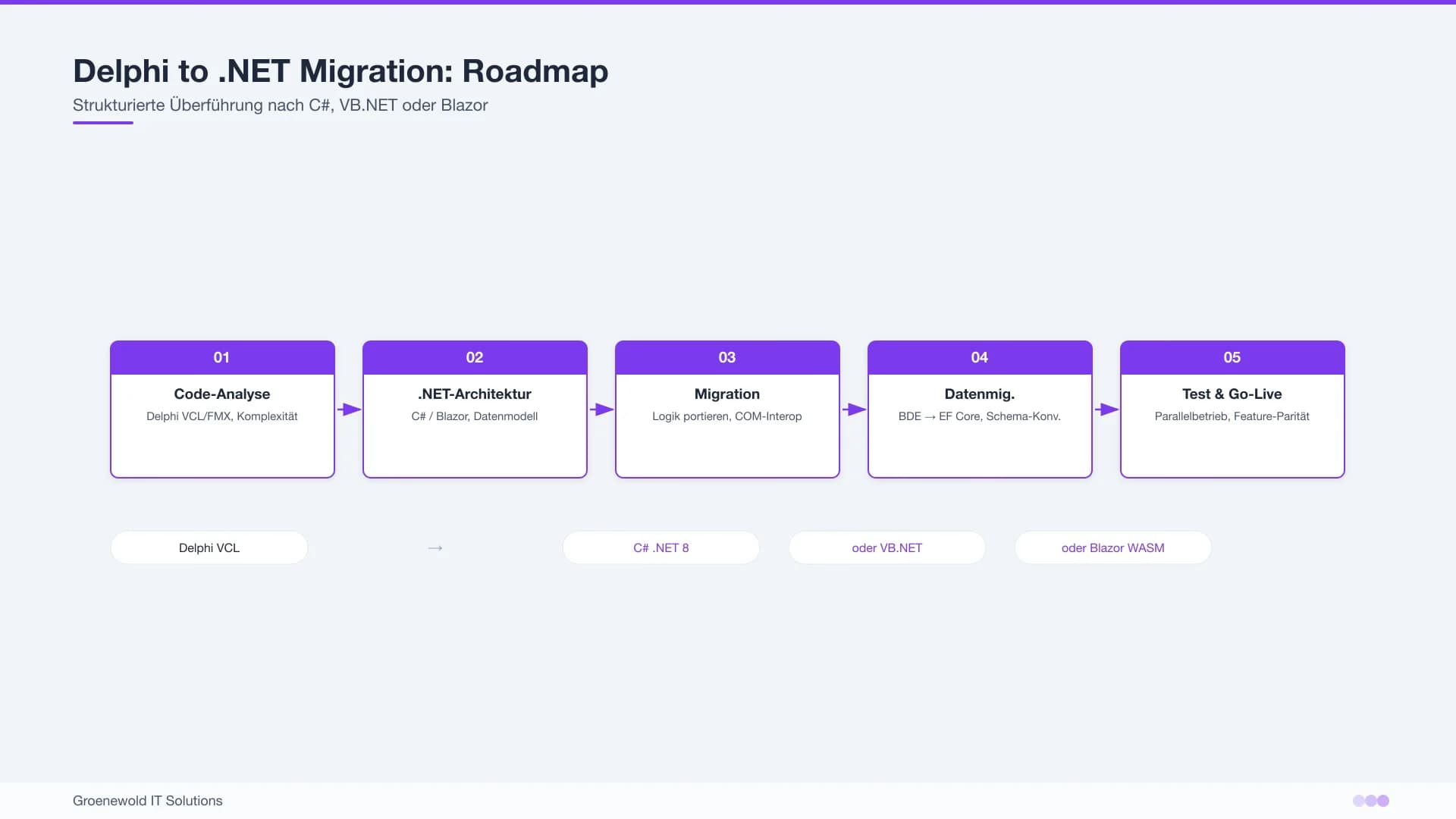
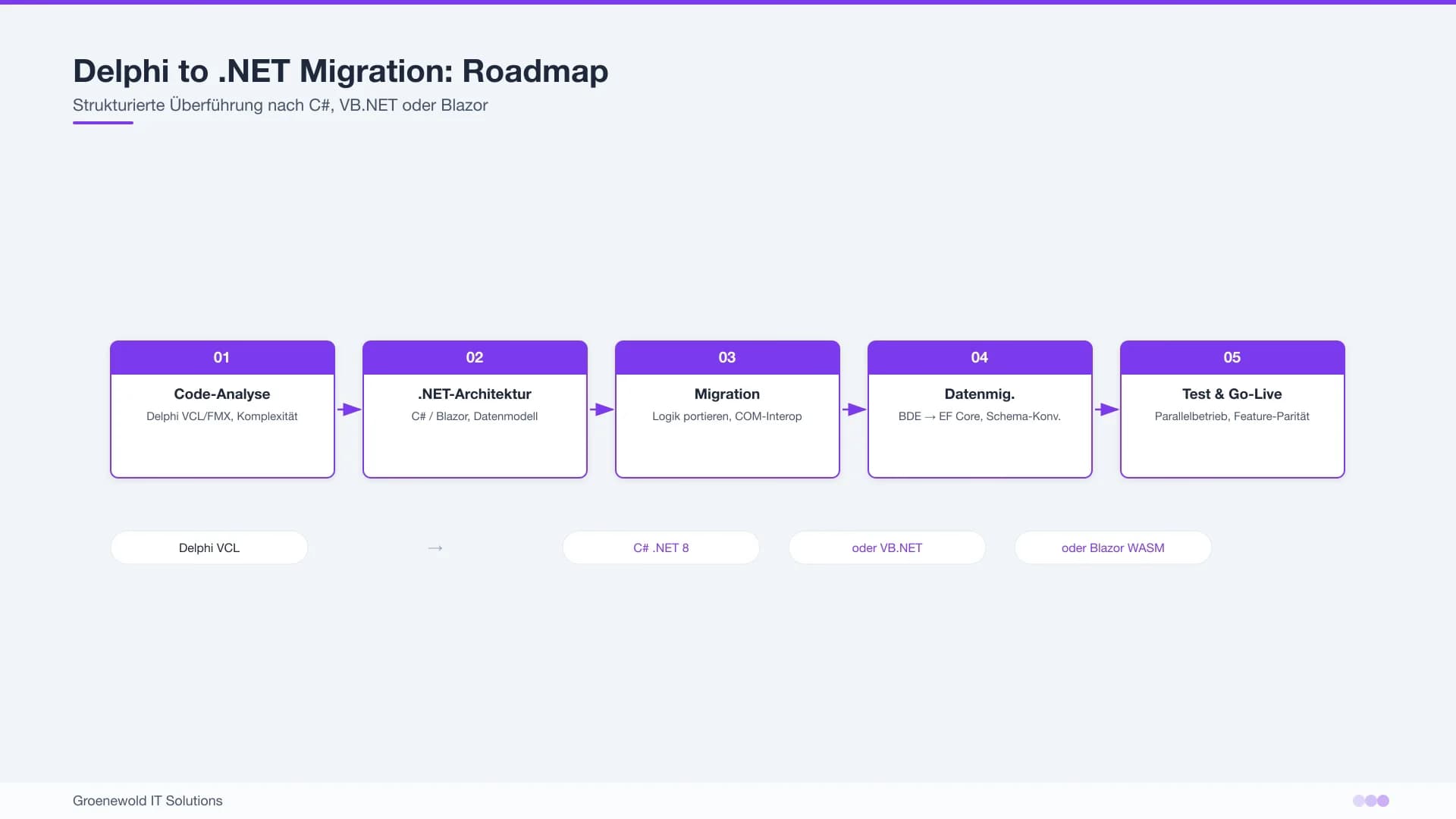
A Delphi to .NET migration is the logical next step for many mid-market companies: Delphi applications with years of business logic are moved to C#, VB.NET or Blazor without rewriting proven processes. Incremental delivery works—COM interop lets Delphi and .NET modules run in parallel until cut-over is complete.
Delphi remains excellent for native desktop workloads. Long-term, staffing pools, library ecosystems and your integration landscape matter: if you want to grow teams in C# or web stacks, align ERP and cloud connectivity through system integration in the .NET ecosystem, or standardise on enterprise identity patterns (.NET, Entra ID, OIDC), a Delphi to .NET migration can reduce total cost of ownership—without rewriting business rules from scratch. We assess whether a strangler-style decomposition or a bounded domain slice is the lowest-risk route.
How does the migration process work?
We begin with a dependable baseline review: modules, persistence, UI flows, batch jobs and external interfaces. Then we define the target—WinForms or WPF for classic rich desktop work, Blazor for browser-first delivery across sites, or .NET MAUI when you need one UI stack across Windows and additional device classes. Work is sliced so production cadence continues: critical domains first, automated tests where feasible, data migration with reconciliations and explicit interface contracts.
What about third-party stacks (DevExpress, TMS, FastReport)?
Where vendors provide .NET equivalents, we can carry capabilities forward or choose controlled alternatives (reporting: SSRS, DevExpress Reporting; grids/trees: respective .NET packages). Where no direct match exists, we encapsulate UI capability and replace incrementally. Reports are not “blindly” converted—layouts and edge cases are validated with business stakeholders. COM and ActiveX dependencies are replaced with supported .NET libraries or bounded interop seams with a clear sunset plan.
Which .NET target fits WinForms, WPF, Blazor or MAUI?
| Criterion | WinForms | WPF | Blazor | .NET MAUI |
|---|---|---|---|---|
| Similarity to Delphi VCL | Very high | Medium (MVVM) | Lower (web model) | Medium |
| Learning curve | Low for desktop teams | Medium | Medium–higher | Medium |
| Future-proofing | Stable, classic UI limits | Strong on Windows desktop | Strong for browser-centric roadmaps | Depends on device mix |
| Cross-platform reach | Windows-focused | Primarily Windows | Browser clients | Broad device mix possible |
| UI modernity | Classic | Highly flexible styling | Modern for distributed users | Modern, platform policies apply |
What does a Delphi-to-.NET migration cost?
Cost depends on domain breadth, data migration, reporting estate and interfaces—not a single LOC metric. After an initial assessment we provide phased planning with credible ranges and optional fixed scopes for well-bounded packages. Budget guidance: our Delphi cost calculator; for Delphi-specific context see Delphi development; for data and BI follow-ups see database & business intelligence; for modernization ROI see legacy modernization ROI calculator.
Typical dependency moves
We move data access from BDE or legacy ADO paths to Entity Framework Core or Dapper depending on performance and team skill. Crystal Reports or legacy viewers are mapped to SSRS, DevExpress Reporting or other sustainable targets—including layout workshops. COM and ActiveX are replaced with NuGet-based components or encapsulated services so no hidden process coupling remains in production. The approach aligns with our legacy modernization practice; comparable desktop migrations such as VB6 replacement on .NET follow the same incremental pattern.
Related services
A specific Delphi-to-.NET migration engagement
This page is for organisations with a genuine replacement decision. We map business logic, data paths and third-party components, select the .NET target and plan pilots, reconciliation and cutover. Parallel operation reduces risk but cannot guarantee an interruption-free migration. For ongoing fixes without a stack change, use Delphi maintenance and development.
Frequently asked questions
FAQ: Delphi to .NET migration
Answers on cost, timeline, target architecture and technical dependencies—for leadership and IT.
Strategy, cost and timeline
Can Delphi code be converted to C# automatically?
Delphi-to-.NET tools deliver syntactic rough conversion—not business correctness.
Logic, data access, UI components and third-party dependencies must be reviewed and adapted manually. We use converters as a starting point, not the finish line; quality assurance is handled by our team in Germany.
What does a Delphi to .NET migration cost?
Cost depends on system size, dependencies and UI strategy.
Smaller systems under ~50,000 LOC: typically €30,000–80,000. Larger ERP-like estates: €100,000–400,000. We start with an assessment for credible phasing and optional fixed scopes for bounded packages. Guidance: /en/costs/delphi-development and /en/costs/roi-modernization.
How long does a Delphi migration take?
A careful Delphi to .NET migration typically takes 6–18 months.
We recommend incremental delivery: assessment, pilot module, then phased replacement—operational risk is checked and limited for each wave. COM interop lets Delphi and .NET modules run in parallel until cut-over.
WinForms, WPF, Blazor or MAUI—which target fits?
WinForms for fast 1:1 desktop carry-over with low learning curve.
WPF for modern Windows desktop UI with MVVM. Blazor when teams are distributed and browser UI is enough. MAUI when you need one UI stack across Windows and additional device classes. We decide after assessment—not by hype.

Plan your Delphi to .NET migration
In an initial call we clarify target architecture, phases and realistic budget ranges.
Technical delivery and third-party stacks
Can the Delphi system keep running during migration?
Yes—incremental migration is our default.
Critical modules stay productive in Delphi while new domains ship in .NET. COM interop or API boundaries separate the stacks cleanly. Each step is testable and releasable before the next begins—no big-bang risk.
What happens to DevExpress, TMS, FastReport and COM components?
Where .NET equivalents exist, we plan strategic carry-over or controlled alternatives (e.g.
DevExpress Reporting, SSRS). Reports are validated with business stakeholders—not blindly converted. COM and ActiveX are replaced with NuGet packages or encapsulated services with a clear sunset plan.
How do we migrate BDE, ADO and FireDAC to .NET?
Data access moves to Entity Framework Core or Dapper—with explicit separation between persistence and business logic.
Delta migration before go-live is checked with count, total and sample reconciliation; remaining discrepancies are documented. We can tie in /en/services/database-business-intelligence for reporting and BI follow-ups where needed.
Do we need in-house .NET skills after go-live?
Long term yes—but not everything on day one.
We document architecture, deployments and runbooks, train your team and can operate releases under retainer. The goal is not permanent dependency on an external silo; handover is part of every migration engagement.

Up to 50% of your investment via BAFA/KfW
Use our funding calculator to see which government grants may apply to your project.
Björn Groenewold – Managing Director