
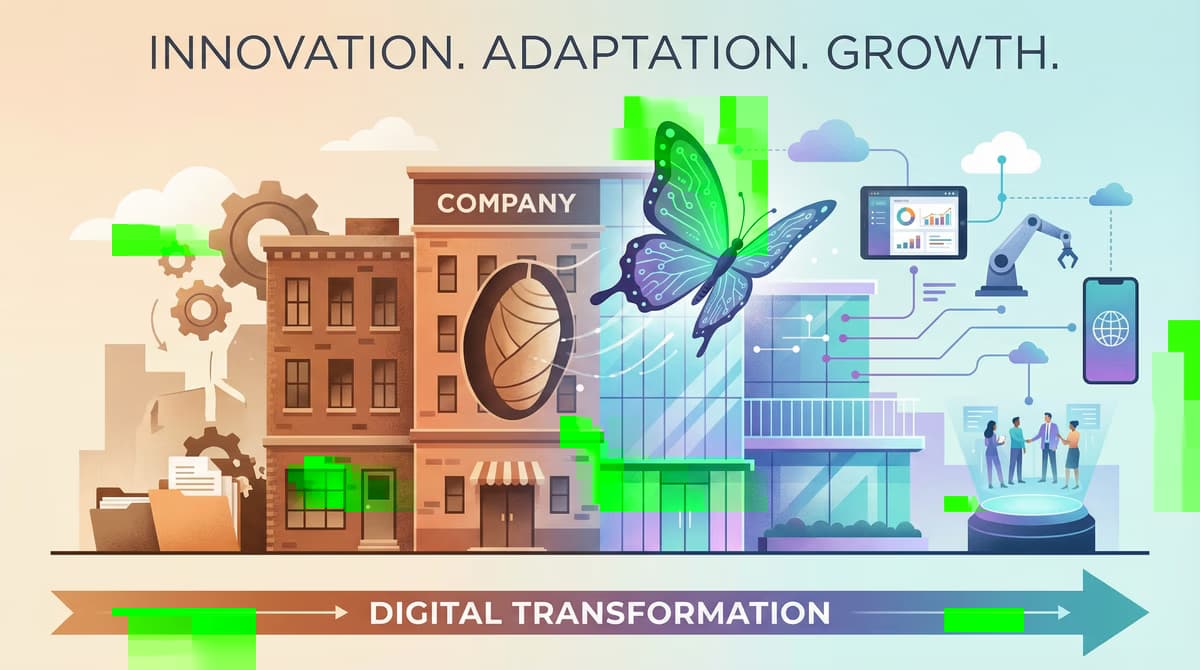
Digitization is no longer a trend, but a decisive prerequisite for the sustainable success of small and medium-sized enterprises (SMEs). But how to develop a fit...
“Digitalization is not an IT project—it is a business strategy.”
– Björn Groenewold, Managing Director, Groenewold IT Solutions
> Key Takeaway: A digitalization strategy for SMEs does not start with technology but with analyzing the biggest pain points in existing processes. The practical path: document the as-is state, prioritize by quick-win potential, start a pilot project, and apply lessons to other areas.
Digitization is no longer a trend, but a decisive prerequisite for the sustainable success of small and medium-sized enterprises (SMEs).
But how do you develop a suitable digitalization strategy that really advances your own company?
This article provides a practical guide and shows how the Digitalization can achieve middle level.
Why is a digitalization strategy vital to the middle class?
Short: A sophisticated digitalization strategy is far more than just the introduction of new technologies.
A sophisticated digitalization strategy is far more than just the introduction of new technologies. It is the timetable that ensures that all digital initiatives are paid to the higher corporate objectives. The advantages of a strategic approach are manifold:
- ** Increase in efficiency:** Digital processes and automated processes reduce manual effort, minimize error sources and release valuable resources for strategic tasks.
- Improved customer service: Digital channels and CRM systems allow SMEs to better understand their customers, to respond more individually and create a seamless customer experience.
- Cost reduction: A paperless office, optimized supply chains and more efficient production processes lead to appreciable cost savings.
- Competitiveness: Companies that actively shape digitalization can react faster to market changes and develop new business areas.
Customer expectations have changed radically in the digital age. They demand fast response times, personalized offers and a transparent service. Only those who meet these requirements will be able to exist on the market in the long term.
The 5 phases to develop your digitalization strategy
Short: A successful digitalization strategy is not developed overnight.
A successful digitalization strategy is not developed overnight. It is the result of a structured process that can be divided into five phases:
| Phase | Name | Activities | | :--- | :-- | :-- | | | | | | | | | | | | | | | | | | | | | | | | | | | | | | | | | | | | | | | | | | | | | | | | | | | | | | | | | | | | | | | | | | | | | | | | | | | | | | | | | | | | | | | | | | | | | | | | | | | | | | | | | | | | | | | | | | | | | | | 1 | ** Analysis of the initial situation (IST analysis)** | - Internal analysis of existing processes, systems and competencies <br>- External analysis of market, competition and technology trends <br>- Implementation of a SWOT analysis (strengths, weaknesses, opportunities, risks) | | 2 | ** Target definition (SOLL condition)** | - derivation of clear and measurable targets (e.g.
according to the SMART method) <br>- definition of the desired positioning in the digital environment <br>- definition of KPIs for success measurement | | 3 | Measure plan | - Development of concrete measures to achieve the defined objectives <br>- Priority and benefit of measures <br>-- Creation of a roadmap with schedule and responsibilities | | 4 | ** Implementation** | - Stepwise implementation of the planned measures <br>- Active integration and training of employees <br>- establishment of an agile
Sources: Unless cited inline, market figures and percentages are for orientation; see public sources such as Bitkom (2025) and Destatis. Project budgets and examples: Groenewold IT Solutions, internal reporting 2026.
References and further reading
Short: The following independent references complement the topics in this article:
The following independent references complement the topics in this article:
- Bitkom – German digital industry association
- German Federal Office for Information Security (BSI)
- European Commission – Digital strategy
- MDN Web Docs (Mozilla)
- W3C – World Wide Web Consortium
<!-- v87-geo-append -->
About the author

Managing Director of Groenewold IT Solutions GmbH and Hyperspace GmbH
For over 15 years Björn Groenewold has been developing software solutions for the mid-market. He is Managing Director of Groenewold IT Solutions GmbH and Hyperspace GmbH. As founder of Groenewold IT Solutions he has successfully supported more than 250 projects – from legacy modernisation to AI integration.
Blog recommendations
Related articles
These posts might also interest you.
Altsystem migration: risk management and fallback strategies for a smooth transition
The Altsystem migration is a necessary step for many companies to remain competitive and not lose the connection technologically. Outdated systems are often expensive in...
Stepwise migration: The Strangler-FIG-Pattern for the modernization of old systems
In today's fast-paced digital landscape, many companies face the challenge of modernizing outdated IT systems. These so-called old systems are often the backbone of the...
Software migration: Ensure data integrity
The migration of software and related data is a critical process that is essential for modernising IT systems. Whether it's about replacing outdated applications...
Free download
Checklist: 10 questions before software development
Key points before you start: budget, timeline, and requirements.
Get the checklist in a consultationRelevant next steps
Related services & solutions
Based on this article's topic, these pages are often the most useful next steps.
Related services
Related solutions
More on Software development and next steps
This article is in the Software development topic. In our blog overview you will find all articles; under category Software development more posts on this subject.
For topics like Software development we offer matching services – from app development and AI integration to legacy modernisation and maintenance. We describe typical use cases under solutions. Our cost calculators give initial estimates. Key terms are in the IT glossary, and in-depth content under topics.
If you have questions about this article or want a non-binding discussion about your project, you can book a consultation or reach us via contact. We usually respond within one working day.