
As of: 12 April 2026 · Reading time: 3 min
In today's digitalized business landscape, the right software is often the decisive factor for growth and competitiveness. Medium-sized companies are facing a...
“Digitalization is not an IT project—it is a business strategy.”
– Björn Groenewold, Managing Director, Groenewold IT Solutions
> Key Takeaway: For SMEs, the choice between in-house development and outsourcing is a question of strategic positioning: in-house secures control and domain knowledge, outsourcing delivers flexibility and access to specialized technologies.
A hybrid model with an internal core team and external specialists often provides the best balance.
Inhouse vs. Outsourcing: The right choice for [software development](/services/software development) in the middle class
Short: In today's digitalized business landscape, the right software is often the decisive factor for growth and competitiveness.
In today's digitalized business landscape, the right software is often the decisive factor for growth and competitiveness.
Medium-sized companies are facing a strategic direction: Should software development be internally struggled with their own team or is the outsourcing to an external specialist the better way?
This decision between Inhouse vs Outsourcing Software Development has far-reaching consequences for the cost, quality and strategic orientation of the company. In this post, we illuminate both models, show case studies from the middle class and give a decision-making aid.
What does in-house development mean?
Short: In-house development means the construction and employment of a separate team of software developers directly within the company.
In-house development means the construction and employment of a separate team of software developers directly within the company. These employees are permanently employed and work exclusively on their employer's projects.
This model offers a number of advantages, such as full control over development processes and deep integration into corporate culture. Direct and direct communication promotes a common understanding and a strong identification with the corporate objectives.
However, this approach also involves considerable challenges. The cost of salaries, social benefits and the provision of modern jobs can greatly burden the budget. In addition, recruiting qualified developers in a competitive market is a long and resource-intensive process.
A team once built can also be easily adapted to a fluctuating project needs, which can lead to lack of flexibility.
The alternative: Outsourcing software development
Short: Outsourcing means to assign the development tasks to an external service provider.
Outsourcing means to assign the development tasks to an external service provider. This can range from the outsourcing of individual projects to the transfer of the entire IT department.
The greatest advantage is often the significant cost savings, as external service providers can benefit from economies of scale and cheaper wage structures.
Companies also get access to a global pool of talents and special knowledge that may not exist internally.
Flexibility is another decisive plus. Teams can be scaled quickly depending on the project phase and needs without having to make long-term commitments. However, there are also risks to this.
Cooperation across different time zones and cultures can lead to communication problems. A lack of direct control and distance from the project can also affect the quality and safety of sensitive business data.
Case studies from the middle class
Short: To make the theory more tangible, we consider zwe
To make the theory more tangible, we consider zwe
References and further reading
Short: The following independent references complement the topics in this article:
The following independent references complement the topics in this article:
About the author

Managing Director of Groenewold IT Solutions GmbH and Hyperspace GmbH
For over 15 years Björn Groenewold has been developing software solutions for the mid-market. He is Managing Director of Groenewold IT Solutions GmbH and Hyperspace GmbH. As founder of Groenewold IT Solutions he has successfully supported more than 250 projects – from legacy modernisation to AI integration.
Blog recommendations
Related articles
These posts might also interest you.
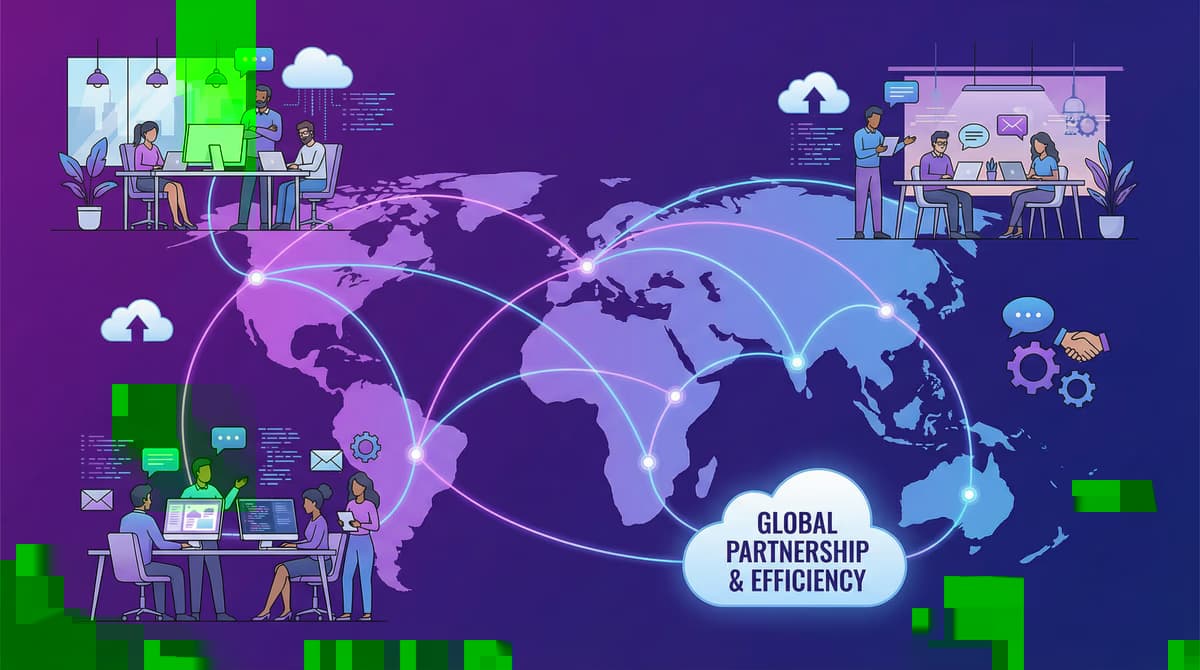
What is offshore development?
> # Offshore development: opportunities and risks in detail > > In today's globalized economy, companies are constantly looking for ways to work more efficiently, reduce costs and equal...
Nearshore vs. Offshore: The key to success lies in communication and time zone management
In today's globalised business world, outsourcing is a key factor for many companies to remain competitive. It allows access to a global talent pool, ...

The bridge between generations: secure knowledge transfer
> An experienced employee leaves the company and with it a treasure of knowledge is lost which has been built for years. A scenario that many companies fear. But there's a confession...
Free download
Checklist: 10 questions before software development
Key points before you start: budget, timeline, and requirements.
Get the checklist in a consultationRelevant next steps
Related services & solutions
Based on this article's topic, these pages are often the most useful next steps.
Related services
Related solutions
Cost calculators
More on Software development and next steps
This article is in the Software development topic. In our blog overview you will find all articles; under category Software development more posts on this subject.
For topics like Software development we offer matching services – from app development and AI integration to legacy modernisation and maintenance. We describe typical use cases under solutions. Our cost calculators give initial estimates. Key terms are in the IT glossary, and in-depth content under topics.
If you have questions about this article or want a non-binding discussion about your project, you can book a consultation or reach us via contact. We usually respond within one working day.