
In today's globalised business world, outsourcing is a key factor for many companies to remain competitive. It allows access to a global talent pool, ...
“Digitalization is not an IT project—it is a business strategy.”
– Björn Groenewold, Managing Director, Groenewold IT Solutions
In today's globalised business world, outsourcing is a key factor for many companies to remain competitive. It allows access to a global talent pool, cost savings and faster market launch of products.
But the decision for the right outsourcing model is often complex. Two of the most common models are nearshore and offshore outsourcing.
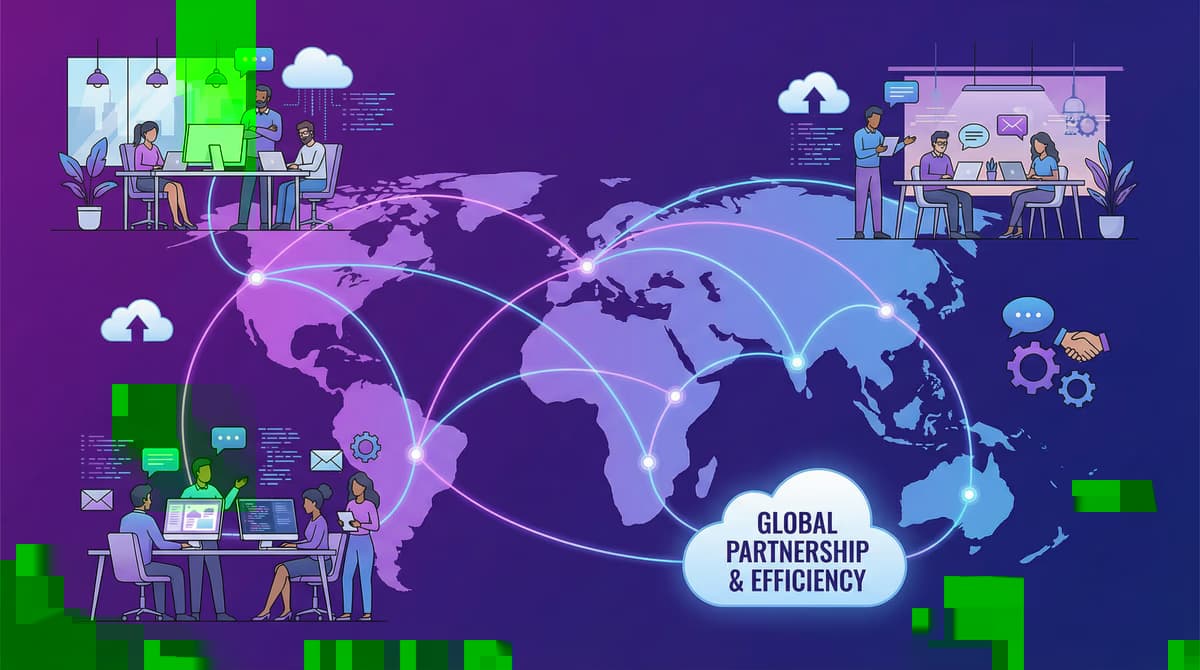
While both have their own advantages and disadvantages, Communication and Time Zone Management are the key factors that can decide on the success or failure of a project.
In this article we highlight the differences between nearshore and offshore development and show how effective management of these aspects becomes the key to successful cooperation.
What is Nearshore outsourcing?
Short: At nearshore outsourcing companies shift their business processes or IT services to neighbouring or nearby countries.
At nearshore outsourcing companies shift their business processes or IT services to neighbouring or nearby countries. For companies in Germany, this typically means cooperation with partners in Eastern and Southern Europe.
The decisive advantage lies in geographical and cultural proximity and the low time differences. This considerably facilitates communication and cooperation.
Advantages of nearshore outsourcing
- Minimal time shift: Cooperation in the same or similar time zone allows smooth communication in real time. Daily meetings, quick tuning and agile operation can be implemented easily.
- Cultural similarity: Minor cultural differences lead to less misunderstandings and more efficient cooperation. Working hours and business practices are often very similar.
- Simplified accessibility: Geographical proximity allows faster and cheaper personal meetings if needed.
- High quality: Nearshore partners often offer highly qualified professionals trained according to similar education standards.
Disadvantages of nearshore outsourcing
- Higher costs than offshore: The wage costs in Nearshore countries tend to be higher than in offshore destinations, although still significantly lower than in their own country.
- ** Limited Talent Pool:** Compared to large offshore markets such as India or the Philippines, the talent pool can be smaller in some Nearshore countries.
What is offshore outsourcing?
Offshore outsourcing refers to the outsourcing of business processes in faraway countries, often on other continents.
Popular offshore locations for German companies include India, the Philippines or Vietnam.
The main driver for offshore outsourcing is the significant cost savings.
Advantages of offshore outsourcing
- ** Major cost savings:** Di
Sources: Unless cited inline, market figures and percentages are for orientation; see public sources such as Bitkom (2025) and Destatis. Project budgets and examples: Groenewold IT Solutions, internal reporting 2026.
References and further reading
Short: The following independent references complement the topics in this article:
The following independent references complement the topics in this article:
- Bitkom – German digital industry association
- German Federal Office for Information Security (BSI)
- European Commission – Digital strategy
- MDN Web Docs (Mozilla)
- W3C – World Wide Web Consortium
> "APIs are the backbone of modern systems; stabilise contracts early or pay twice in integration work later." > > — Björn Groenewold, Managing Director, Groenewold IT Solutions
<!-- v87-geo-append -->
About the author

Managing Director of Groenewold IT Solutions GmbH and Hyperspace GmbH
For over 15 years Björn Groenewold has been developing software solutions for the mid-market. He is Managing Director of Groenewold IT Solutions GmbH and Hyperspace GmbH. As founder of Groenewold IT Solutions he has successfully supported more than 250 projects – from legacy modernisation to AI integration.
Blog recommendations
Related articles
These posts might also interest you.

The bridge between generations: secure knowledge transfer
> An experienced employee leaves the company and with it a treasure of knowledge is lost which has been built for years. A scenario that many companies fear. But there's a confession...

API-First approach: Avoid data silos from the start
In today's digitalized business world, data is the life elixir of each company. They enable informed decisions, personalized customer experiences and efficient behavior...

Detecting data silos: symptoms and diagnosis for your company
In today's data-driven business world, access to accurate and timely information is crucial for success. But many companies struggle with an invisible, but precious...
Free download
Checklist: 10 questions before software development
Key points before you start: budget, timeline, and requirements.
Get the checklist in a consultationRelevant next steps
Related services & solutions
Based on this article's topic, these pages are often the most useful next steps.
Related services
Related solutions
More on Software development and next steps
This article is in the Software development topic. In our blog overview you will find all articles; under category Software development more posts on this subject.
For topics like Software development we offer matching services – from app development and AI integration to legacy modernisation and maintenance. We describe typical use cases under solutions. Our cost calculators give initial estimates. Key terms are in the IT glossary, and in-depth content under topics.
If you have questions about this article or want a non-binding discussion about your project, you can book a consultation or reach us via contact. We usually respond within one working day.