

Digitization of public administration is one of the biggest challenges of our time. Citizens and businesses are rightly expecting that they are just as easy to use state services...
“Digitalization is not an IT project—it is a business strategy.”
– Björn Groenewold, Managing Director, Groenewold IT Solutions
> Key Takeaway: Software for the public sector must combine accessibility (BITV 2.0), IT security (BSI baseline protection), data protection, and interoperability with existing specialist procedures.
Best practices: user-centered design, open standards, modular architecture, and close collaboration with departments.
Software for the public sector: Best practices for successful digitization
Short: Digitization of public administration is one of the biggest challenges of our time.
Digitization of public administration is one of the biggest challenges of our time. Citizens and businesses rightly expect that they can use state services as easily and intuitively online as the offers of commercial suppliers.
A modern and powerful ** software for the public sector** is the key to fulfilling these expectations and setting up the administration in a sustainable manner. However, the development and implementation of such solutions is complex and associated with special obstacles.
In this article, we highlight the most important best practices that help authorities and organisations to successfully implement their digitalization projects.
The special challenges of administrative digitization
Short: The development of software for the public sector differs in many ways from projects in the private sector.
The development of software for the public sector differs in many ways from projects in the private sector. Public institutions are subject to strict legal and regulatory requirements, in particular with regard to data protection and information security.
Stronger hierarchies, long-term decision-making processes and complex budgetary regulations can make agile and flexible procedures difficult. In addition, a heterogeneous IT landscape, which has grown over decades and which makes seamless integration of new applications a real challenge.
Last but not least, the developed solutions must address a broad user group with different technical knowledge and be accessible to disabled people.
Key factors for successful software in the public sector
Short: In order to meet these challenges and to successfully shape digital change, various success factors and best practices have established themselves in practice for the public sector software .
In order to meet these challenges and to successfully shape digital change, various success factors and best practices have established themselves in practice for the public sector software. These range from strategic planning to technological implementation to cultural change within administration.
Security and compliance as top priority
Citizens' confidence in digital administrative services is and falls with the security of their data. Therefore, the development of software for the public sector requires the highest standards of information security and data protection.
This includes not only robust encryption technologies and secure authentication methods, but also strict compliance with statutory requirements such as the General Data Protection Regulation (GDPR).
Focus on user centering and accessibility
Successful administrative software must focus on people. This means that it must be easy to use, intuitively understandable and accessible to all citizens. The integration of future users into the [development process](/services/software development), e.g
References and further reading
Short: The following independent references complement the topics in this article:
The following independent references complement the topics in this article:
- Bitkom – German digital industry association
- German Federal Office for Information Security (BSI)
- European Commission – Digital strategy
- MDN Web Docs (Mozilla)
- W3C – World Wide Web Consortium
<!-- v87-geo-append -->
About the author

Managing Director of Groenewold IT Solutions GmbH and Hyperspace GmbH
For over 15 years Björn Groenewold has been developing software solutions for the mid-market. He is Managing Director of Groenewold IT Solutions GmbH and Hyperspace GmbH. As founder of Groenewold IT Solutions he has successfully supported more than 250 projects – from legacy modernisation to AI integration.
Blog recommendations
Related articles
These posts might also interest you.
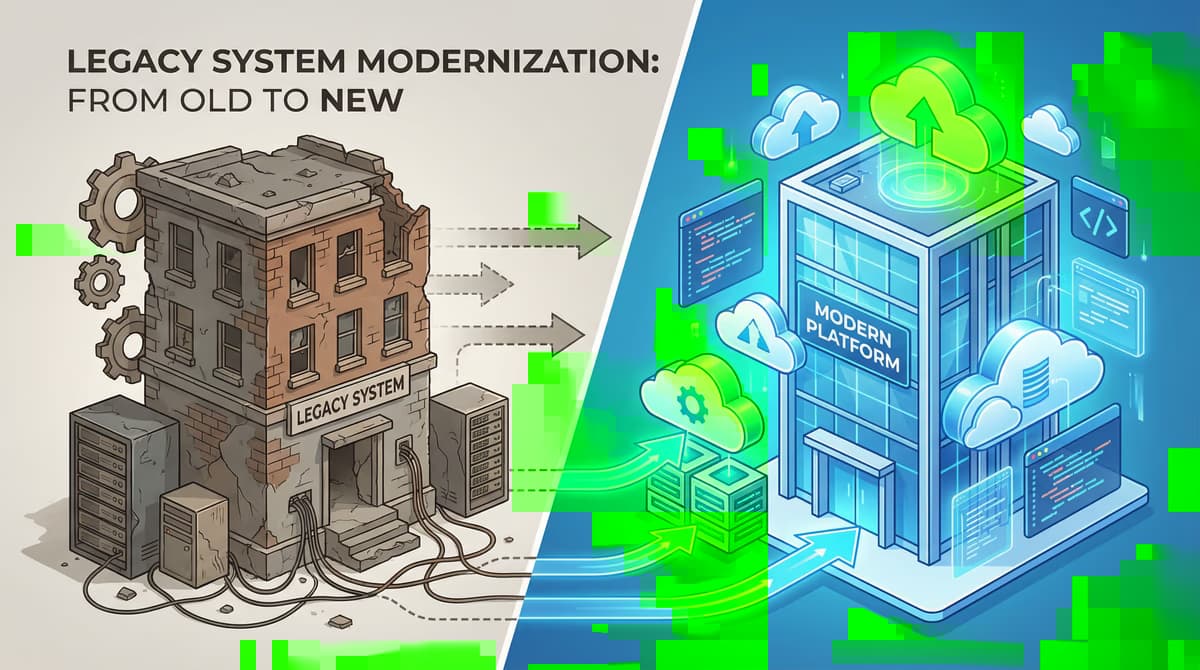
Altsystem migration: risk management and fallback strategies for a smooth transition
The Altsystem migration is a necessary step for many companies to remain competitive and not lose the connection technologically. Outdated systems are often expensive in...
Stepwise migration: The Strangler-FIG-Pattern for the modernization of old systems
In today's fast-paced digital landscape, many companies face the challenge of modernizing outdated IT systems. These so-called old systems are often the backbone of the...
Software migration: Ensure data integrity
The migration of software and related data is a critical process that is essential for modernising IT systems. Whether it's about replacing outdated applications...
Free download
Checklist: 10 questions before software development
Key points before you start: budget, timeline, and requirements.
Get the checklist in a consultationRelevant next steps
Related services & solutions
Based on this article's topic, these pages are often the most useful next steps.
Related services
Related solutions
More on Software development and next steps
This article is in the Software development topic. In our blog overview you will find all articles; under category Software development more posts on this subject.
For topics like Software development we offer matching services – from app development and AI integration to legacy modernisation and maintenance. We describe typical use cases under solutions. Our cost calculators give initial estimates. Key terms are in the IT glossary, and in-depth content under topics.
If you have questions about this article or want a non-binding discussion about your project, you can book a consultation or reach us via contact. We usually respond within one working day.