
As of: 19 June 2026 · Reading time: 4 min
Key takeaways
- Outdated software is a security risk and innovation brake.
- Strategies to tame the 'monoliths' and make your IT sustainable.
Outdated software is a security risk and innovation brake. Strategies to tame the 'monoliths' and make your IT sustainable.
“Digitalization is not an IT project—it is a business strategy.”
– Björn Groenewold, Managing Director, Groenewold IT Solutions
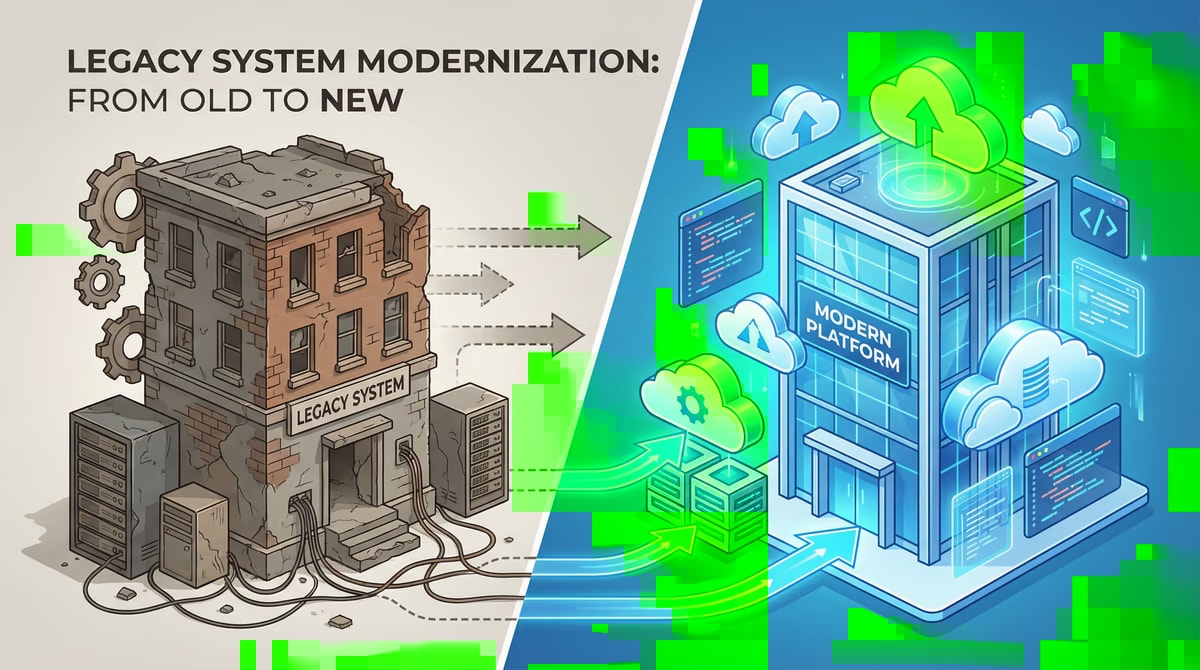
Legacy system modernization follows proven strategies: rehosting for quick cloud migration, replatforming for moderate adaptations, refactoring for deep architectural redesign, and the Strangler Pattern for low-risk gradual replacement.
The choice depends on system criticality and available budget.
DevPartner Home Blog Services Contact Modernization
Modernizing Legacy Systems: A Guide by Dr. Thomas Weber 08. June 2026 Outdated software is a security risk and innovation brake. Strategies to tame the 'monoliths' and make your IT sustainable.
Short: "Never change a running system" – this old IT break is dangerous today.
"Never change a running system" – this old IT break is dangerous today. Legacy systems (old systems) are often the backbone of the company, but they are based on outdated technology.
They are expensive in maintenance, difficult to expand and an infestation gate for hackers. But how do you modernize a system that cannot fail?
When is a system "Legacy"?
Short: Executive answer: Outdated software is a security risk and innovation brake.
Executive answer: Outdated software is a security risk and innovation brake.
When planning Modernize legacy systems: A guide from idea to delivery, Legacy Modernisation, Cost Calculator: Legacy Modernisation, Solution: Legacy Reduction sowie Monolith vs. Microservices offer practical next steps on our site.
Not every old software is bad. A system becomes a problem (legacy), if:
- Yeah. There are no more security updates for basic technology (e.g. old PHP, Java 6, Windows Server 2008).
- Yeah. There are hardly any developers who understand the language (e.g. COBOL, Delphi).
- Changes last extremely long and often lead to new errors (spaghetti code).
- Yeah. It is not compatible with modern tools (cloud, mobile, API).
Strategies for Modernization (The 6 R's)
Short: Gartner defines different approaches.
Gartner defines different approaches. The most important for software development are:
1. Rehosting (Lift & Shift)
Short: The application is moved unchanged to a modern infrastructure (e.
The application is moved unchanged to a modern infrastructure (e.g. cloud). Advantage: Fast, hardware costs drop. Disadvantage: Do not solve problems in code or architecture.
2. Replatforming
Short: Small adjustments to take advantage of the new platform (e.
Small adjustments to take advantage of the new platform (e.g. changing from own database to Managed Database in the cloud). Advantage: Good midway from effort and benefit.
3. Refactoring / Rearchitecting
Short: The code is improved and restructured without changing the function.
The code is improved and restructured without changing the function. A monolith is often broken up in microservices. Advantage: Makes the system manageable and scalable.
Disadvantage: Warm and requires deep understanding of the old code.
4. Rebuilding (Rewrite)
Short: The software is redeveloped from scratch.
The software is redeveloped from scratch. Advantage: You get rid of all old loads, most modern technology. Disadvantage: Highest risk, expensive, takes long. Risk of business logic being "forged".
The Strangler-Pattern approach
Short: For large monoliths we often recommend the "Strangler Fig Pattern" (Würgefeigen-Muster).
For large monoliths we often recommend the "Strangler Fig Pattern" (Würgefeigen-Muster). Instead of rebuilding everything at once (Big Bang), you build new features as modern microservices next to the old system.
Step by step, functions are removed from the old system and transferred to the new system until the old system can be "destroyed" and switched off.
This minimizes the risk as the old system continues while the new one grows.
Why modernization fails
- Missing documentation: No one knows exactly what the code does ("Business Logic Trap").
- Underestimated effort: "It's just a little code to rewrite."
- Feature Creep: You want to rewrite 1000 ne
References and further reading
Short: The following independent references complement the topics in this article:
The following independent references complement the topics in this article:
- Bitkom – German digital industry association
- German Federal Office for Information Security (BSI)
- European Commission – Digital strategy
- MDN Web Docs (Mozilla)
- W3C – World Wide Web Consortium
Frequently Asked Questions (FAQ)
What is this article about: “Modernize legacy systems: A guide”?
This article summarizes practical aspects of Modernize legacy systems: A guide for decision-makers and delivery teams. In short: Outdated software is a security risk and innovation brake.
Strategies to tame the 'monoliths' and make your IT sustainable.
Who benefits most from the content described here?
It is especially relevant for organizations in Legacymodernization that need reliable systems, clear interfaces, and predictable delivery — from mid-market teams to specialized departments.
How does this topic fit into an IT or digital strategy?
You can map the topic to service building blocks such as custom software and delivery support: architecture reviews and iterative rollout reduce risk and rework. For multi-system landscapes, IT consulting and architecture helps align vendors and internal teams.
What are sensible next steps if we need support?
For architecture, implementation, or a second expert opinion, book a free initial consultation — including timeline and interface alignment.
About the author

Managing Director of Groenewold IT Solutions GmbH and Hyperspace GmbH
Since 2009 Björn Groenewold has been developing software solutions for the mid-market. He is Managing Director of Groenewold IT Solutions GmbH (founded 2012) and Hyperspace GmbH. As founder of Groenewold IT Solutions he has successfully supported more than 250 projects – from legacy modernisation to AI integration.
Blog recommendations
Related articles
These posts might also interest you.
Replace legacy software: strategies and fall knitting
In today's fast-paced digital world, outdated software systems, often referred to as legacy software, are one of the biggest challenges for companies. You can find innovations frombrem...
Legacy Migration: Strategies for a smooth transition
In today's rapidly changing digital landscape, outdated IT systems, often referred to as legacy systems, represent a considerable challenge for many companies. Although she...

Using Public Funding for Business Digitalization
Companies use funding for digitization in a targeted manner - with clear project logic, appropriate programs and less risk in application and implementation.
Free download
Checklist: 10 questions before software development
Key points before you start: budget, timeline, and requirements.
Get the checklist in a consultationRelevant next steps
Related services & solutions
Based on this article's topic, these pages are often the most useful next steps.
Related services
Related solutions
Related comparison
Cost calculators
More on Legacymodernization and next steps
This article is in the Legacymodernization topic. In our blog overview you will find all articles; under category Legacymodernization more posts on this subject.
For topics like Legacymodernization we offer matching services – from app development and AI integration to legacy modernisation and maintenance. We describe typical use cases under solutions. Our cost calculators give initial estimates. Key terms are in the IT glossary. Books and long-form guides appear on the publications page; deeper articles live under topics.
If you have questions about this article or want a non-binding discussion about your project, you can book a consultation or reach us via contact. We usually respond within one working day.