
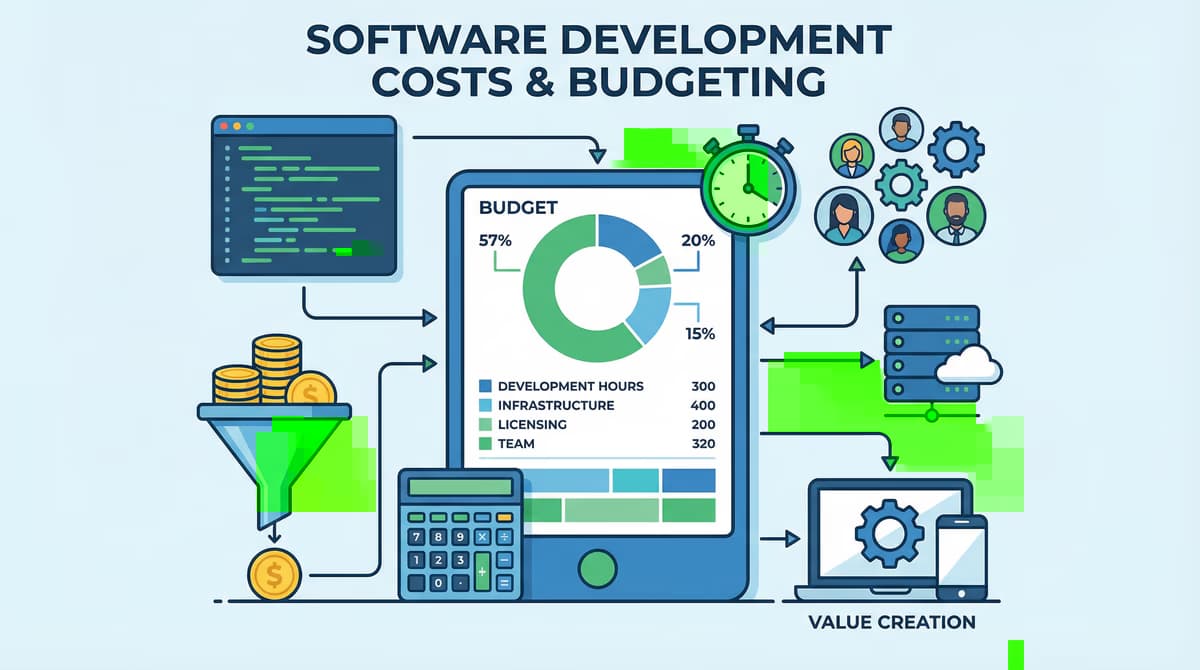
In today's globalised business world, companies face a crucial question in the implementation of IT projects: should they rely on local expertise, the development in ...
“Digitalization is not an IT project—it is a business strategy.”
– Björn Groenewold, Managing Director, Groenewold IT Solutions
> Key Takeaway: Nearshore (e.g., Poland, Romania) offers 30–50% lower hourly rates than Germany with similar time zones and EU data protection.
Offshore (e.g., India, Vietnam) saves up to 70% on hourly rates but carries higher risks in communication and quality.
Onshore delivers the best overall quality at the highest hourly rates.
In today's globalised business world, companies face a crucial question in the implementation of IT projects: should they resort to local expertise, shift the development into the distance or choose a central route? The decision between onshore, offshore and nearshore development has far-reaching consequences for costs, quality and efficiency.
This article highlights the differences and helps you to find the optimal strategy for your company.
The three outsourcing models at a glance
Short: Before we devote ourselves to the detailed cost comparison, it is important to understand the three basic models of IT outsourcing.
Before we devote ourselves to the detailed cost comparison, it is important to understand the three basic models of IT outsourcing.
Onshore development: The local solution
At Onshoring, you will commission a developer team in your own country. This promises smooth communication, cultural proximity and simple legal frameworks. Personal cooperation on site is easily possible, which can be particularly advantageous in agile projects.
Offshore development: The global perspective
Offshoring means the outsourcing of development projects in faraway countries, often in Asia or Eastern Europe. The main driver for this model is the considerable cost savings in developer salaries. Companies get access to a huge global talent pool.
Nearshore Development: The Golden Midway
Nearshoring strikes a bridge between the two extremes. The development is moved into a nearby country with a similar time zone, for example within Europe. This model tries to combine the cost advantages of offshoring with the cultural and geographical proximity of onshoring.
The comparison Nearshore vs Offshore Development is therefore particularly relevant for many companies.
Detailed cost comparison: More than just the hourly rate
Short: The most obvious cost differences lie in the developer's hourly rates.
The most obvious cost differences lie in the developer's hourly rates. While a developer in Germany costs an average of 60-120 euros per hour, the rates in Nearshore countries can be 30-55 euros and even lower in offshore destinations. But a pure focus on the hourly rate is too short.
Hidden costs and other factors can significantly change the overall picture.
| Factor | Onshore | Nearshore | Offshore | | :-- | :-- | :-- | :-- | :-- | | | | | | | | | | | | | | | | | | | | | | | | | | | | | Hour rates High | Medium | Low | ** Communication effort | Gering | Moderat | High | ** ** Travel costs** | Gering | Moderat | High | | Cultural differences | Minimum | Gering | Significant | | Time zone difference | None | Gering (0-2 hours) | Large (up to 12 hours) | | Project management panel| Gering | Moderat | High | ** ** Hidden costs** | Gering | Moderat | High |
Hidden costs in outsourcing
Regardless of the selected model, additional costs
Transparency: Where no primary source is named in the text, figures are illustrative; compare Bitkom and Destatis. Project-related statements: Groenewold IT, 2026.
References and further reading
Short: The following independent references complement the topics in this article:
The following independent references complement the topics in this article:
- Bitkom – German digital industry association
- German Federal Office for Information Security (BSI)
- European Commission – Digital strategy
- MDN Web Docs (Mozilla)
- W3C – World Wide Web Consortium
<!-- v87-geo-append -->
About the author

Managing Director of Groenewold IT Solutions GmbH and Hyperspace GmbH
For over 15 years Björn Groenewold has been developing software solutions for the mid-market. He is Managing Director of Groenewold IT Solutions GmbH and Hyperspace GmbH. As founder of Groenewold IT Solutions he has successfully supported more than 250 projects – from legacy modernisation to AI integration.
Blog recommendations
Related articles
These posts might also interest you.
Altsystem migration: risk management and fallback strategies for a smooth transition
The Altsystem migration is a necessary step for many companies to remain competitive and not lose the connection technologically. Outdated systems are often expensive in...
Stepwise migration: The Strangler-FIG-Pattern for the modernization of old systems
In today's fast-paced digital landscape, many companies face the challenge of modernizing outdated IT systems. These so-called old systems are often the backbone of the...
Software migration: Ensure data integrity
The migration of software and related data is a critical process that is essential for modernising IT systems. Whether it's about replacing outdated applications...
Free download
Checklist: 10 questions before software development
Key points before you start: budget, timeline, and requirements.
Get the checklist in a consultationRelevant next steps
Related services & solutions
Based on this article's topic, these pages are often the most useful next steps.
Related services
Related solutions
More on Software development and next steps
This article is in the Software development topic. In our blog overview you will find all articles; under category Software development more posts on this subject.
For topics like Software development we offer matching services – from app development and AI integration to legacy modernisation and maintenance. We describe typical use cases under solutions. Our cost calculators give initial estimates. Key terms are in the IT glossary, and in-depth content under topics.
If you have questions about this article or want a non-binding discussion about your project, you can book a consultation or reach us via contact. We usually respond within one working day.