
Legacymodernization
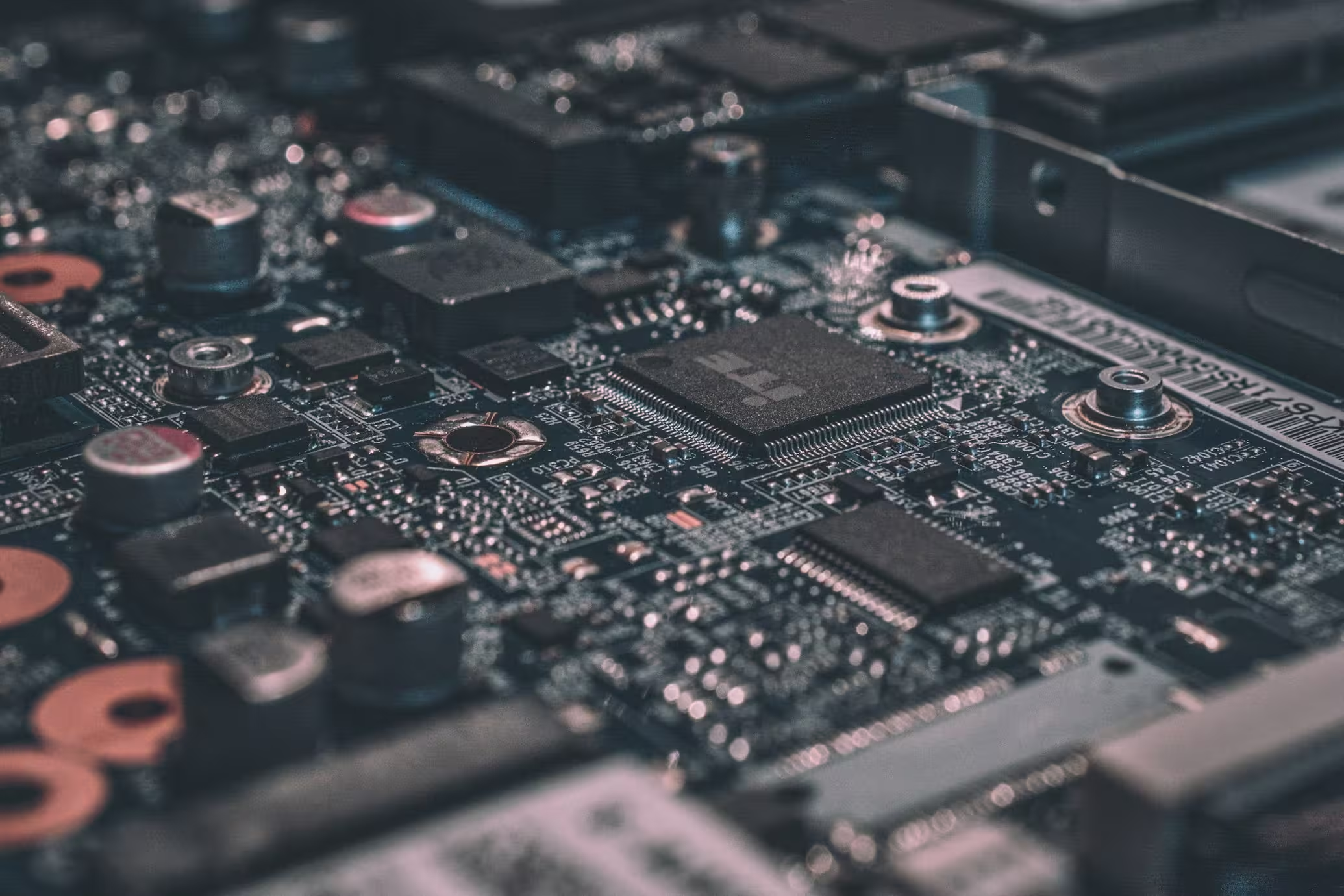
Modernize legacy systems: A guide
Outdated software is a security risk and innovation brake. Strategies to tame the 'monoliths' and make your IT sustainable.

When internal Delphi capacity disappears, business-critical releases stall. A specialised Delphi agency keeps things moving. We structure modernisation, release cadence and—where needed—replacement of historic versions. Transparent and low-risk, so urgency does not default to a costly full rewrite. Engineering Made in Germany from East Frisia.
Together we control rising maintenance costs and strengthen your estate's long-term viability. For a planned platform shift, we guide migration to .NET. Scope and approach are outlined in our Delphi migration to .NET offering.
We support mid-sized companies wherever desktop applications underpin revenue, production or field operations. Delphi maintenance, to us, is more than hotfixes. It means reliable release trains, compatibility with new Windows versions and builds your IT can reproduce. We address rising maintenance costs and technical debt with clear roadmaps instead of firefighting.
When internal Delphi developers retire or leave, handovers can become chaotic. We structure prioritisation and acceptance with business and IT. Modernisation does not collapse into a rushed full rewrite. For a planned platform move, see our approach to migrating from Delphi to .NET.
International tenders often list "Delphi Developer" as a requirement. Yet time zones, quality standards and traceability vary widely. We are a dependable German alternative. Our team works to clear engineering rules, documents architecture decisions and guides demanding migrations—for example Delphi 7 to Delphi 12—without language barriers.
For first-run numbers on effort and budget, use our Delphi development cost calculator. For strategic legacy work see legacy modernisation from Delphi estates and the cluster article Delphi maintenance and ongoing care.
Groenewold IT Solutions builds Made in Germany. We deliver pragmatic roadmaps with measurable milestones—whether you consolidate releases, renew components or add REST and cloud interfaces step by step.
Examples from anonymised desktop case studies. Delphi often stays the primary shell while we add REST, local queues and batch exports for neighbouring systems. See the full set on desktop application references.
Delphi planning stays authoritative. Telematics status and map data are aligned via REST and a resilient queue.
OAuth2 REST, nightly reconciliation and explicit conflict rules between mailing calendar, shop and CRM.
PDF/A hand-off to a signature provider plus structured finance batches. Contract lists remain authoritative in Delphi.
Migrations start with a solid inventory. We check the Delphi version, compiler targets, third-party packages, build scripts and database layers. Typical pain points are: ANSI to Unicode conversion (AnsiString vs UnicodeString), replacing legacy BDE with FireDAC, and clearing deprecated APIs that only surface on newer compilers.
Where UI and shipping targets require it, we plan phased modernisation. This can mean moving from VCL styles to FireMonkey for cross-platform clients. We never break everything at once. Each milestone stays deployable, regressions stay limited and daily operations are not traded for a big-bang rewrite. For paths toward other stacks, see Delphi migration to .NET.
| Criterion | Hiring in-house Delphi developers | Engaging an external Delphi agency |
|---|---|---|
| Time-to-hire (skills shortage) | Often many months before productive contribution. The market for Delphi permanent hires is thin. | Faster ramp with an established team. We scale capacity on demand instead of running long vacancies. |
| Resilience (leave / sickness) | Low to medium. Knowledge often concentrates on few people. Holidays and illness delay releases. | High. Overlapping staffing and documented handovers reduce key-person risk. |
| Scalability at project peaks | Limited by headcount. Peaks mean overtime or external helpers with onboarding overhead. | Team size and specialist roles flex for release windows, then normalise afterward. |
| Knowledge transfer during modernisation | Strong when mentoring time exists. With staffing gaps modernisation often stalls. | Reviews, guidelines and handovers into your organisation are explicit roadmap modules. |
| Total cost of ownership (TCO) | Salary, recruiting, training and standstill during absence. Legacy topics often carry higher follow-on cost than planned. | Predictable project and retainer models. Variable cost tracks demand instead of fixed payroll alone. |
Delphi is still one of the most dependable environments for professional desktop software. Many organisations rely on it for manufacturing, logistics, healthcare and finance. Applications compile to native code, start instantly and avoid heavy runtimes. This makes Delphi ideal when resources are tight or uptime is critical.
We have delivered Delphi development, maintenance and modernisation for more than 15 years. Our work ranges from small utilities to large enterprise systems. We are frequently engaged to move Delphi 7 estates to current RAD Studio versions. This keeps applications compatible with modern Windows and security standards.
Updating a Delphi application is often more economical than a ground-up rewrite. With FireMonkey we can reach macOS and Linux without discarding business logic. We give honest guidance: when to stay on Delphi, when modernisation is enough, and when another stack is the better long-term bet.
Delphi maintenance keeps releases predictable. Delphi modernisation moves you forward without freezing the business.
Native desktop applications
High-performance native desktop applications for Windows, macOS and Linux—core Delphi development work.
Delphi modernisation
Modernisation for legacy estates—refactoring, version upgrades and UI refresh without losing domain logic.
Delphi maintenance & data layers
Delphi maintenance for databases, reporting and integrations—so development stays shippable every sprint.
We advise on architecture, staffing and whether Delphi development or a staged modernisation fits your constraints.

Frequently asked questions
Yes. We work across Delphi versions from Delphi 5 through current RAD Studio. Turbo Pascal is fine too.
Not necessarily. Phased modernisation is often more economical. We start with critical modules and continue while daily operations run normally.
Yes. We use REST APIs with modern web front ends. UniGUI and TMS WEB Core are options for a more direct migration path.
Costs depend on system complexity. Ongoing maintenance including security updates and smaller adjustments starts at around EUR 2,000 per month.
Day rates for external Delphi developers typically fall between EUR 600 and 1,200, depending on seniority and engagement model. Fixed prices work well for bounded packages such as audits or defined releases. Ongoing maintenance or migration often runs time-and-material with transparent reporting. Use our public Delphi development cost calculator for first-pass budgeting.
RAD Studio and Delphi 12 are actively maintained. For desktop workloads with hardware proximity, offline use or fast startup, Delphi remains capable and cost-effective. If you need full browser access, larger hiring pools or consistent multi-platform UX, a staged modernisation may make sense. We plan that without putting today's operations at risk.
Qualified Object Pascal capacity is scarce. Universities rarely teach Delphi, senior practitioners retire, and freelancers are not always available at short notice. A specialised team with documented handovers and SLAs is often faster and more predictable. You also get redundant coverage instead of a single-person bottleneck.
Long-term production on Delphi 7 carries risk. Security coverage is limited, Unicode handling is incomplete, and friction with current Windows and endpoint protection grows over time. For auditability and staffing, we recommend migrating to a supported Delphi version with clean dependencies and testable builds.
VCL is the classic Windows-native stack. It delivers high desktop performance and a large component library when Windows is the primary target. FireMonkey is the cross-platform UI stack for Windows, macOS, Linux and mobile. It is useful when you need shared logic across device types. We choose based on delivery targets, not slogans.
Yes. Many SMEs engage us when critical Delphi capacity disappears. We document the current state and prioritise risks such as licences, third-party components and build servers. We take over releases in phases, often in parallel with your team. Delphi maintenance covers more than hotfixes. It includes compatibility testing with new Windows releases and coordination with endpoint protection policies.
Modernisation is planned as a roadmap, not a big bang. We compile and ship reliably first, then migrate FireDAC, High-DPI or REST in controlled steps.
For us, Delphi maintenance covers RAD Studio licence cycles, ageing vendor components and a reliable build pipeline. We maintain release notes for business stakeholders, version configuration files and acceptance testing on reference machines. Where modernisation is not yet funded, we isolate risk via feature flags or plug-in boundaries.
Patch cycles and backups are aligned with your IT before deployments. For audits, every change is tied to tickets. This is critical for manufacturing and regulated environments.
Delphi modernisation is typically incremental. We use one branch per theme, for example BDE to FireDAC, Unicode or High-DPI. Automated regression tests are added where feasible and pilot users validate each change per site. Interim builds remain production-ready throughout. There is no freeze until everything is finished. Maintenance keeps the current production line stable and urgent fixes are back-ported. Cutover windows are aligned with operations and business stakeholders.

We align Delphi maintenance, Delphi modernisation and Delphi development in one plan.
Schedule a callDelphi development stays strong when offline use, hardware proximity or fast startup matters. Examples include production lines, instrumentation or field teams without stable Wi-Fi. Modernisation can preserve core business logic while adding REST, MQTT or cloud connectivity. Maintenance keeps hybrid estates viable until a rewrite is economically justified. When Delphi developers are scarce internally, external coaching plus a roadmap is often cheaper than a rushed rewrite.
It depends on code volume, release cadence and integrations. Smaller teams may manage with 0.5 to 1 FTE plus build support. Complex multi-tenant estates often need two developers for overlap and cover. Delphi maintenance without dedicated capacity becomes firefighting before major updates. We recommend a minimal continuous slice instead of one-off project islands. Modernisation can be decoupled in time but must not starve error correction.
Up to 50% of your investment via BAFA/KfW
Use our funding calculator to see which government grants may apply to your project.
Related topics
Complementary services from other areas
These services are frequently requested together with Delphi Development or complement it thematically.
Integration & Interfaces
Operations, Support & Stabilization
Data, Analytics & Databases
Delphi Development is most effective when it is aligned with your business goals, existing systems, and team capabilities. At Groenewold IT Solutions we combine product thinking, clear architecture, and hands-on delivery so that every project delivers measurable value. We address operational, compliance, and performance aspects early so that later releases stay on track.
Our approach to Delphi Development emphasises transparent backlogs, close collaboration with your stakeholders, and incremental delivery. Whether you need a discovery workshop, an MVP, or a full-scale implementation, we define scope, effort, and success criteria up front. With over 250 completed projects we have the experience to recommend the right level of investment and the right next steps for your situation.
Explore our services overview for the full portfolio, our topic pages for in-depth articles linked to each service, and the IT Glossary for key terms. For books and practical guides by Björn Groenewold, see publications. If you would like to discuss your project, we are happy to clarify scope, priorities, and a realistic timeline in a short consultation.
Decision guidance
Our topic overview links related articles and entry points alongside this service page.
Book a short, no-obligation intro call about Delphi Development – straightforward next steps.
Recent articles from our blog that match this service.
Modernize legacy systems: A guide
Outdated software is a security risk and innovation brake. Strategies to tame the 'monoliths' and make your IT sustainable.
Delphi Legacymodernization: Old applications fit for...
Strategies for modernising old Delphi applications.
The 7 strategies for legacy moderation: Which fits...
A detailed overview of the 7 Gartner strategies for legacy modernisation. Find the right approach for your company, from Rehosting to Replacing.