
In today's fast-paced digital landscape, many companies face the challenge that their proven software no longer meets the current and future requirements step ...
“Digitalization is not an IT project—it is a business strategy.”
– Björn Groenewold, Managing Director, Groenewold IT Solutions
*February 2026 *
In today's fast-paced digital landscape, many companies face the challenge that their proven software can no longer keep pace with current and future requirements.
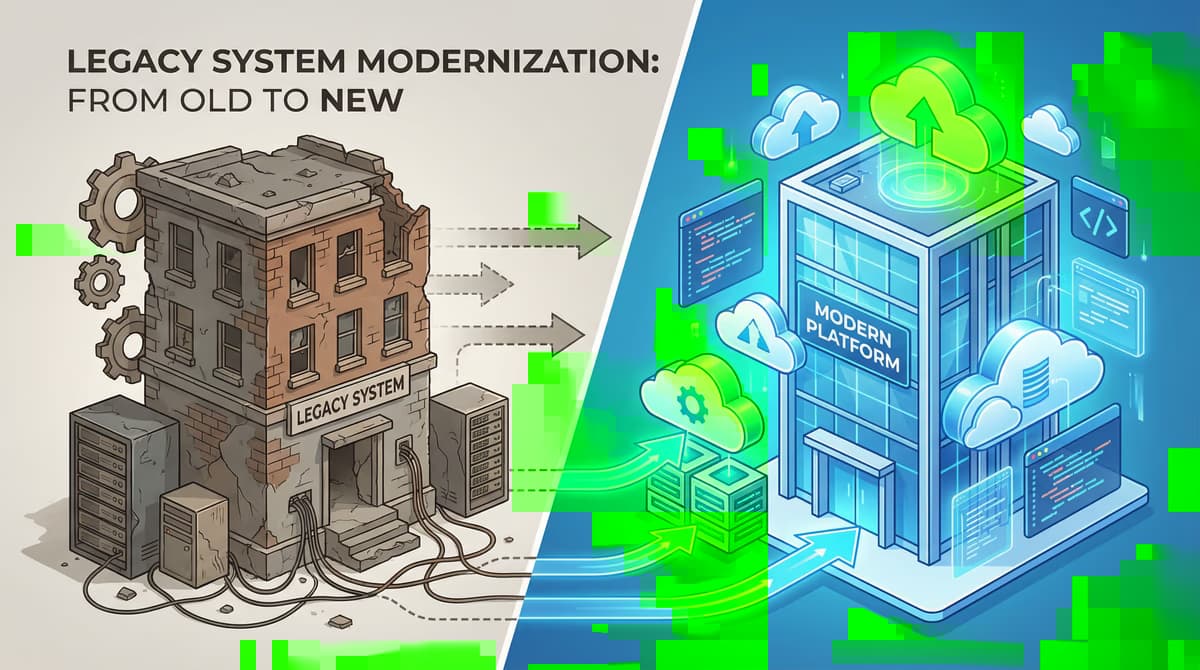
The decision whether an existing application is to be modernized or completely replaced is of strategic importance and has far-reaching consequences for the competitiveness and efficiency of a company. But when is the point where pure modernisation is no longer sufficient and the change to a new solution becomes indispensable?
This article highlights the critical factors that play a role in this decision and shows when it is time to release old software.
The boundaries of modernization
Short: Software moderation can in many cases be a sensible strategy to extend the service life of an application and improve its functionality.
Software moderation can in many cases be a sensible strategy to extend the service life of an application and improve its functionality. Approaches such as refactoring code, migration to a new infrastructure or connection to modern interfaces can increase performance and security.
However, there are clear indications that modernisation is reaching its limits and that the basic problems can no longer be solved.
Technological ageing
One of the most obvious signs is the technological basis of the software. If the underlying programming language, the framework or the database are no longer supported by the manufacturer, significant security risks arise. Missing security updates make the system vulnerable to attacks and data breaches.
In addition, it is becoming increasingly difficult and expensive to find developers who are familiar with outdated technologies, making maintenance and further development more difficult.
Increased complexity and maintenance costs
Software that has grown over years is often becoming a complex and difficult to understand system. Each new requirement leads to further adjustments that make the system even more confusing. This “technical debt mountain” leads to exploding maintenance costs and a drastically reduced agility.
If the cost of maintaining the old system exceeds the potential cost of a new development, a critical point is reached.
When is a redemption indispensable?
Short: The decision to completely replace a software should be well thought out.
The decision to completely replace a software should be well thought out. The following scenarios illustrate when a new development of modernisation is preferable.
| Factor | Signs of necessary detachment |
|---|---|
| Business requirements | The software can no longer represent new business models or processes. |
| Scalability The system cannot withstand company growth and meets its performance limits. | |
| ** Integration | Connection to modern cloud services, mobile applications ode |
References and further reading
Short: The following independent references complement the topics in this article:
The following independent references complement the topics in this article:
- Bitkom – German digital industry association
- German Federal Office for Information Security (BSI)
- European Commission – Digital strategy
- MDN Web Docs (Mozilla)
- W3C – World Wide Web Consortium
> "AI in mid-sized companies works when processes are measurable and data is trustworthy—a pilot without a success metric is theatre." > > — Björn Groenewold, Managing Director, Groenewold IT Solutions
<!-- v87-geo-append -->
About the author

Managing Director of Groenewold IT Solutions GmbH and Hyperspace GmbH
For over 15 years Björn Groenewold has been developing software solutions for the mid-market. He is Managing Director of Groenewold IT Solutions GmbH and Hyperspace GmbH. As founder of Groenewold IT Solutions he has successfully supported more than 250 projects – from legacy modernisation to AI integration.
Blog recommendations
Related articles
These posts might also interest you.
Altsystem migration: risk management and fallback strategies for a smooth transition
The Altsystem migration is a necessary step for many companies to remain competitive and not lose the connection technologically. Outdated systems are often expensive in...
Stepwise migration: The Strangler-FIG-Pattern for the modernization of old systems
In today's fast-paced digital landscape, many companies face the challenge of modernizing outdated IT systems. These so-called old systems are often the backbone of the...
Software migration: Ensure data integrity
The migration of software and related data is a critical process that is essential for modernising IT systems. Whether it's about replacing outdated applications...
Free download
Checklist: 10 questions before software development
Key points before you start: budget, timeline, and requirements.
Get the checklist in a consultationRelevant next steps
Related services & solutions
Based on this article's topic, these pages are often the most useful next steps.
Related services
Related solutions
Related comparison
Cost calculators
More on Software development and next steps
This article is in the Software development topic. In our blog overview you will find all articles; under category Software development more posts on this subject.
For topics like Software development we offer matching services – from app development and AI integration to legacy modernisation and maintenance. We describe typical use cases under solutions. Our cost calculators give initial estimates. Key terms are in the IT glossary, and in-depth content under topics.
If you have questions about this article or want a non-binding discussion about your project, you can book a consultation or reach us via contact. We usually respond within one working day.